In Ukraine, there are villages where, even in peacetime, access to medical services was scarce. With the onset of full-scale war, that situation has only worsened. Entire regions, once near the front lines, were temporarily occupied and later liberated, leaving their populations without proper healthcare. The old system has been disrupted; many healthcare workers have fled, and the supply of medications has become unreliable. In the best cases, there is a family doctor or a nurse on hand. If the family doctor is only available online, it’s a blessing—at least they’re there, if only a phone call away.
But for many, seeing a specialist or undergoing a full examination means travelling tens of kilometers. And sometimes, those roads are perilously dangerous. So, many opt to stay home, not daring to venture out. It feels safer to risk a lack of care than to be caught in shelling, turning into a casualty. In these circumstances, volunteers step in to fill the gap. While they can’t solve every problem, for those living on the front lines or in the so-called “grey zones,” their support often makes the difference between life and death.
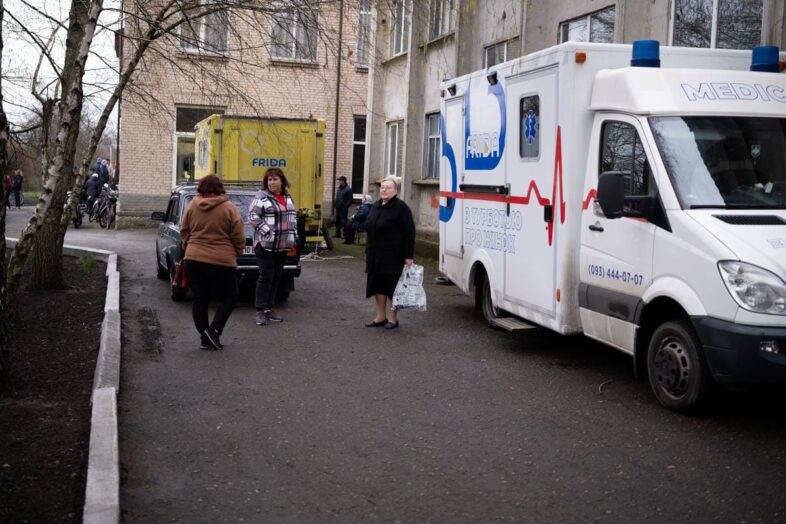
The distance from Kherson to Muzikyvka is just a few kilometres—around 10. In the past, villagers would travel to Kherson’s hospitals for treatment, as the village only had a small clinic where you could get basic tests, have your temperature checked, and be referred to a hospital in the city. But that was before the war. Now, everything has changed beyond recognition. The village’s family doctors have left, and the only option is to consult with them or get a referral over the phone. The quality of these consultations is a bit of a lottery—more or less predictable, depending on the day.
Travel to Kherson itself is no longer an option for many, as it’s simply too dangerous. “There’s constant shelling, and it’s terrifying to travel by bus,” shares Lyubov Ivanivna, a local resident. “To hire a car, you have to pay extra, and we’re pensioners now. Even if you go, you never know if you’ll be able to see the right specialist. Many specialists travel to Kherson from Mykolaiv, and they might fall ill or simply not show up. You might take a bus, stand in a long queue, and when it’s your turn, find that your last bus back leaves at 2 p.m. Then you have to make the trip again.”
For those who own cars and have the money, safer options like Mykolaiv or Kryvyi Rih become the go-to destinations for treatment, rather than Kherson. But not everyone can afford this. A taxi ride would cost at least a thousand hryvnias, which makes it something few can do regularly.
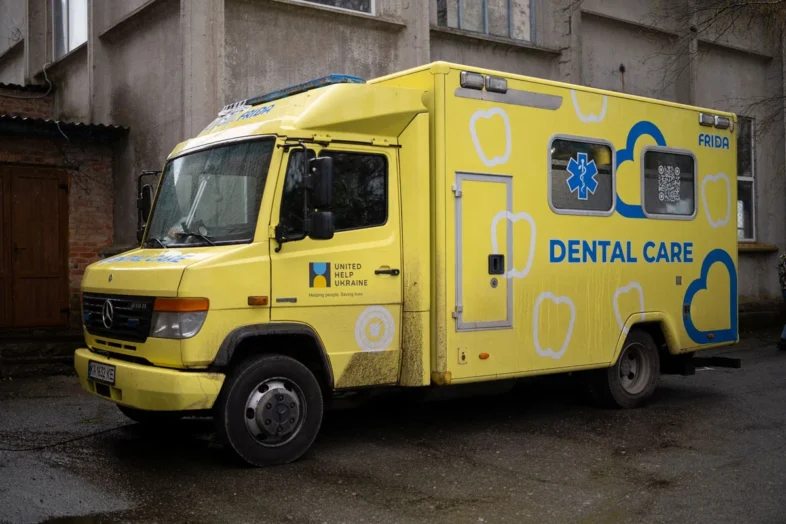
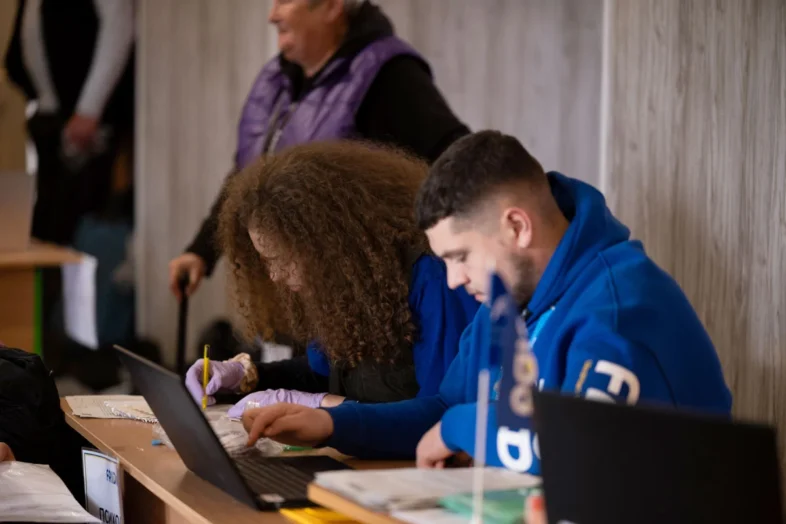
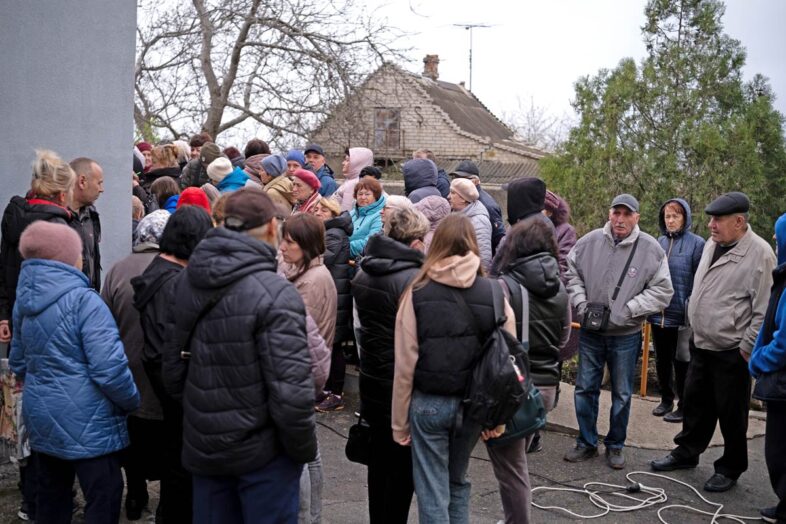
The residents of Muzikyvka are, in many ways, fortunate. Its proximity to the regional centre and the presence of a spacious outpatient clinic, despite the challenges, provide some advantages. Volunteers don’t overlook the village, bringing not just food, medicines, pasta, and cleaning supplies, but entire medical teams as well. These teams come equipped with all the necessary gear, offering locals the chance to undergo examinations, consult with specialists, receive dental treatment, have ultrasounds, and more—all without having to leave the village.
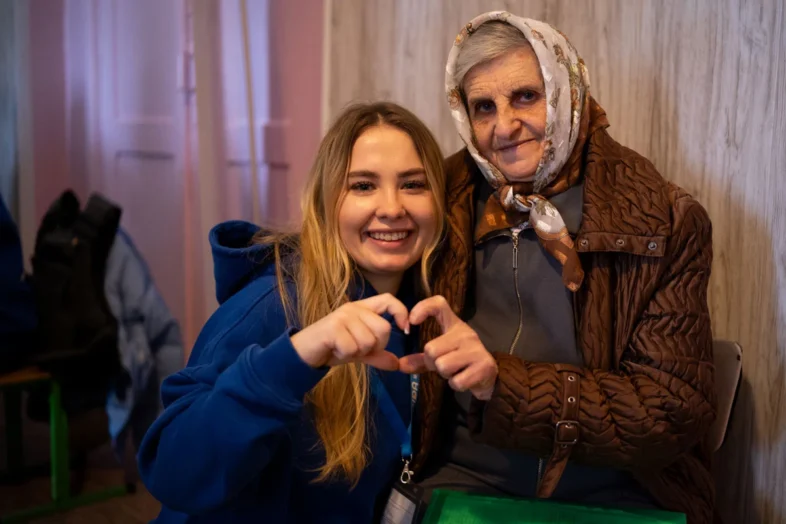
Lyubov Ivanivna explains that for more than a year now, she and her husband have been under the care of cardiologists who regularly visit Muzikyvka to provide treatment. “We’re managing well; the outpatient clinic is still functioning,” she says. “There’s space to set up equipment, and doctors can see patients. That’s why they come quite often—almost every week.”
She also has thyroid issues. “Before the war,” she continues, “I used to go to Kherson, where I had surgery at the oncology dispensary and went for regular check-ups. Now it’s been bombed. The departments are scattered across various hospitals in Kherson, and many specialists have left. Though we have many volunteer doctors visiting our village, we’ve yet to get the specialist I need. Because I’m on hormone treatment, I needed an endocrinologist-nephrologist. Finally, one came. I got the consultation I needed, both for my hormones and my kidneys.”
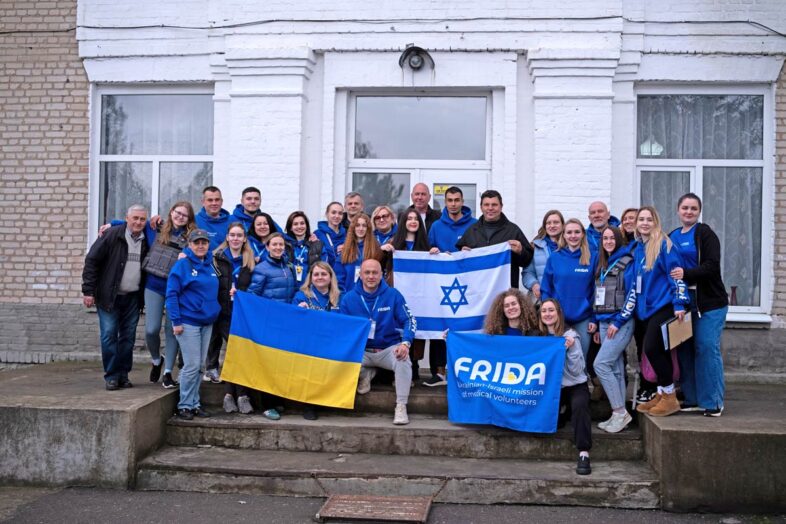
Several organisations are providing vital support in Ukraine during this crisis, and one of them is the Ukrainian-Israeli medical volunteer mission, FRIDA Ukraine. Established at the onset of the full-scale war, FRIDA has been operating across some of the most dangerous areas, offering medical help to civilians caught in the crossfire or living under occupation. Its doctors work in Kharkiv, Sumy, Kherson, Donetsk, and Zaporizhzhia regions. All of them are highly skilled professionals, usually working at some of the country’s top medical institutions, and they give up their free time to offer assistance to those in desperate need. Their services are entirely free, provided with remarkable selflessness.
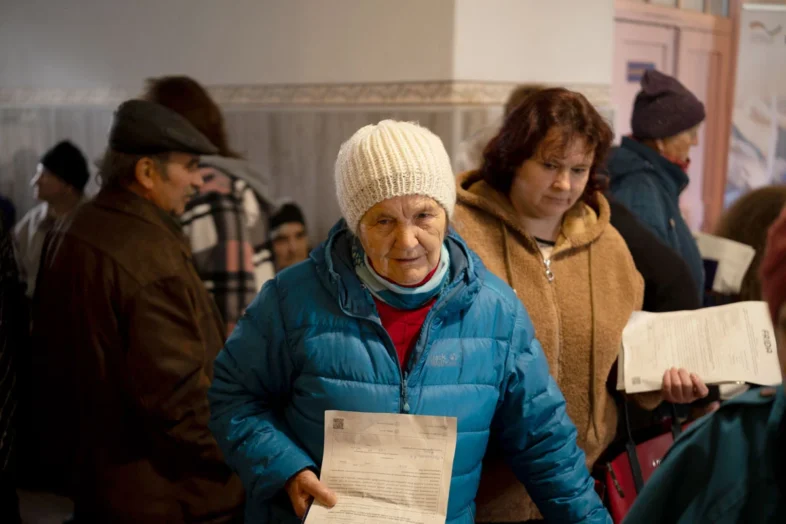
Valentina Serhiivna, a 74-year-old from the village of Kamianske near Vilnyansk in the Zaporizhzhia region, heard about FRIDA’s visit through her neighbours. She hasn’t been feeling well recently. She’s just buried her son, and her granddaughter has gone off to war. So, when she learned that doctors would be in her village, she seized the chance to consult with them. Valentina needs to see a dentist to have a tooth removed, a cardiologist, and a psychologist. But in her village, those kinds of services are unavailable. There used to be a hospital, but it’s gone now. The pharmacy is also closed. The nearest doctors are seven kilometres away in Vilnyansk — half an hour by minibus, which only runs three times a day. And when you’re suffering from heart problems and high blood pressure, travelling that far is no small feat.
Of course, in a real emergency, you can call an ambulance, but that doesn’t always guarantee help. “If you’re still breathing, they might come,” says Valentina Serhiivna wryly. “But otherwise, no one will show up.” She recalls a time when she was seriously unwell, unable to get out of bed. She called an ambulance, and they gave her some drops before leaving. “I went outside, collapsed, lost my balance. Thankfully, my neighbour came to help, sat me down.”
Despite this, Valentina is pleased with the consultation she received from the FRIDA Ukraine volunteer doctors. She says they asked all the right questions, explained everything clearly, and offered practical advice.
Her neighbour, Natalia, also decided to take advantage of the opportunity to consult with the volunteer doctors. She’s been struggling with constant anxiety and was relieved to receive some much-needed support. “I saw an endocrinologist, had an ultrasound of my thyroid, and consulted a neurologist. They prescribed medication and gave me advice on how to manage the anxiety. Now, the main thing is to follow through. I also want to have a check-up with a gynaecologist — it’s been three years.”
High blood pressure, cardiovascular issues, and psychological disorders are among the most common complaints in these frontline areas. Of course, there are many other health concerns, but these are the most typical. Given the constant stress, the looming threat of violence, and the fear for loved ones, it’s no surprise that people’s health is so affected. In this context, the support of medical specialists becomes absolutely vital.
Those who haven’t experienced the war firsthand often ask: why do people continue to live in such difficult conditions? Why don’t they just leave for somewhere safe, somewhere peaceful? But that’s a question born of misunderstanding. It’s not just about the fact that everyone has their own reasons and story. Leaving your home, stepping into the unknown with nothing, is never an easy choice. There’s always the hope, however small, that the suffering will end, that peace will return, and that life will once again bloom in all its colour.
Natalka shares that when the war began, her family planned to leave. They even started packing. “But somehow, we stayed. My son refused to leave at all. He’s 11 years old. He’s already very anxious. And if we left… well, we’d miss our home. You’d have to leave it to someone or sell it…”
The work of volunteer doctors, travelling to settlements where medical services are inaccessible, may seem like a temporary solution in wartime. But this experience could be valuable even in peacetime. The restoration of a fully integrated healthcare system will likely take time. Furthermore, sparsely populated villages or entire regions will inevitably remain where people still struggle to access quality medical care. In these cases, mobile medical teams will be essential—providing the necessary care, not as a temporary volunteer effort, but as a service under the patronage of the state.
It’s also important to mention the growth of telemedicine, a service that saw rapid development in Ukraine during the COVID-19 pandemic. However, it’s only now that it seems to be taking off in a truly meaningful way. In Muzikivka, a village near Kherson, a fully functioning telemedicine centre has recently opened at the local outpatient clinic, offering free consultations with doctors. In total, there are now 12 such centres across the Kherson region. Their establishment was made possible by funding from the European Union and Germany, with support from the CASERS non-governmental organisation. Like FRIDA, CASERS operates mobile medical centres and helps with evacuations and hospitalisations.
“At first, people were sceptical about telemedicine,” says Olena Tsokol, senior nurse at the Muzikivka centre. “They couldn’t understand how treatment could happen through a screen. But those who tried it found it worked. They started sharing their experiences: ‘I went, I liked it, it was just like seeing a doctor in person.’”
The centre’s operation is straightforward. People approach the nurse, who arranges a telemedicine consultation with a family doctor or specialist. All consultations are free, provided the patient has a referral from a family doctor. The centre also benefits from volunteer doctors and partners who are ready to support its work. On the day of the appointment, the patient arrives and consults with the doctor via video conference. The nurse assists with the examination, using telemedicine equipment to share the results with the doctor. After the consultation, the patient receives all necessary recommendations, referrals, and any additional information. If required, the nurse arranges follow-up appointments or additional consultations with other specialists.
“The telemedicine centre is an incredible asset,” says Olena Tsokol. “Our family doctors work remotely, and the local paramedic is 76 years old. As you can imagine, someone of that age often falls ill themselves. People are also hesitant to travel to Kherson for specialist consultations due to security concerns. And specialists—like endocrinologists, for example—are in short supply. There’s only one for the entire region, and the waiting list stretches for months. If someone needs urgent care, there’s no way of seeing such a specialist in Kherson. But the telemedicine centre provides access to a wide range of specialists: cardiologists, ENT doctors, endocrinologists, neurologists, and more—over 30 specialties in total. It offers a large database, accessibility, safety, and, best of all, it’s free. We can also conduct quick tests for hemoglobin, uric acid, and total cholesterol. Our equipment allows us to measure blood pressure and record sounds, which are transmitted directly to the doctor. This means the cardiologist can hear the same sounds we do, thanks to our devices. People can choose the doctor they prefer, and if they’re not happy with the consultation, they have the option to switch. If a doctor falls ill, we find alternatives in other hospitals. For example, today we had an endocrinologist from Rivne consult with a 70-year-old patient, and she left feeling satisfied with the care.”
“Of course, some specialists require a full consultation that can’t be done through telemedicine, such as an ultrasound technician or an ophthalmologist. In those cases, we submit an application and volunteers arrange for the necessary specialist to come at an agreed time. We inform the community through social media, and people can sign up to attend. If someone needs to be hospitalised, we issue an electronic referral, and an ambulance transports the patient to Kherson—or, if necessary, they can go to a safer location themselves. Medical volunteers can also assist with this if contacted.”
“It’s a relief that we have telemedicine in Muzikivka,” says Lyubov Ivanivna. “I know many people are already making use of it. It’s incredibly relevant for us, given the circumstances we’re living in. My neighbour, for example, has a hormonal imbalance. We did the tests, received the results, and saw that her levels were elevated. So, she’s already signed up for telemedicine to get a consultation with an endocrinologist.”
Setting up a telemedicine centre requires more than just good intentions—it needs the right space and equipment. These centres are typically established within local clinics or medical points in the community. For the 12 centres now operating across the Kherson region, everything from the furniture to the consumables, including mobile phones and the paid services from mobile operators, was provided by the CASERS charity. “We just walked in and started working,” says Olena Tsokol. “We’ll see how things unfold, but we’re committed to keeping the centre running because it’s absolutely crucial right now.”
“During the occupation, we mostly survived thanks to the help of volunteers,” continues Olena Tsokol. “We took lists from people of the medications they needed, handed them over to the volunteers, who brought what they could, and then we distributed the medications. Our facility stayed open every day—we didn’t miss work. But at the clinic, we only had emergency care medications, for urgent cases. There was nothing for chronic conditions. The real issue was with insulin-dependent people, who couldn’t leave because the occupiers were stationed at all the exits. They couldn’t get insulin. Then, thankfully, things improved. We were very well supported by volunteers and our residents who had left and weren’t under occupation. We occasionally received insulin and made sure it got to the people who needed it. That’s how we managed to survive in those conditions.”
Inna, a resident of Muzikivka, also remembers how volunteers brought vital help to the village during the occupation. She says her family didn’t have anyone with chronic illnesses, so no one needed medication. But there were still other pressing needs, and the volunteers were a lifeline in those times.
When Kherson region was under occupation, Inna was in the final months of her pregnancy. She was meant to give birth in Kherson, as she required a cesarean—a procedure the rural clinic couldn’t perform. However, in the early weeks of the occupation, the Russians imposed strict movement restrictions on civilians, making it nearly impossible to reach the regional centre. There was even an instance when a woman from a neighbouring village had to give birth in Muzikivka because she wasn’t allowed to travel to Kherson. Fortunately, the village had both a midwife and a gynecologist who were able to assist with the birth at the local clinic.
When Inna’s time came, she was taken to Kherson in advance to avoid any risks. The conditions at the maternity hospital were good, and the staff were kind. “It was only scary when we heard explosions nearby,” she recalls. “Then, everyone was sent to the basement until things calmed down.” While in the maternity ward, she was given a baby box with diapers, but they ran out quickly, and she would have had to buy more if not for the volunteers.
At that time, a pack of diapers in Kherson’s market cost 1,500 hryvnias. Fortunately, volunteers managed to bring humanitarian aid from the non-occupied territories, delivering it to the village council or the clinic, where it was distributed based on need. “I don’t know how they managed to get it here,” Inna says, still amazed. “But somehow, they did. Even during the occupation, we still got diapers. And they somehow brought medicines as well. I heard the Muzikivka clinic was providing medication for people with thyroid problems.”
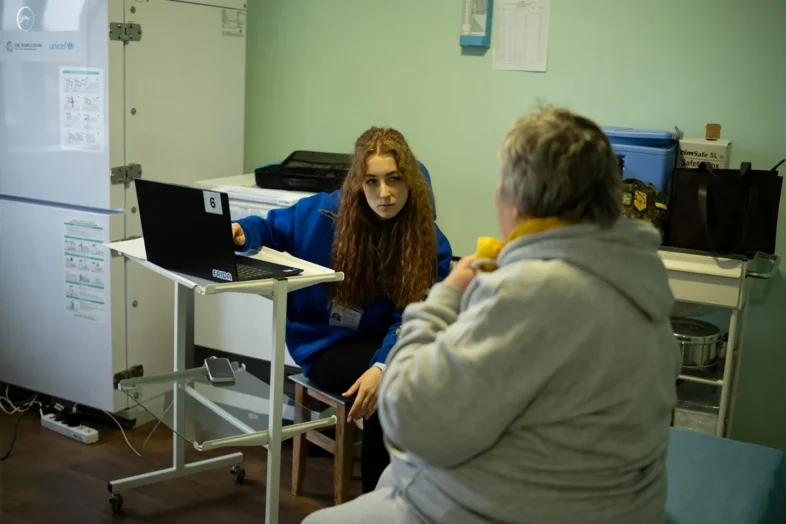
It might seem that without volunteers in the frontline or recently de-occupied areas, access to medical services would be nearly impossible. While that perception is only partly true, it’s important to note that some elements of the healthcare system are still functioning. However, the state is currently struggling to restore the full network of services and meet all the needs of the population. This is where volunteers have stepped in, taking on an essential role in providing support where the state cannot. From delivering basic medicines to setting up telemedicine centres that integrate into the broader healthcare system, their work is invaluable. The hope is that, over time, the need for volunteer assistance will lessen as the state healthcare system regains its footing.