
In his early March 2025 speech, French President Emmanuel Macron emphasised that Russia has become a direct threat to both France’s security and that of the entire continent. He argued that the aggressor state is responsible for escalating its war in Ukraine into a global conflict, with tangible involvement from non-European nations such as Iran and North Korea.
At the same time, President Trump’s stated intention to potentially scale back the U.S. presence in Europe and NATO presents a significant threat on multiple fronts. Firstly, it erodes trust in the United States as an ally within the Alliance. Secondly, it emboldens the Russian aggressor, inviting further provocations. Thirdly, it effectively shifts the responsibility for Europe’s security squarely onto the Europeans.
In this context, Macron’s proposal for France to take on the role of Europe’s nuclear security guarantor warrants serious consideration. As Poland’s Defence 24 insightfully noted, such a shift would “substantially limit the areas in which the Trump administration could leverage its influence over allies.” It is difficult to dispute this view. France’s vision of gradually reducing European dependence on the United States now seems increasingly plausible.
After the Second World War, NATO was the cornerstone of Western Europe’s military security. However, when it came to nuclear weapons, the United States held primary responsibility, with the United Kingdom also playing a role. France, as a major power, rejected this arrangement and never fully placed its trust in American guarantees. It even withdrew from NATO’s military structures to pursue an independent nuclear deterrent.
From today’s perspective, in light of Washington’s blatant betrayal of its allies and its growing rapprochement with Moscow, it is evident that French President Charles de Gaulle—who initiated nuclear research in the 1940s—along with Prime Minister Pierre Mendès France, who launched France’s nuclear programme, and General Pierre-Marie Gallois, the architect of France’s independent nuclear strategy, were remarkably prescient. Their foresight allowed France to become the fourth country in the world to develop nuclear weapons independently. Unlike the British, who remain reliant on the United States for ballistic missiles, France developed its nuclear arsenal without American assistance.
Now, as the world faces increasingly turbulent times and the need for new security strategies, President Emmanuel Macron has proposed extending France’s nuclear deterrent to protect the rest of Europe. While this does not come close to matching the formidable nuclear arsenal of the United States, Europe may soon find itself with little alternative, given the rapidly shifting geopolitical landscape. It is, therefore, important to assess both the missile and nuclear capabilities of the Fifth Republic, as well as the potential of France’s nuclear umbrella.
France’s nuclear capability
France’s nuclear doctrine, established in the 1960s under General de Gaulle, is built on the principle of strategic deterrence. The idea is that any aggression against the country would come at such a high cost to the aggressor, due to the threat of nuclear retaliation, that it would deter such actions. At the same time, France does not rule out the first use of nuclear weapons, particularly against states that “threaten France’s vital interests.”
The doctrine is anchored in three core principles, as articulated by President François Mitterrand in 1994. First, nuclear deterrence exists solely to protect the nation’s vital interests. Second, Paris reserves the right to issue a “final warning strike” if an adversary comes “too close” to crossing the threshold of those vital interests. The specific definition of this threshold, as well as what constitutes vital interests, is left to the discretion of the sitting president, who serves as commander-in-chief of France’s armed forces. Third, the French nuclear deterrent must be capable of inflicting greater harm on the adversary than the damage that sparked the conflict in the first place.
One of the defining features of France’s nuclear doctrine is its strategic independence, especially within NATO, as Paris alone determines the use of its nuclear arsenal without external influence.
The French doctrine also permits a single nuclear strike in self-defence, acting as a “final warning” and a display of resolve at a critical moment. Should this prove ineffective, the next step could be a full-scale nuclear strike targeting key military sites within enemy territory. Following strategic arms reductions in 1996, when France decommissioned its land-based S3 ballistic missiles from the Plateau d’Albion, the French nuclear triad lost its ground-based component. Only sea- and air-based nuclear and thermonuclear delivery systems remain in service.
According to the latest data, France currently possesses 280 operational thermonuclear warheads (with 10 in reserve), making it NATO’s second-largest nuclear power and the fourth-largest globally. While this is considerably fewer than Russia (4,380) or the United States (3,708), it surpasses the United Kingdom (225). Moreover, the combined total of French and British warheads exceeds China’s current arsenal of 500.
The backbone of France’s modern strategic deterrent consists of four second-generation Le Triomphant-class nuclear-powered ballistic missile submarines, built between 1989 and 2009: Le Triomphant, Le Téméraire, Le Vigilant, and Le Terrible. These submarines are 138 metres long, with a beam of 12.5 metres and a draught of 10.6 metres. Their displacement is 12,640 tonnes surfaced and 14,335 tonnes submerged. They can reach speeds of 25 knots and operate at depths of up to 500 metres, with a crew of 111.
Their propulsion system features both a main (GUE) and an auxiliary (DUE) power plant. The core component of the GUE is a K-15 pressurised water nuclear reactor, producing 150 MW. Unlike their American counterparts, these reactors use low-enriched uranium, with an enrichment level ranging from 7% to 20%.
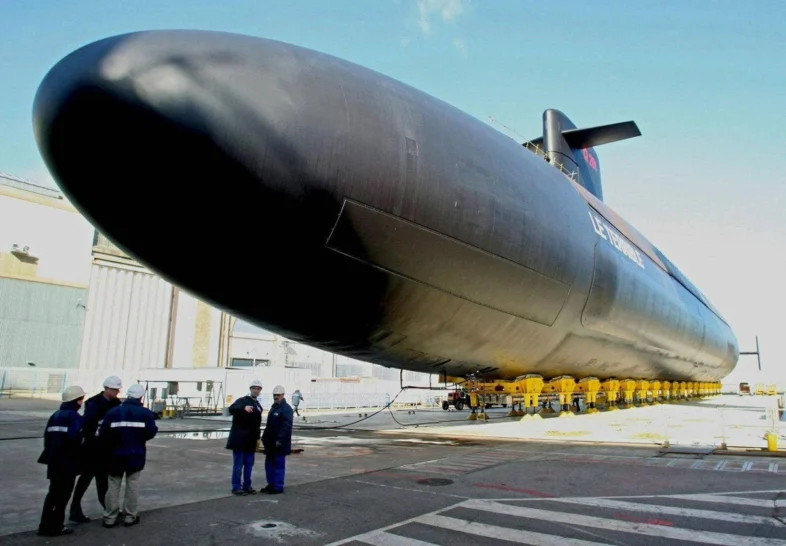
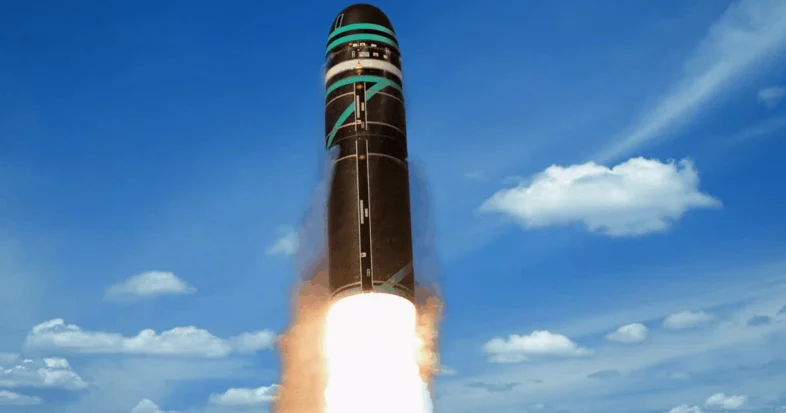
The primary armament of this class of submarines consists of 16 M51 submarine-launched ballistic missiles (SLBMs), each with a range of up to 10,000 kilometres. While each missile can carry up to 10 nuclear warheads, they are typically equipped with 4 to 6 due to the limited number of available warheads. Each warhead has a yield of 100 kilotons and is fitted with independent target guidance. Together, the four French ballistic missile submarines carry a total of 64 M51 missiles.
All of France’s nuclear-powered ballistic missile submarines are based at Île Longue in Brittany. At any given time, one submarine is typically on combat patrol, another is undergoing repairs, a third is restoring its combat readiness after maintenance, and the fourth is preparing for repairs after its patrol. For context, the United States Navy operates 14 Ohio-class missile submarines, each armed with 20 Trident II D-5 intercontinental ballistic missiles (ICBMs).
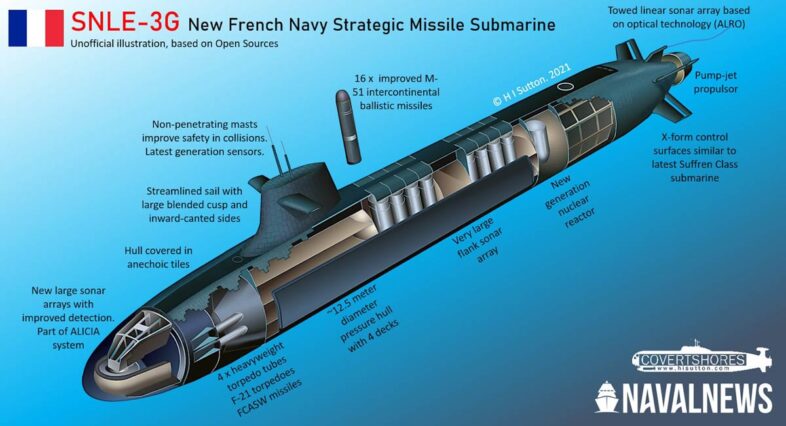
In November 2023, France tested a new version of the M51-3 submarine-launched ballistic missile, featuring an extended flight range and enhanced capabilities to counter adversaries’ missile defence systems. This upgraded missile is expected to be deployed on future third-generation nuclear-powered submarines, the SNLE 3G (Sous-Marin Nucléaire Lanceur d’Engins de Troisième Génération), which will replace the Le Triomphant-class submarines in the French Navy.
The SNLE 3G project’s research and development is slated for completion by the end of 2025. Following this, Naval Group plans to begin construction of the first submarine of the new generation. A ceremonial steel-cutting event for the submarine took place on March 20, 2024, with delivery to the Navy scheduled for 2035. The remaining submarines will follow at five-year intervals, and the SNLE 3G submarines are expected to serve with the Marine Nationale until 2090.
The general specifications for the SNLE 3G project are now known: a length of 150 metres, submerged displacement of 15,000 tonnes, armament consisting of 16 upgraded M51-3 or M51-4 ballistic missiles, and four 533mm calibre torpedo tubes for launching torpedoes and anti-ship cruise missiles.
In contrast to the French approach, the United States still maintains a land-based component within its nuclear triad. This includes 400 Minuteman III ICBMs, each equipped with single-warhead re-entry vehicles. All are housed in silo-based launchers across the continental United States.
Finally, the United States holds a significant advantage over France in strategic aviation, with 153 strategic bombers armed with 322 nuclear bombs (B61 and B83). In addition, several hundred multirole aircraft are equipped with 230 B61 bombs, as well as AGM-86 cruise missiles, which are also capable of carrying nuclear warheads.
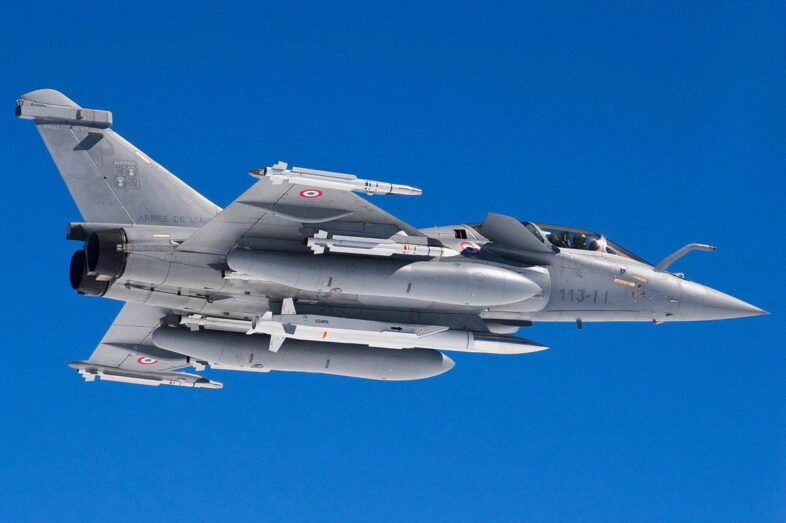
The French aviation component of its strategic forces is considerably more modest, consisting of 54 ASMP-A (Air-Sol Moyenne Portée-Amélioré) tactical missiles, each armed with a TN 81 nuclear warhead. The warhead’s yield can be adjusted between 100 and 300 kilotons, with a range of up to 600 kilometres. These missiles are designed for use in the later stages of conflict escalation and for delivering tactical nuclear strikes.
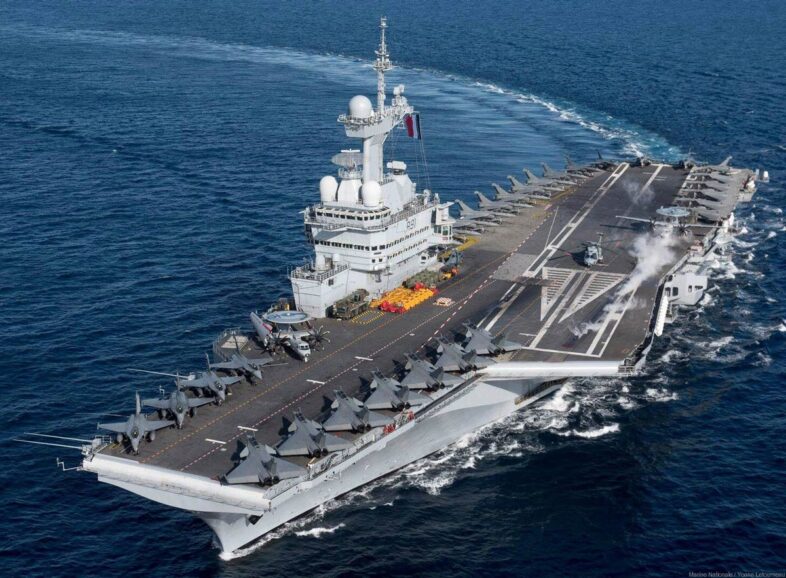
The ASMP-A missiles are deployed on multirole Rafale fighters—40 of the BF3 version with the Air Force and 10 of the MF3 naval version, stationed aboard the nuclear-powered aircraft carrier Charles de Gaulle. However, during peacetime, the carrier does not carry nuclear weapons.
While there is a clear disparity in the resources and nuclear capabilities between France and the United States, the key factor in nuclear deterrence is not the quantity of weapons, but the mere possession of them. Indeed, with over 50 tactical ASMP-A missiles and 64 M51 SLBMs on submarines, France provides Europe with a deterrence capability comparable to the several thousand nuclear warheads in the US arsenal.
Nuclear aircraft carrier diplomacy
Beyond the naval and air components of nuclear deterrence, another key element of French policy is its use of nuclear diplomacy. This involves deploying French Navy ships to assert their presence in distant parts of the world’s oceans—a modern iteration of the gunboat diplomacy of the 19th century. While it is uncommon to showcase nuclear-powered ballistic missile submarines abroad, the nuclear-powered aircraft carrier Charles de Gaulle is ideally suited for this role.
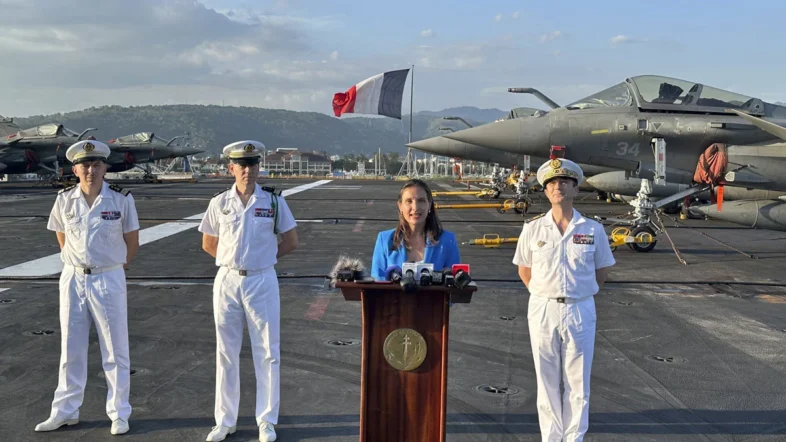
The Charles de Gaulle serves not only as a showcase for French military technology but also as a platform for strike aircraft, including nuclear-capable weapons carriers, and a tool of political influence. As a modern nuclear-powered aircraft carrier, it is also highly effective in delivering missile and bomb strikes using non-nuclear weapons, engaging real targets in ongoing military conflicts across various regions, from Afghanistan to the Middle East.
This “Frenchman with an atomic heart” is powered by two nuclear reactors producing 2×75 MW. Measuring 261.5 metres in length and with a full displacement of 432,000 tonnes, it cruises at a speed of 27 knots, with an unlimited range. The ship’s crew comprises 1,850 sailors, petty officers, and officers. Typically, the air group aboard includes 10 multirole Dassault Rafale MF fighter jets, 24 Dassault-Breguet Super Étendard attack aircraft, 2 long-range radar detection aircraft (Grumman E-2 Hawkeye), and 2 Eurocopter AS365 Dauphin helicopters.
The Charles de Gaulle is equipped with advanced air defence systems, including 4×8 launchers for MBDA Aster 15 surface-to-air missiles and 2×6 Mistral missiles, along with electronic warfare systems and modern radar for medium and short-range detection. These systems can simultaneously track up to 2,000 airborne targets.
A more powerful, next-generation nuclear-powered aircraft carrier, the PANG (Porte-avions de nouvelle génération), is already under development to replace the Charles de Gaulle. The project is set for completion by the end of 2025, with the new carrier scheduled for delivery to the Navy in 2037.
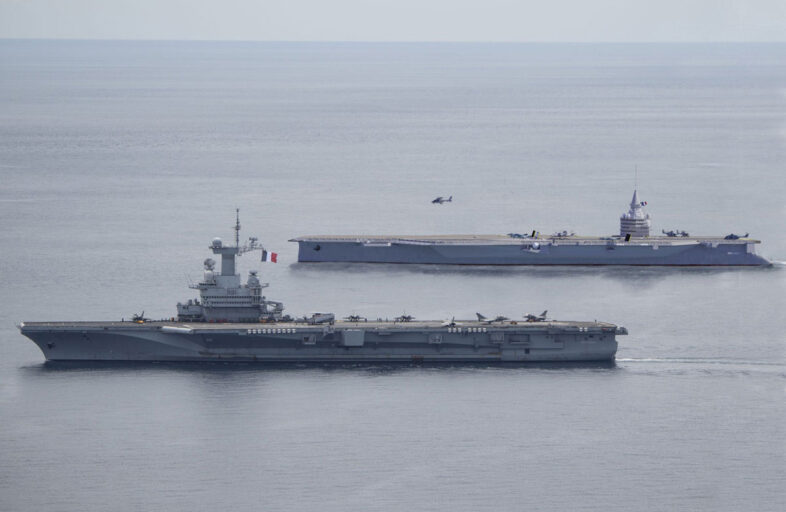
At 310 meters in length, 80 meters in width, and a displacement of 75,000–80,000 tonnes, the PANG will be the largest warship ever built in Europe. It will be powered by a three-shaft plant with an output of 80 MW, enabling a top speed of 27 knots. The ship’s complement will number around 2,000 sailors, petty officers, and officers.
Onboard, the aircraft group will comprise 32 next-generation jets, three E-2D early warning aircraft, and a range of drones. The ship will feature state-of-the-art electromagnetic catapults (EMALS) from General Atomics for aircraft launches.
How the French nuclear umbrella could protect Europe
While Paris has been actively advocating for the idea of providing Europe with its own nuclear umbrella, and engaging in extensive consultations with military leaders and politicians, it remains too early to discuss the practicalities at a European level. Any such arrangement will need to be worked out and agreed upon with key players across the continent. Currently, experts rule out the deployment of French nuclear warheads on the soil of allied nations, as this would require legislative approval both nationally and within the EU.
Additionally, there have been proposals suggesting the potential transfer of French combat aircraft capable of carrying nuclear weapons to Germany. However, this idea has already faced opposition from right-wing parties in the country, and should Marine Le Pen rise to power in the upcoming elections, Macron’s initiative could well be abandoned.
At the same time, France may continue to showcase its nuclear deterrence capabilities in Europe through joint military exercises with Eastern European countries, involving French nuclear-capable aircraft. For instance, as part of its regular national exercises, known as Poker, two squadrons of Rafale jets from the Saint-Dizier airbase annually travel thousands of kilometres across French territory, simulating the destruction of designated targets with cruise missiles.
According to experts from Germany and Poland, these exercises could be scaled up to a European level, with combat aircraft from other nations participating. Initially, they would act as escort fighters for nuclear-capable aircraft, but should a European agreement be reached, they could later take on the role of carriers of such weapons.
Expanding the French nuclear umbrella to include other European countries could enhance European security, provided that European nations also take steps to establish their own missile defence system, independent of the United States—essentially creating a European missile defence shield to protect against ballistic missile threats.
However, concerns have emerged following statements from the new administration in the White House. There are growing doubts about whether the U.S. would intervene to defend Europe in the event of a Russian ballistic missile strike. For instance, would the U.S. use its AEGIS Ashore missile defence bases in Poland’s Redzikowo or Romania’s Deveselu? Moreover, it’s not inconceivable that President Trump could even present Europe with a separate bill for the use of these missile defence systems.
Building a European defence production capability will take time, significant investment, and strong political commitment. However, many important and intriguing developments are already unfolding in Europe, shaping the security landscape of its nations in this new era. Furthermore, due to security concerns and the unpredictability of the Trump administration, European countries are increasingly opting to source weapons and military equipment from European firms rather than American manufacturers.
According to a recent report by Politico, American arms manufacturers have been effectively excluded from the EU’s new large-scale defence initiative, Readiness 2030 (also known as the White Paper for European Defence — Readiness 2030). In place of U.S. suppliers, Brussels is deepening its partnerships with countries like South Korea and Japan, as well as with members of the European Free Trade Association (EFTA).
Notably, one of the four key pillars of the EU’s defence plan focuses on Ukraine. It aims to boost defence spending, create necessary defence infrastructure and logistical corridors for troop movements, and transform Ukraine into a formidable force by increasing military aid. This includes involving Ukrainian enterprises in European defence programs and strengthening the capabilities of the European defence industry to ensure weapons can be produced in the required volumes and at the necessary pace.
In the Polish expert community, there is strong backing for the unconditional acceptance of Macron’s proposal to extend the French nuclear umbrella to Eastern European countries. Unlike the American approach, this proposal does not require countries to purchase weapons from France or commit to large future projects, such as nuclear energy. All that is needed is a demonstrated willingness to cooperate with both the US and France. Under certain conditions, Ukraine could also benefit from this opportunity.
Some insight into the cost of the French nuclear umbrella has emerged. According to the Ukrainian publication Defense Express, excluding development costs and other expenses related to owning and maintaining nuclear weapons, but factoring in the annual operational costs, it accounts for 14% of France’s defence budget for 2024. This translates to €47.2 billion under the “nuclear deterrence” category. This is the price for Paris’s strategic deterrent—the French nuclear umbrella. And, under its protection, European nations will soon be expected to significantly increase their defence spending.