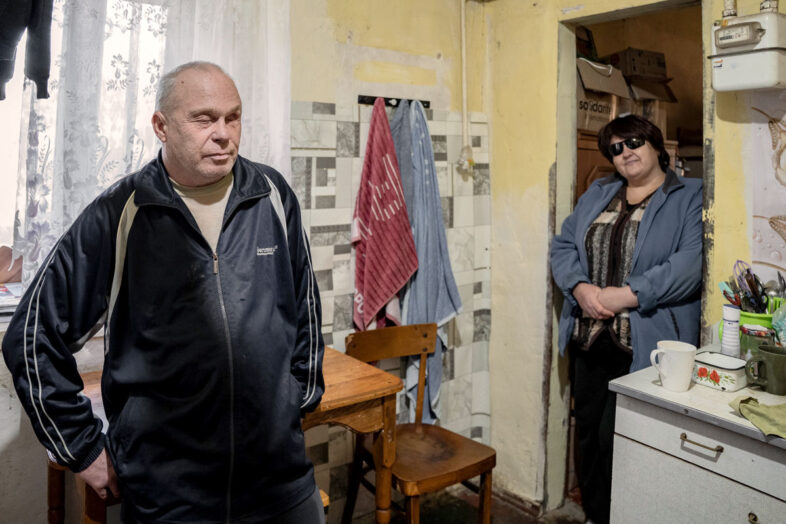
“We’ve been together for 12 years, and how we look—it’s a mystery to both of us”
Before Russia’s full-scale invasion, they lived in a city with a beautifully peaceful name—Myrnohrad. It was here, in the Donetsk region, the homeland of Oksana, that Viktor moved more than a decade ago.
Now, Oksana is 50, and Viktor is 53. They met at the Filatov Institute of Eye Diseases and Tissue Therapy in Odesa. Both lost their sight in adulthood—Oksana due to a tragic acid attack, and Viktor because of an infectious eye disease.
“A nurse at the burn centre where I was being treated led Viktor to me, placed his hand on mine, and told us to get acquainted,” Oksana remembers. She says the doctors fought tirelessly to save her sight—nine complex surgeries, a long and exhausting rehabilitation. But the hardest part came afterwards: accepting that her vision was lost forever. She admits that for a long time, she didn’t want to talk to anyone.
“Viktor was persistent, yet gentle. He’d stop by just to talk, and if he sensed I wasn’t in the mood, he’d quietly leave. He had a great sense of humour and always knew how to cheer me up. “Come to Cherkasy with me—we’ll herd geese,” he’d joke. We’d part ways, each heading home, but stayed in touch over the phone. It didn’t take long for us to realise how much we truly enjoyed each other’s company and wanted to be together,” Oksana says, her smile wide as she remembers.
Their wedding was simple but heartfelt—flowers, witnesses, and a small gathering of friends. They didn’t tell their families beforehand. They went to the registry office, signed the papers, and only then shared the news. Not everyone understood or approved. Even those closest to them were taken aback. But people will always be people…
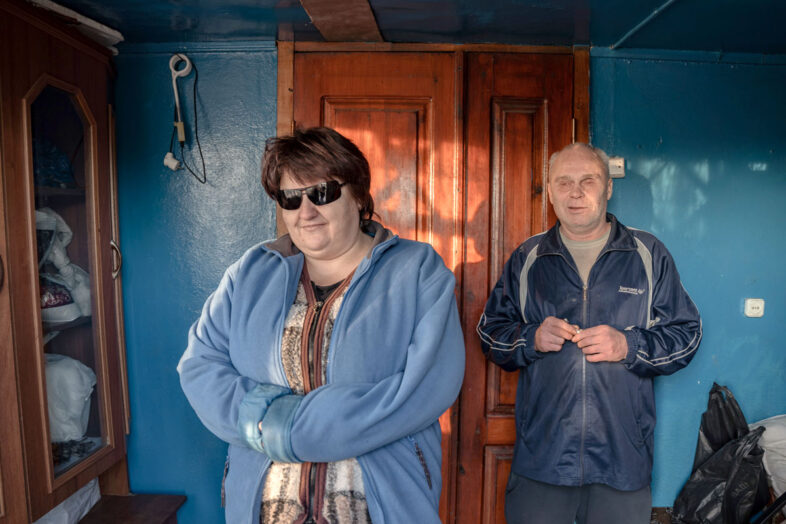
Viktor was born in Crimea and moved with his parents to Kuzmyna Hreblya in the Cherkasy region when he was 19. He often recalls the peninsula as a kind of paradise on earth. “The climate was perfect—the sea, the forests… My childhood and youth were there. Friends, hiking trips—it was a great time.” In Cherkasy, he worked as a tractor driver on a farm and nurtured a hobby of breeding pigeons. Skilled at all sorts of handiwork, he continues to do everything with his own hands, even after losing his sight.
Before the tragic incident, Oksana worked as a shop assistant. She was the life of the party—cheerful, easygoing, always surrounded by friends. But after the attack, many of those friendships faded away. “I don’t blame them. I guess that’s just the kind of friends they were,” she says, her tone matter-of-fact.
They’ve been together for 12 years now, yet they’ve never seen each other. “It’s an impossible dream—to know what my husband looks like,” Oksana says, smiling softly. “My friend tried to help, to explain it to me. But I never quite understood…”. Today, Oksana and Viktor experience the world through sound, touch, imagination, and memory. And that’s how they felt the war too—through touch. A touch that was hellish.
“I never understood the phrase ‘your hair stands on end’—until the shelling started”
When Viktor’s niece called from Kuzmyna Hreblya at five in the morning on February 24, 2022, and said, “We’re being bombed,” Oksana didn’t believe it. “Bombed? How? Yes, we’d heard talk of a full-scale war since 2014,” she recalls. “In Myrnohrad, distant explosions had been a regular background noise for years. But we’d learned to tune them out.”
As blind people, they rely on their hearing. In the spring of 2022, Oksana could hear the rumble of military equipment moving near their house. “It was terrifying—you couldn’t tell if it was to the left, behind the building, still there, or already gone. The constant droning was nerve-wracking. I went to the doctor, saying I couldn’t sleep. They told me I had an overactive imagination. ‘How can you possibly know what’s happening if you can’t see?’ they said.”
Yet there were moments when friends and acquaintances told her, “It’s a good thing you can’t see any of this—because it’s pure horror.”
They had a rough idea of when the Russian missile strikes would come—usually around three in the morning. So everyone would stay up, waiting. Once it hit, that was it—you could finally go to bed. But then they started bombing the city at ten in the morning. And after that, it never stopped…
“In the mornings, you’d rush to the store, grab whatever you could, and sprint straight back home. There was no drinking water, so we’d risk making our way to the private sector to fetch some from a well. But soon, even stepping outside the building became terrifying.”
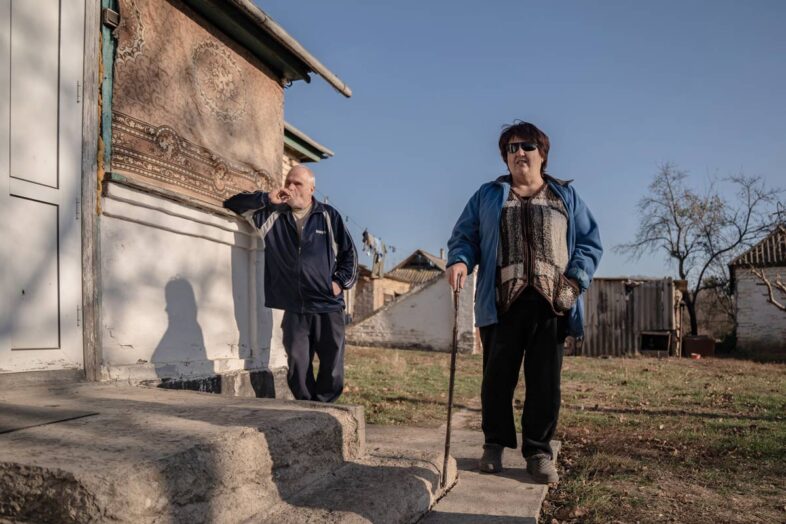
The first major Russian strike hit, and half the school was blown apart. “Such a shame—it was a beautiful school, and they’d just finished renovating it. Then a missile struck the mine nearby—it felt like the end of the world.”
“I was lying on the floor, and Vitya was shouting, ‘Don’t even think about getting up!’ So I crawled to the farthest corner,” Oksana remembers. They lay there for hours, waiting, until they finally heard their neighbours moving around. Only then did they dare venture outside to see what was left. When a guided bomb hit, they were lucky—they weren’t there anymore.
They left their home in Myrnohrad for Cherkasy several times, only to return again. Because no matter what, home—even just by touch—still felt like home. But every return was harder than the last.
“As soon as you enter Donetsk region, everything feels black. I’m not even talking about the constant explosions—the horror is something you can feel. I never knew what it was like before—to actually feel your hair move on your head. To feel your scalp shifting back and forth. And then, in your throat, fear sits like a lump that won’t go away.”
When we ran down to the basement under our building—the kind people use to store preserves—even the dogs followed us, trembling with fear. Animals are terrified of explosions. We hid there during the shelling, but we knew it wouldn’t save us.
Fear distorts everything. You can’t eat, you can’t sleep—you curl up, trying to disappear into yourself. And if you live in that state for too long, you can lose your mind. It’s not worth it. No matter how heartbreaking it is to leave behind your home, your belongings—especially when you’ve spent ten years saving up and renovating, only to abandon it all… But over time, you realise you can live without those things. The most important thing is to live. To sleep peacefully. To wake up without fear.
And yet, you still long for home. Everyone I know who left wants to go back. But Myrnohrad is practically a war zone now. Only a few remain—some couldn’t bear to leave their goats, others simply had nowhere else to go.
Today, we heard about a friend of ours, another blind man. A strike hit—his house collapsed like a house of cards. He’s still lying there under the rubble. There’s no one left in the city to pull him out.”
“There are more good people in the world, and we feel it with our hearts”
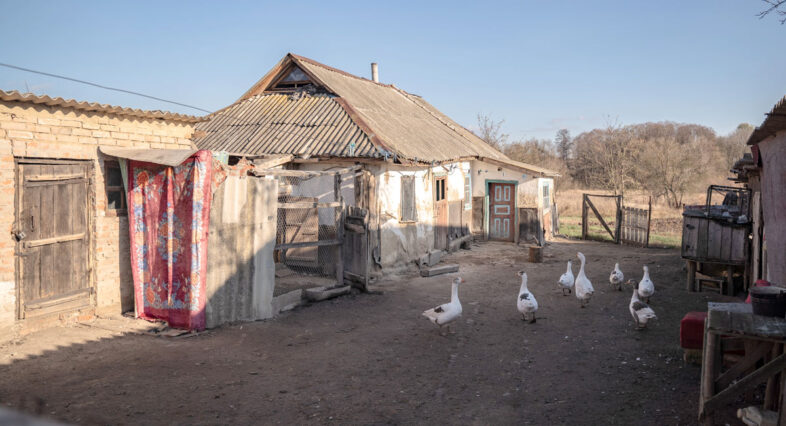
In Kuzmyna Hreblya, Viktor and Oksana live in his childhood home, sharing space with Oksana’s father, their niece Nadiya, and her two children. Nadiya’s husband is serving on the front lines, while Oksana’s mother remains in a village near Pavlohrad. “I’d bring her here, but the house is small—there just isn’t enough space for everyone,” Oksana explains. “We wanted to buy a place in the village, but we’re not there yet. The money for a proper house with all the amenities just isn’t there.”
The couple runs their household independently. They keep chickens, geese, and cats. “Vitya does everything—hammers nails, makes repairs, chops wood, tends the stove. He can even sew. And I handle the laundry, cook, clean, and prepare preserves for the winter,” Oksana says. “I used to need help pouring boiling water into jars, but now I’ve figured it out myself. People often ask, ‘How do you cook if you can’t see?’ I listen. When the borscht boils, I know it’s time to add the vegetables.”
Recently, Oksana and Viktor bought a new electric oven, and Oksana has learned to bake charlotte cakes and other desserts. “I love making lazy cabbage rolls. We shred the cabbage together—Vitya chops, I pack it down,” she says with a smile.
Cooking is often a family affair, with Nadiya joining in. “We live in harmony,” Oksana adds. “The only real help we need is someone to run errands for us or take us to the doctor when we’re unwell.”
They stay connected to the world through gadgets equipped with special voice programs. “Our phones read messages out loud, and we store contacts using voice commands. When you called me, I simply said, ‘Yulia, save,’ and it recorded your number,” Oksana explains. They rely on these devices for everything—from navigation to managing daily tasks. Mykola, a businessman from Kyiv who sells these phones, is also blind. He uses the same technology to navigate, even when travelling abroad. He also sells talking watches, scales, multi-cookers, and washing machines designed for the blind—all controlled by smartphone. “There’s even a measuring tape that announces measurements. We wanted to buy one, but even before the war, it cost five thousand hryvnias, which was too expensive for us,” Oksana adds. “The one thing we did manage to get was a talking blood pressure monitor. And of course, our phones—without them, we’d be lost.”
But beyond technology, people remain their greatest support. “We depend on others a lot,” Oksana continues. “Especially in unfamiliar places. Once, in Myrnohrad, I stepped outside in the evening without my cane or phone and lost my bearings. A neighbour saw me, came over, and walked me home.”
“In general, there are far more good people in the world than bad,” Oksana says. “We receive a lot of help, especially when we’re traveling. Once, we got caught in a snowstorm, and our bus was stuck for hours. Strangers helped us book a hotel, bought us coffee and pastries, and even got us new tickets afterward.”
Viktor adds, “How do we tell if someone’s kind? By the way they speak, by their voice. Intonation, even pauses in a conversation, reveal a lot. You can sense when something’s off—when someone’s attitude isn’t quite right. A few times, I’ve felt that unease. But mostly, people are kind and friendly. They understand and help. Still, I don’t like asking for help—I try to manage on my own.”
When they applied for the Polish-Ukrainian project Rodyna Rodyni (“Family to Family”), Oksana admits they didn’t have high hopes. “We spent so much time gathering documents, filling out forms, and waiting. Then, we received two little hearts—one yellow, one blue. ‘Everything is fine,’ they told us. We never expected the help to come so quickly. With the funds from the project, we bought potatoes for the winter, stocked up on firewood, and secured enough food to last.”
“I know there are people who have it much harder than we do,” Oksana continues. “Few actually see us as people with disabilities. We do everything ourselves—we’re not bedridden. But no one really understands what it’s like to see nothing, to live with only darkness before your eyes. Try covering your eyes and walking from here to the shop. It’s incredibly difficult…”
“We’re deeply grateful to all the kind people, to Polish families, for their compassion and support,” she adds.
“We flip tough moments, always finding the silver lining”
To relieve stress, Oksana turns to books. “Lately, I’ve been getting into fantasy,” she says with a smile. “My husband laughs and says, ‘You’ve got dragons and elves.’ But I lose myself in that world, where I can think less about the bad things and my fears. I used to watch movies and listen to music, but now it’s all fairy tales.”
Viktor, on the other hand, finds comfort in his pigeons. He has only five now, but he knows each one by name, talks to them, and feeds them. When asked what gives him strength, he pauses for a moment before answering, “My wife… I loved her character from the very beginning. She’s gentle, kind, tender, and caring. She worries about me. I have one dream—a quiet, peaceful life. I’m so tired of these wars. I want people to live in peace, harmony, and joy. Everything else will fall into place. As long as there’s health.”
Before losing her sight, Oksana says she loved watching travel shows. “Oceans, islands, distant countries, beautiful nature… The world is incredible. It’s just that people don’t appreciate it,” she reflects. “And now, all we hear about are hurricanes, tornadoes, and fires. It’s all because humans interfere with the natural world. We’re ungrateful. But I always believe in the best. Life goes on. Never give up.”
She pauses, then adds, “You know what else works? Turning things around, finding the positive in the negative. Saying, ‘Look, how good—you’re lucky.’ That’s how we try to turn tough situations around, with humor. How else can you do it?”
“When you’re busy with something, you forget that you can’t see,” she continues. “Nothing is impossible. A person gets used to everything. They can do anything.”