
The Ukrainian Week spoke to Andriy Klymenko, head of the Monitoring Group at the Black Sea Institute of Strategic Studies and editor-in-chief of the specialised portal BlackSeaNews, about Russia’s shadow fleet, the impact of sanctions on Russian oil, and the potential for tightening controls on Russian oil traffic in the Baltic Sea.
***
— It’s often said that sanctions on Russia’s oil sector are largely symbolic and ineffective. Do you agree?
— Over the past three years of war, Russia has faced an unprecedented wave of sanctions, and their number continues to rise. We’re already seeing some clear signs of their impact. Take airstrikes, for example: where once 15 to 20 Tu-95 bombers would take off, each carrying multiple missiles, now we see far fewer—just five or six planes, each carrying only one missile. The frequency of missile strikes has also dropped significantly, largely because they’re struggling with production.
The evidence is clear: sanctions are working. If Russia is forced to use missiles that are essentially North Korean knock-offs with much weaker capabilities, relies on North Korean soldiers, and has to copy Iranian drones because it can’t make its own, that tells you something. The effect of sanctions may be gradual, but it’s definitely happening.
Of course, we all want these sanctions to hit Russia’s military-industrial sector even harder. This is about saving Ukrainian lives—both military and civilian—and preventing further devastation of our country. So the big question is: what more can be done to significantly cut Russia’s financial resources for this war? And this brings us to Russia’s maritime oil exports, which offer a unique opportunity—both for us and for our European friends, allies, and partners.
— What makes this moment unique?
— The issue of Russian oil has gained significant traction among our Baltic neighbours and other EU countries. This is a major win for Ukraine. There’s now a coordinated effort to figure out the best ways to reduce Russia’s oil exports. Ukrainian experts and government officials have been focused on this since October 2024, and it has become a central topic in nearly every meeting with Northern and Baltic countries.
For years, Russia has been referred to as a “gas station masquerading as a country”—and that description still holds true. Energy exports account for more than half of Russia’s total export revenue, depending on global prices. To be specific, in recent years, energy exports have made up between 55% and 70% of Russia’s total earnings, fluctuating with the prices of oil and gas.
It’s important to note that for a long time, both public and media attention in Ukraine and Europe has been focused on natural gas. However, gas has never accounted for more than 20–22% of Russia’s total natural resource exports. Coal makes up another 6–8%, while the remaining three-quarters comes from crude oil and petroleum products. A few months ago, when we broadened our focus to include the Baltic Sea alongside the Black Sea, our analysis revealed that 60% of Russia’s maritime oil exports pass through the Baltic. Another 20% moves through the Black Sea, with the remaining 20% going through the Russian Far East. As for the Northern Sea Route, its share is minimal, hindered by the harsh Arctic winters and ice-covered waters.
In the Black Sea, we are largely powerless, with the Bosphorus and the Dardanelles straits under Turkish control. Despite its pro-Ukrainian stance, Turkey has stuck to its well-established policy of balancing relations with both sides. In the Russian Far East, crude oil pipelines mainly supply China, with some shipments heading to North Korea and beyond. Again, this is largely out of our influence. But the Baltic Sea, which handles 60% of Russia’s seaborne oil exports, offers a very different opportunity.
— What are the approximate volumes of oil we’re talking about?
— Around 11 to 12 million tonnes of crude oil and 3 to 4 million tonnes of petroleum products pass through Baltic ports every month. Every country along the Baltic coast is now part of the European Union and NATO. Further along, where the oil exits via the Danish straits, you have Norway—also a NATO member, though not part of the EU. In essence, the Baltic Sea has become an internal body of water for both the EU and NATO. This is where Ukraine is focusing its efforts to significantly reduce Russia’s maritime energy exports.
Recently, global media reported a sharp drop in Russian oil sales in December, citing European Union sanctions. In reality, the decline occurred in January, not December, and it wasn’t due to sanctions. Rather, it was a direct consequence of Ukraine’s long-range drone strikes on Russia’s primary export hub, Ust-Luga.
Normally, around 55 tankers leave that port each month, but in January, only 44 departed—a shortfall of roughly 1 million tonnes of oil. However, Russia managed to make up for this loss by rerouting shipments through another port, Primorsk, also located in the Leningrad region.
For the past six months, we’ve been hearing that around 300 tankers are under sanctions imposed by the UK, EU, and US. Yet, we haven’t seen any dramatic changes. Why is that? What does it actually look like in practice? In practical terms, 95 to 100 tankers leave Baltic ports every month, each carrying between 100,000 and 150,000 tonnes of oil. This is the reality behind what’s often referred to as the “shadow fleet.”
— Why do you refer to it as a myth, given how extensively the Western press covers this fleet?
— As monitoring specialists, we’re confident that the “shadow fleet” narrative was invented by the Americans. It was created in much the same way they introduced the $60 per barrel price cap. What’s the message? That the shadow fleet is hard to track, outdated, risky, and that no one really knows who owns it.
But when we started investigating this so-called shadow fleet, we realised we could track all the tankers. In fact, we were monitoring about 20% more tankers than the major global marketing centres—those considered authoritative and well-funded, whose data is used by major international news agencies.
I remember back in July 2024, we compared our numbers with data from one of the largest market intelligence centres, published in a major global business outlet. While we recorded 99 or 100 tankers, their report listed 29 fewer. But that doesn’t prove there’s some invisible “shadow fleet” that can’t be tracked. We can see them.
The issue is that the—let me use another key phrase—artificial intelligence processes all this data algorithmically. Without human verification, it ends up missing or failing to detect at least 20% of the tankers and their cargo. Whether that’s intentional or not, it’s hard to say. Maybe they’re still operating under the assumption that it’s peacetime. For instance, they don’t account for how Russian electronic warfare (EW) disrupts maritime tracking systems. And that interference can manipulate or even completely disable signals.
Their AI doesn’t pick up on cases where a tanker’s crew switches off tracking, making it impossible for the departure port to be logged. But we do—though, of course, we don’t disclose our methodology. Our team has been monitoring vessels at sea through maritime intelligence services since 2010. Fifteen years of experience counts for something. Beyond that, I’d argue that Ukrainian experts in maritime monitoring are far more motivated than their counterparts in Europe or the United States.
— Which countries are shipping Russian oil?
— In January 2025 alone, 96 tankers carrying crude oil (excluding oil products) left the Baltic Sea. The leading transporters? Greek-owned tankers. They’ve consistently made up 30% of the total—just as they have in the past. We’ve been monitoring this closely since April. Why isn’t this talked about more? Probably because it’s an uncomfortable truth: a third of all Russian crude oil leaving Baltic ports is shipped around the world by tankers from an EU and NATO member state. Of course, these tankers aren’t bringing the oil to Europe, but they’re heading to places like India, Turkey, and China.
We know every single tanker, its owners—even down to the address of the shipping company’s office. We’re talking about five well-known Greek companies, all owned by Greek billionaires.
And in second place? You might be surprised, but it’s the Russian Federation itself. Seventeen tankers in total. Some have been re-registered—about five or six still officially belong to Russia, but the rest are now registered in Dubai, UAE. That’s no secret either—around 1,500 Russian companies have moved their registrations to Dubai as well.
You will also be surprised to learn who’s now in third place—Azerbaijan, a major maritime player. Fourteen tankers are owned by companies registered there. After that, we have nine tankers from China, mostly registered in Hong Kong, followed by another nine from India, eight from Turkey, three from Vietnam, and one from Kazakhstan.
Here’s something worth noting: out of the 96 tankers, only one could, at a stretch, be considered part of the so-called shadow fleet—simply because it’s registered in a so-called “flag of convenience” country. These are offshore jurisdictions, but there’s nothing inherently criminal about them. They were originally set up for tax minimisation. Typically, only six to nine tankers out of 100 fall into this category. Anyone familiar with the industry knows that the offices handling these offshore registrations are usually based in the UK, the US, and other developed countries.
The issue of flags isn’t that significant. They can be changed in just a few days. If, for example, tankers carrying Russian oil are flagged in Barbados, the country would quickly remove them from its registry to maintain its reputation. The operator would then re-register the vessel under another island nation within days.
As for the myth about the shadow fleet being made up of ancient, environmentally hazardous ships—there’s some truth to it, but not the whole story. In the maritime industry, the key factor in whether a ship can operate is its safety. The main gauge of a tanker’s technical condition is whether it appears on the white, black, or grey lists of international port control memorandums. Each country has port control authorities responsible for inspecting vessels. When a ship, particularly a large tanker carrying 100–150,000 tonnes of oil, presents additional risks to the port, the country, or the environment, a port control inspector will assess its condition.
What do we know about the condition of the tankers leaving the Baltic Sea? In January, 15% of the 96 tankers transporting Russian crude oil from the region were on the blacklists of international port control memorandums. In December, this figure stood at 16%, and in September, it was as high as 28%. There are also grey lists, which document various violations. These reports include issues such as engine problems, malfunctioning valves, hull damage, or equipment failures. When numerous violations pile up, a ship is placed on the blacklist. A smaller number of violations lands it on the grey list, and about 40% of tankers departing from the Baltic Sea fall into this category.
As for the average age of these vessels, in January and the months prior, it was 15.3 years. Greek-owned ships are slightly younger, averaging 12 years old. Tankers registered in Azerbaijan, China, India, and Turkey are older, with an average age of 18 years, while those from Vietnam average 21 years, and those from Kazakhstan are 23 years old.
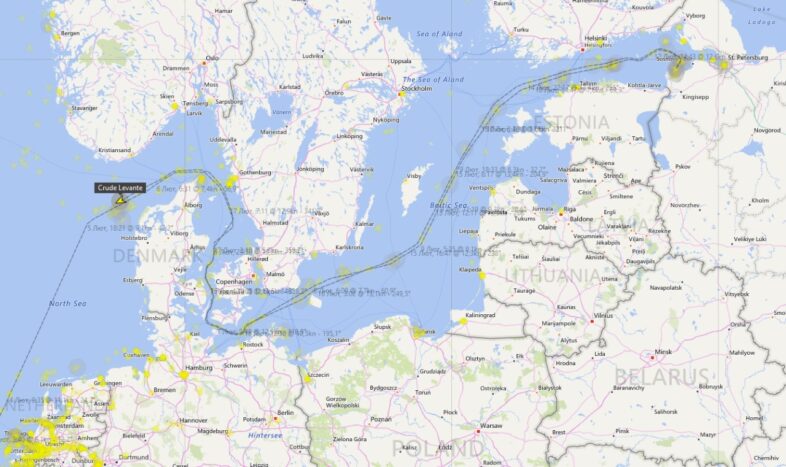
The situation was significantly influenced by an incident involving Russian tankers in the Black Sea on December 15. The following day, December 16, leaders from the Baltic and Northern countries gathered in Tallinn for a summit at the presidential and prime ministerial level. Naturally, the spill, which saw 8,000 tonnes of fuel oil dumped into the sea, prompted serious reflection. After all, we’re talking about tankers carrying 150,000 tonnes of crude oil. The potential consequences of a spill on that scale in the relatively small Baltic Sea—which is almost half the size of the Black Sea—would be catastrophic. This raises important questions about insurance. Half of the tankers are covered by the top-tier London Club, while the rest rely on insurers from India, Russia, and China.
Another key issue is the so-called price cap, introduced on December 7, 2022, right after Russia’s full-scale invasion of Ukraine. Alongside an embargo imposed by the G7, the EU, and Australia, this measure sought to limit Russian oil sales. These countries made it clear that they would no longer purchase Russian oil. But it’s important to clarify: this isn’t a sanction on Russian oil or petroleum products, it’s an embargo. If, for example, India transports this oil, it’s not in violation of any rules—they haven’t refused to purchase it, after all.
So, the idea of sanctioned Russian oil is an exaggeration – it’s simply not true. There are no sanctions in place. Now, let’s talk about the price cap. When it was introduced in December 2022, with a limit of $60 per barrel for crude oil, Vladimir Putin swiftly issued a decree on the matter. This decree has been extended three times and is still in effect. It categorically forbids Russian companies from using the price cap to determine the value of their oil, and even mentioning it is prohibited. Numerous journalistic investigations, including from the Associated Press, CNN, Reuters, and others, have shown that oil sold from Russian tankers to India and China is priced well above the cap.
The price cap format was essentially designed by the Americans to make enforcement impossible. There’s no mechanism for verification. On the Russian side, a commission from the Cabinet of Ministers, headed by Mikhail Mishustin, oversees the enforcement of Putin’s decree. In practice, the price cap is a colossal fake, created largely out of the Biden Administration’s fear that global oil prices might rise.
They were concerned that even the slightest disruption could lead to a 5-cent increase in gasoline prices at American petrol stations.
For a long time, everyone was content to let things slide because no one really wanted to take action. But today, the situation has changed. And it’s not about a shift in the U.S. presidency—it’s about the mood in Europe. The sentiment now can be summed up like this: “Listen, European countries—our friends, allies, and partners—you’re giving us €100 billion in aid every year. Half of that goes to the budget for social programs, and half is funneled into shells, tanks, air defense systems, and other military support.”
Yet, in the same year, while European nations are diverting funds away from their own budgets and social programs, Russian oil is still flowing past your shores—oil worth one and a half, maybe even twice, what you’re sending to Ukraine. And this oil is moving right through your maritime zones, including Denmark’s territorial waters, all in plain sight. Meanwhile, every year, you’re continuing to sacrifice these billions for Ukraine’s defense. It doesn’t add up. This has to stop. And the Baltic states, in particular, are coming to terms with this reality. They’re realising that something must change—and quickly.
It wasn’t just the accident involving Russian tankers in the Black Sea, or the suspicions of sabotage, but also the damage to several tankers departing from Russian ports in the Baltic that has underscored the risks in that region. These incidents highlight the very real threat to the Baltic. What we need now is for European nations to adopt a package of measures that could at least halve the volume of oil passing through the region. A complete economic embargo on all trade with Russia is essential. Interestingly, just six months ago, Daniel Fried—the architect of American sanctions policy and former head of the formidable Office of Foreign Assets Control (OFAC)—voiced the same sentiment.
— What is Ukraine pushing for at the moment?
— Ukrainian maritime lawyers argue that the responsibilities of a coastal state, as outlined by the UN Convention on the Law of the Sea, support the application of Article 51 of the UN Charter on self-defense. This means countries have the right to take necessary actions: to stop, inspect, demand, or even escort ships if needed.
International maritime law is designed for peacetime, but today, both Europe and Ukraine are at war. In the Baltic Sea, we’re seeing aggressive actions, mainly sabotage. Finally, the Baltic states are acknowledging this reality. It’s not just Lithuania, Latvia, and Estonia anymore; Poland, Germany, Finland, and Sweden are all now saying, “Perhaps it’s time for us to pass legislation that expands the powers of coastal states in regulating maritime oil traffic in the Baltic.”
One tanker carries a million barrels of oil. Multiply that by $70 per barrel, and you’re looking at a cargo worth $70 million. Add another $20-30 million for the value of the tanker itself—around $100 million for a single voyage. Of course, this could be contested in court, but to avoid legal battles, a solid legal framework must be put in place. Ukraine needs this process to move quickly. And I’m confident Ukraine will continue its sanctions, particularly using unmanned forces.
Next, at least 15% of the tankers passing through the Baltic Sea are on the blacklists of international port control memorandums, meaning they are in urgent need of repair. It should be agreed that no vessels on these blacklists should be allowed to operate in the region.
The next step could be for the Baltic states to approach their Greek counterparts and ask, “How much longer will 30% of the tankers serving Russia’s military-industrial complex continue to sail under the Greek flag each month? It’s time to remove your tankers from the Baltic, as you’re supporting the aggressor.” That would address 45% of the issue. Then, there’s the matter of the age of these tankers. A simple rule could be introduced: no tankers older than 15 years should be allowed to operate. This would immediately eliminate ships registered in Azerbaijan, China, Turkey, Vietnam, and Kazakhstan from the equation.
We must stop believing in myths. Instead, we need to rely on hard data, analyse it carefully, and take decisive action to reduce the flow of ‘blood oil’ that fuels this endless war.