Strolling down Saksahansky Street in Lviv, it’s hard to imagine that behind one of these buildings lies a little corner of Crimea. Yet, nestled within the modernist stone facades is the Crimean Tatar Cultural Centre—a vibrant hub of the sun-drenched peninsula in the heart of Lviv’s rain-soaked streets.
“The locals are curious about us and our unique culture,” says Islam Tohlu, head of the centre, speaking to The Ukrainian Week.
Lviv’s Crimean Tatar community is now around a thousand strong. The centre serves as both a gathering place and a cultural bridge, offering an insight into Crimean Tatar heritage and its deep-rooted ties to Islam. Regular events and open lectures welcome schoolchildren, students, tour guides, and anyone eager to learn about Crimean Tatar traditions—from the intricate ornek patterns to the rich flavours of its cuisine and the history that binds it all together. Just days before our conversation, the centre hosted a discussion where local schoolchildren posed questions to a rabbi, an imam, and a priest—part of its ongoing mission to foster dialogue and understanding.
The centre also serves as a key religious hub for Lviv’s Muslim community, offering dedicated prayer rooms. Beyond its walls, the city is home to two other mosques—the Muhammad Asad Mosque and the minaret-topped mosque at the Southern Market.
Lviv’s residents are generally open and curious about Crimean Tatar culture, and integration has been smooth. However, as Islam Tohlu notes, occasional misunderstandings still surface—particularly on social media, where ignorance about Ukraine’s indigenous peoples persists. “The sight of mosques, the call to prayer, or other cultural and religious elements sometimes fuels misplaced fears that ‘Muslims are flooding in,’ especially among more orthodox communities. But these are isolated cases of ignorance—something we actively work to dispel through our cultural and educational initiatives,” he explains.
More broadly, there is still work to be done in fostering the understanding that Ukrainians and Crimean Tatars belong to the same political nation. “Crimea is our homeland. We were born and lived there for centuries. We had our own state, one that lasted for generations—until Russia conquered it,” Tohlu says.
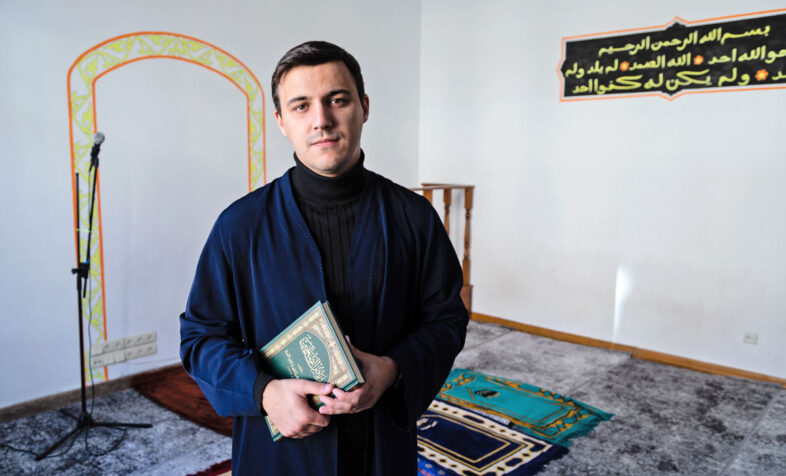
Islam Tohlu, Head of the Crimean Tatar Cultural Centre. Photo: Kateryna Moskalenets. Crimean Tatar Cultural Centre of Lviv
From Crimea to Drohobych
One of the first Crimean Tatar communities in western Ukraine took root in Drohobych in March 2014. From this small nucleus, a strong network began to form across the city and region. Among those drawn to Drohobych was Amet Bekir, who was forced to leave his home in Crimea that September. Today, he serves as the cultural events manager at the Crimean Tatar Cultural Centre in Lviv and leads the public organisation Areket—meaning ‘Movemen’ in Crimean Tatar.
In 2015, Amet and his family found refuge through Caritas, a charity run by the Sambir-Drohobych Diocese, which provided them with accommodation and support to help them integrate. For nine months, Amet and his wife worked on Caritas projects, marking the beginning of their civic activism. What started as an informal initiative, Drohobych Qırımlı, soon evolved into the NGO Areket, which remained active from late 2015 to 2017.
By 2017, the family decided to relocate to Lviv—a move partly influenced by Amet’s son, Mustafa, who had earned a place at the Ukrainian Leadership Academy. He was the only Crimean Tatar among the academy’s five branches.
Since May 2017, the Crimean Tatar Cultural Centre has been operating in Lviv, and in November of that year, Amet and his wife joined its activities. The couple, along with the Areket, helped shape the Centre’s strategy, with a focus on cultural-educational, religious (such as Muslim community gatherings and supporting traditions), and political activities (such as participating in the campaign supporting the “Kremlin Prisoners”).
The heart of the Crimean Tatar community in Drohobych today is the Ikhsan-Sincerity Cultural Centre. Since the full-scale invasion, many Crimean Tatars who had legal grounds to leave—such as large families—moved abroad. While the community has grown smaller, its spirit remains as strong as ever. New faces have also joined, including those displaced for a second time. Among them is Illyas Useinov, who now serves as the centre’s imam.
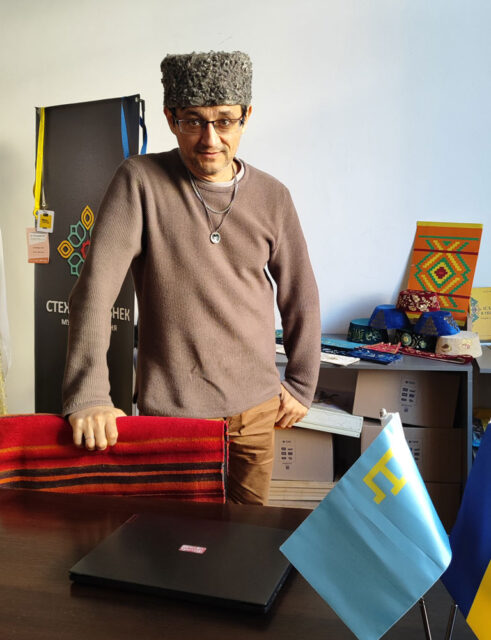
Amet Bekir, Manager of Cultural Events at the Crimean Tatar Cultural Centre in Lviv and Head of the Public Organisation “Areket.” Photo: Kateryna Moskalenets, Crimean Tatar Cultural Centre of Lviv
Illyas was first forced to leave Crimea in 2016. In 2019, he and his family bought a house in Melitopol, hoping to rebuild their lives. “I never imagined living in western Ukraine. I always wanted to be closer to Crimea—its climate, its people, its way of life,” he tells The Ukrainian Week. But when Russian forces advanced on Melitopol, he had no choice but to flee once again. Friends helped his family escape just half an hour before the invaders arrived. They took an evacuation train to Lviv and then a bus to Drohobych—drawn, like so many before them, by the Crimean Tatar community that had been rooted there since 2014.
For Illyas, Drohobych felt different. Unlike in Crimea, where Russian propaganda had long branded Crimean Tatars as traitors, here he encountered no prejudice. “The first thing I noticed was that people here understand this is their land. The local population is more conservative in preserving their identity, their sense of self,” he says.
Illyas Useinov observes that many in Drohobych have a deep sense of place—they know their roots, their ancestors, and the history of their city. Generations have lived here, preserving a strong sense of cultural and national identity. In contrast, he says, Crimea has been stripped of this connection. The majority of its population today consists of Russian settlers with no real ties to the land and no shared historical memory.
“The true roots of Crimea have been uprooted—because they are Tatar,” he explains. “Russian roots, on the other hand, are what we call ‘suitcase—then the train station—then Moscow.’ They come, they take over, but they know it does not belong to them. And that knowledge makes them feel like they’re always sitting on packed suitcases, never fully at home.”
The Crimean Tatar Cultural Centre in Drohobych is more than just a community hub—it’s a space for integration and exchange. One room is equipped with sewing machines, donated through a UN grant secured by a community member. There are plans to hold open workshops where local women can come to sew, socialise, and connect with Crimean Tatar women. The centre also houses a chess club, a computer classroom, and a youth space with table tennis tables, welcoming both community members and locals to interact and learn from one another.
Taste of home
Starting a new business in the middle of a full-scale war is a risk few are willing to take. Uncertainty looms over every decision, making investments of time and money feel especially precarious. But that didn’t stop Ms Lerane. At the end of 2023, she opened Crimean Courtyard, an ethnic café that quickly became a beloved spot in the city for those who appreciate Crimean Tatar cuisine and culture.
Like Illyas Useinov, Ms Lerane has been forced to flee her home twice because of the Russians. She and her family left Irpin for Lviv on 6 March 2022, having already relocated there in 2016 after being driven from her native Crimea. Despite the chaos of the full-scale invasion, she and her son remained calm—partly because of her husband’s military experience, and partly because, as a Crimean Tatar, she had always expected the war to escalate.
“For ten years, I knew this wasn’t over,” she says. “History shows that Russia never stops—whether in Moldova, in Chechnya where there were two wars, in Georgia with Abkhazia, or in eastern Ukraine.”
In Lviv, Ms Lerane and her family found shelter with Oksana Novikova, the Crimean Perepichka bakery chain owner. Later, through Crimean acquaintances, they managed to secure a small but relatively affordable place to live—no small feat at a time when rental prices had soared.
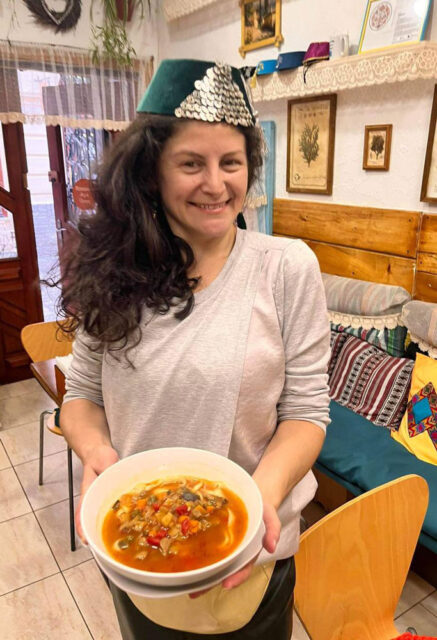
Lerane Kh. opened her ethnic café “Crimean Courtyard” in the midst of the full-scale war. Photo: From the personal archive of Ms Lerane
“These things get sorted out when you actively look for solutions,” she says. “There was no point in complaining or feeling sorry for myself. My husband was already at the front with an airborne assault brigade, and I had no other family around. I had to take responsibility for myself and my child. So, I rolled up my sleeves and got to work. The sooner you start, the better.”
Then came new challenges—her husband’s injury, which drained resources, and repeated attempts to start a business. It wasn’t until the third try that she finally succeeded.
Ms Lerane launched Crimean Courtyard with the help of an Oxfam grant, in partnership with Lviv Bank. The funding was modest, requiring her to invest additional resources into securing premises, equipment, and furniture. But above all, she needed people. Businesses, after all, are built by people. She assembled a team of displaced Ukrainians from Donetsk, Luhansk, Sumy, and Crimea—employees who, like her, were starting over. They learned through trial and error, supporting each other despite the inevitable stresses.
The café continues to grow, though wartime realities mean fewer guests than in peacetime. Ms Lerane also acknowledges a more specific challenge—many men, fearing mobilisation, avoid public spaces, making it difficult to run a delivery service. Still, she remains committed to investing in Crimean Courtyard, ensuring fair wages for her staff, and pushing forward despite the obstacles.
Battling the ‘blind spots’
At the start of Russia’s war against Ukraine in 2014, many Ukrainians had significant gaps in their understanding of the Crimean Tatars and the history of the Crimean Peninsula. While awareness has improved over the years, there is still progress to be made.
Amet Bekir says discussions are currently underway with historian Yaroslav Hrytsak about expanding the second volume of History of Ukraine to include more on the Crimean Tatars. The revised edition is expected to cover their role in the Ukrainian steppe, the history of the Crimean Khanate, and the concept of Khan Ukraine.
“The Crimean Tatars are already part of Ukraine’s historical heritage,” Bekir notes. “Without Crimean Tatars, we cannot fully understand Ukraine’s own past.” But this isn’t just about history—it’s about the present. “In every fifth battalion of the Ukrainian Armed Forces, you’ll find at least one or two Crimean Tatars,” he adds.
There have also been legislative shifts. Speaking to The Ukrainian Week, Kamila Tashieva, the Ukrainian president’s representative in Crimea, says her office helped draft the law “On Indigenous Peoples of Ukraine.” The legislation guarantees the Crimean Tatars, Krymchaks, and Karaites the right to preserve and develop their social and cultural institutions within the Ukrainian state.
In 2023, Ukraine established the National Commission on Crimean Tatar Language Issues to support efforts to revitalise the language. Several universities have since introduced Crimean Tatar courses. “We’re also working to raise awareness among Ukrainians about Crimean Tatar culture and history,” Tashieva says. “It’s an inseparable part of our national identity.”
The dream of return
Everyone The Ukrainian Week spoke to dreams of returning to Crimea—to their parents, families, and loved ones. But they also acknowledge that not everyone will go back.
“I hold on to the hope that my grandchildren will one day see the Crimean Tatar world in Crimea,” says Amet Bekir. He believes the role of the Crimean Tatar community in mainland Ukraine is to preserve and showcase its culture, so those who left can hold on to the hope of returning. “Of all the Crimean Tatars who left in the 18th, 19th, and 20th centuries, 99% never returned. Only some who were deported to Central Asia after the genocide of May 18, 1944, made it back. If we leave Ukraine now, we risk severing our ties completely. But if we stay, we have hope.”
Ms Lerane also dreams of returning. She believes there will be plenty of work to do after de-occupation. “God willing, Crimea won’t be in ruins like Bakhmut, Soledar, or Donetsk. God willing, reestablishing Ukrainian institutions won’t be as difficult, and there will be fewer collaborators to deal with. Either way, there will be enough work for those who return. But not everyone will.”
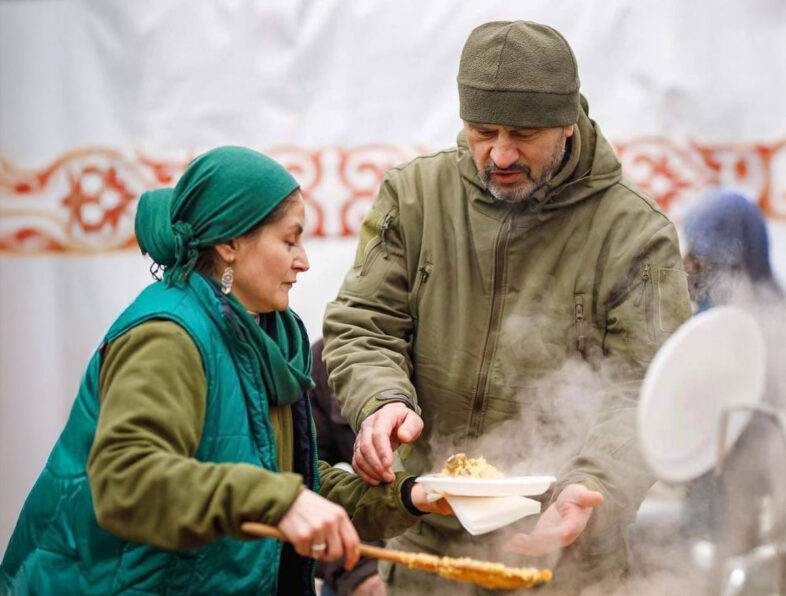
Many Crimean Tatars are fighting in the Ukrainian Armed Forces, with some having sacrificed their lives for Ukraine’s free future. Photo: From Mrs. Lerane’s personal archive
Our heroine dreams of opening a “Ukrainian courtyard” in Crimea — a place adorned with the yellow and blue flag, the Ukrainian anthem, and references to Christian holidays and national memorial days like the Holodomor. It would be a space to tell the story of Ukrainian identity, music, and traditions, inviting people to rediscover Ukraine through its smells, sounds, and tastes. She jokes, “Could there be a Ukrainian burger or borscht-flavoured ice cream?” Then adds, “There’s so much to be done in Crimea to remind the locals about Ukraine.”
For Ms Lerane, dispelling the myth that Crimean Tatars are merely waiting for Crimea’s liberation is crucial. Many, she points out, are already fighting as part of the Ukrainian Armed Forces. She remembers those who died for Ukraine’s freedom, including Gennadiy Afanasiev, Ed Khalinok, and Reshat Ametov — a posthumous Hero of Ukraine — alongside many other fallen or imprisoned Crimean Tatars. These names are spoken of in Ukraine, and they will be remembered in a free Ukrainian Crimea. For Ms Lerane, the work for Ukraine’s future starts now, in the city where she lives, as well as in the Crimea she longs to return to.
And the others interviewed by The Ukrainian Week share her conviction. Only a strong, united Ukraine, with everyone’s combined efforts, will overcome the enemy it faces. We are learning more about one another, growing closer, and working together for the good of Ukraine.