Oleg Sentsov is a well-known filmmaker, screenwriter, writer, and activist. In 2024, his documentary Real, which focuses on Ukraine’s offensive in the Kherson region in 2023, had its premiere at the 58th Karlovy Vary International Film Festival.
Before the film hits Ukrainian cinemas, The Ukrainian Week caught up with Sentsov to chat about making Real, the role of sound in the film, the realities of war, and whether art can actually change the world.
***
— In an interview, you mentioned that making this film was an accident. Can you tell us more about how that happened?
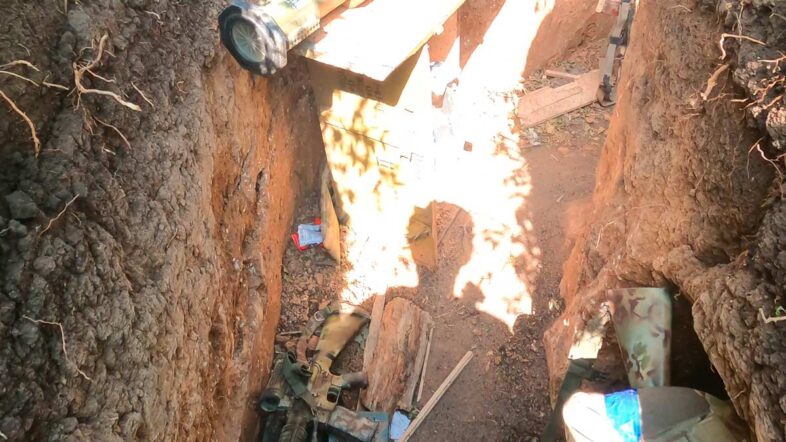
– We call it a film out of habit, but it’s more of a raw recording. It came about by chance during a battle, although the fighting itself isn’t visible in the footage—only the sound can be heard. The camera accidentally turned on while I was checking to see if I’d left it behind when we were evacuating from a damaged Bradley. I didn’t even realize it was recording at the time. Later, when I was going through the files on my flash drive, I found the footage, skimmed through it, and almost deleted it because I thought it was nothing special. But then I decided to watch it more carefully, and memories hit me like a wave. By then, months had passed, and some of my friends from that battle had been killed.
I showed the video to some friends in the film industry and asked if anything could be done with it. They said, “This is interesting and unusual—you should try.” So we focused on restoring the sound, but everything else stayed as it was—no editing or colour correction. GoPro cameras capture very flat audio, but we didn’t want to turn the footage into a Hollywood production by adding sound that wasn’t actually there.
When Real was shown in the cinema, the experience was incredibly powerful. Many of my comrades who watched it instinctively ducked at the sound of incoming shells—it’s pure reflex. The reaction was the same in the trenches as it was in the theatre. The real strength of the film is that it gives viewers an authentic sense of what war is really like—the feeling of being in the trenches, where you see nothing, understand nothing, have no information, and everything is pure chaos. And I don’t want viewers to think the film shows any kind of incompetence—this is just how every battle unfolds.
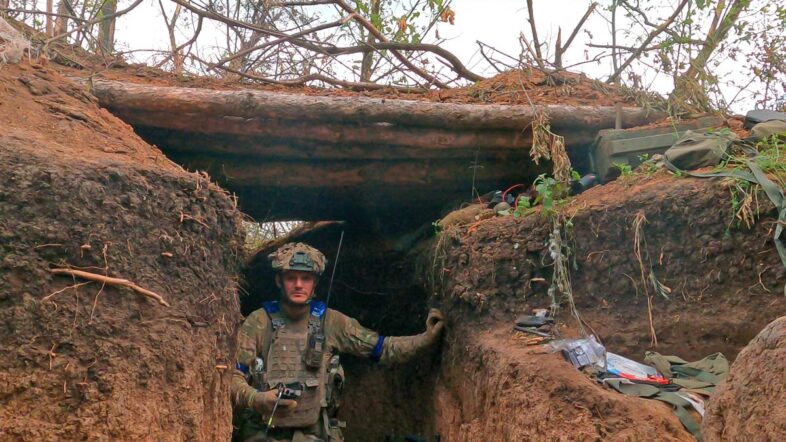
Photo: Scenes from the ‘Real’
— Was the sound just an enhancement of what was already there, or did you add anything from a sound library?
– No, we used the sound recorded by the GoPro and just enhanced it. For instance, if you can hear the Bradley moving nearby, we took that original sound, layered it, and boosted it. It was very detailed work. The sound engineers hadn’t experienced war themselves, so I visited them several times to help them understand what things actually sound like and how to restore them accurately.
The sound in the film is exactly how it should be. If you look at other footage shot by soldiers on GoPros, those videos are often more edited, with a bigger focus on action, but the sound is usually a problem. For example, with drone footage, they always add sound effects because Mavics don’t record audio. But that’s a simpler job—what we were doing was much more complex. Restoring sound to a cinematic level is no easy task.
— Real premiered at the Karlovy Vary Film Festival. How do foreign audiences react to it? From my point of view, it must be tough for people who are far removed from war to really grasp all the realities, abbreviations, and military terms?
– I was curious about that too because, before the premiere, I’d only shown the film to a focus group—mainly fellow filmmakers. At Karlovy Vary, there were 300 people in the audience, including Viggo Mortensen, local filmmakers, critics, and regular viewers—a real mix of people. And 95% of them had no connection to the war. I was really interested to see how they would react, especially since the film is packed with chaotic information. At first, you don’t really understand what’s going on, then you start to make sense of bits of it, and there’s a lot of repetition. It’s already tough to take in just by listening, and on top of that, they had to read a lot of subtitles.
Surprisingly, they responded really well. They understood what was happening because very few films actually show war as it truly is. But this one does. The usual editing and staged scenes you see in films follow different rules, whereas here, the sense of war feels completely authentic. The press reviews were fantastic—not just the usual “Ukraine, war, Sentsov—let’s praise it” kind of thing. No, people genuinely wrote about the film and shared their real impressions. The words that came up over and over were “impressive” and “immersive.”
— Have you had a chance to see other documentary films about this war?
— Unfortunately, I haven’t seen Peaceful People, but I know what it’s about—intercepted conversations between Russian soldiers and their relatives. I heard enough of those at the start of the war when the Security Service of Ukraine was releasing recordings. Those conversations are disgusting—I can’t listen to them for long. That’s why I haven’t watched the film yet. But I did see 20 Days in Mariupol—a very powerful piece of work. I also saw Porcelain War, which is a different kind of film.
— In Peaceful People, the sound isn’t tied to the visuals—it becomes a separate character. Does sound play a similar role in Real?
— It’s not just in my film—it’s a general reality of war. If you’re an infantryman sitting in a trench, you can see very little. Ninety per cent of the information you get in war comes through sound. And the decisions you make based on those sounds determine your life and the lives of those under your command.
— You’ve probably recorded a lot of similar footage. What made you choose this particular piece to turn into a film?
— Honestly, I don’t have that much material. Soldiers usually film everyday stuff—cats, fried potatoes—but when it comes to combat, it’s mostly just GoPro footage. And even then, you have to remember to turn it on, which isn’t always top of mind. Sometimes, the camera shifts—during one battle, I ended up filming an hour of sky and treetops. More often than not, I just forget to record because, as a commander, my main job is leading the team and managing the situation. When something happens, your first instinct is to grab your rifle and radio, not a camera—you’re not thinking like a cameraman.
And even when you do manage to record, battles last a long time. In films, everything happens fast, but the battle shown in Real lasts eighteen hours, and the film itself is only an hour and a half. From the other footage we had, we made two short videos by combining clips from my GoPro and others, editing them into strong stories. I posted them on Facebook in 2023 and 2024—one operation went well, the other didn’t. They were pretty typical; you’ve probably seen a lot like them. But Real really stood out in terms of approach, which is why we decided to turn it into a film.
— There are a lot of documentary films being made right now. How do you decide what should and shouldn’t be shown in this war?
— I don’t really know. How do people die? You don’t always see it. Sometimes, you’re there when a comrade dies. Sometimes, you see injuries. Occasionally, you witness a death, but more often, you hear it over the radio. It’s not like in the movies, where someone steps forward and says, “That’s it, guys, we’re finished, goodbye.” That rarely happens. Usually, someone just stops coming through on the radio, and then there’s silence. Sometimes, that silence lasts for hours, sometimes for days. I had that experience near Bakhmut in 2022. He was a company commander, and we were under his command. He couldn’t reach my dugout because of heavy shelling, so he told me to wait. We were talking about adjustments and other things. Then another guy comes over the radio and says, “Bograt—200.” And that was it. That’s how it happens.
— In your opinion, is it more important to make fictional or documentary films about the war right now?
— I don’t think a good fictional war film can be made while the war is still ongoing. There are examples—Hollywood made some in the 1940s—but those were mostly propaganda and never really artistic. The best war films, both in Europe and America, were made after the war when people had time to reflect and process everything. I’m not in favour of making fictional films about the war right now. This is the time for documentaries, for recording the reality—just go and film. Once the war is over, then we can look back, reflect on memories, add personal insights, and create fictional films.
If you were to show the full truth of war as it really is, it would be horrifying. Not because of the killings, severed limbs, dismembered bodies, or the trenches filled with corpses—that’s not the point. The real horror lies in the injustice, in the awful human reality of war, not just the fighting but the decisions, the events, and the mistakes that lead to tragic consequences. If people knew the kinds of decisions made during war—the unnecessary losses we suffer because of lies, betrayal, ambition, or the willingness to sacrifice others for personal gain—all the filth of human nature—that would be the hardest thing to face. Many veterans don’t want to talk about it, either because they were directly involved or just witnessed it up close. That’s the most unpleasant part of war. The losses—yes, they’re incomparable. But the injustice? That’s the worst.
— Do you think art can change the world? Or at least change a person?
— Cinema, like art in general, is a form of soft power. It works slowly and gradually, shaping the future and always building up over time. It’s not like you watch a film and suddenly become a different person, or that Russians will watch a film about Ukraine and instantly change their views. That’s just not how it works.
When people abroad ask me, “Why did you pick up a rifle instead of staying with a camera?”, I always say: When tanks are rolling through your cities, it’s too late to sing songs—you won’t stop them that way. But songs, art, and everything that represents and supports us and our war are still incredibly important. They help us keep this war alive in our memories and in the memories of future generations.
Still, thirty years from now, this war will be like the Second World War is to us—something distant. It will be like those May school ceremonies, where veterans come to classrooms, rattle their medals, and share stories. After experiencing this war, I understand past wars so much better because all wars are the same.
My film has one goal: to tell the story of this war—to show its horrors, struggles, and injustices—so that we can stop the next one from happening.
***
Oleg Sentsov was born in 1976 in Simferopol. He studied at Kyiv National Economic University from 1993 to 1998, later attending cinematography courses in Moscow. In 2008, he co-founded the company Krai Kinema. His feature film debut, Gamer, premiered at the International Film Festival in Rotterdam in 2012.
A passionate participant in the Euromaidan protests, Sentsov frequently returned to Simferopol after Russia’s temporary annexation of Crimea, where he tried to organise rallies for a united Ukraine and provided essential supplies to Ukrainian soldiers stationed in Crimea. On 10 May 2014, Russian security forces detained him in Simferopol, and by 25 August 2015, he was sentenced to 20 years in a high-security prison on terrorism charges. He was released and returned to Ukraine on 7 September 2019 as part of a prisoner exchange between Ukraine and Russia.
When Russia launched its full-scale invasion, Sentsov joined the Territorial Defence Forces. By December 2023, he had risen to the rank of junior lieutenant in the Armed Forces of Ukraine and was serving as the commander of an assault company in the 47th Brigade.
Sentsov is the recipient of the Sakharov Prize for Freedom of Thought from the European Parliament (2018) and Ukraine’s Taras Shevchenko National Prize (2016). As a filmmaker, he directed Gamer (2011) and Numbers (2019). His film Rhino (2021) won Best Feature Film at the Stockholm International Film Festival.