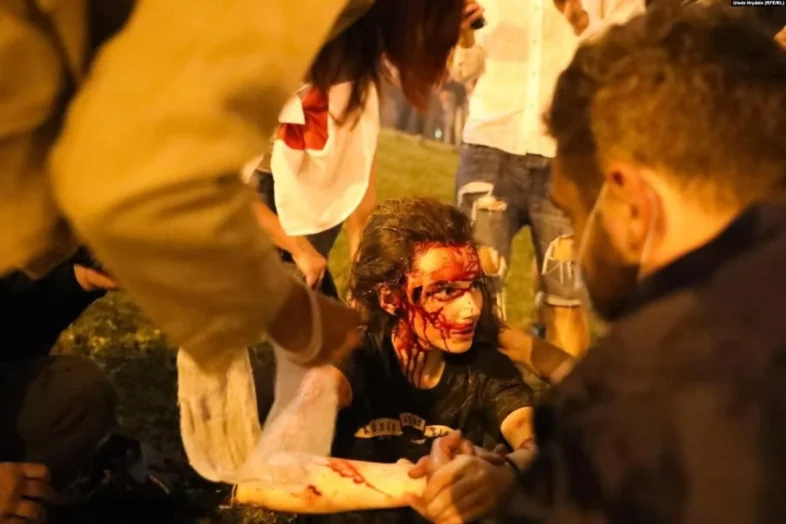
On 17 January 2025, Mariya Zaitseva, a fighter in the 2nd International Legion and a citizen of Belarus, was killed in action on the front lines near Pokrovsk. A passionate activist who had opposed Lukashenko’s regime, Mariya became a symbol of resistance when, in August 2020, a photograph of the 19-year-old, bloodied and wounded, spread across global media. From that moment, her path took her from an exiled activist and volunteer to a soldier, standing at the heart of the largest conflict since World War II. She fought not only for Ukraine but for the future of democracy, the freedom of her native Belarus, and the values of a progressive world threatened by tyranny.
Mariya died in battle, doing what she had always done—fighting for what she believed in—just one day after turning 24.
“She wanted to help those in need”
“Anyone who was part of the 2020 protests or closely followed them in Belarus remembers the photo of Mariya, bloodied and wounded,” says Krystsina Shyianok, former coordinator of the Medevac medical-humanitarian programme in the Czech Republic and director of the Belarusian Democratic Forces Office there. “In Prague, we filed a complaint with the prosecutor’s office about a breach of the arms embargo after discovering that the grenades used by Belarusian security forces were manufactured in the Czech Republic. No violations were found, since such weapons can be sourced through third countries. But it gave us the opportunity to approach the Czech authorities with a proposal to launch a medical-humanitarian programme for those injured in the Belarusian protests. And it was the Czech Republic that became the first to offer state-level support for wounded Belarusian activists.”
Among those seeking help was Mikita, a young Belarusian who had been with Mariya when she was injured by a stun grenade in Minsk on 9 August 2020. The blast left her with a traumatic brain injury, shrapnel wounds to her eye and temple, eardrum damage, and an arm injury. Mikita himself was also hurt by the grenade, Krystsina Shyianok recalls. He came to the Czech Republic with Mariya.
“At first, we didn’t realise she was the girl from the famous photo,” Krystsina says. “She came to Hradec Králové for a dressing change. The doctor asked her what the wound had looked like when she was injured. Mariya went online and showed him that very image. That’s when I realised who we had brought to the Czech Republic. That’s when we first met.”
After completing the six-month Medevac programme, Mariya enrolled in a preparatory course at the Czech Technical University to learn Czech. The university provided accommodation and a scholarship. Unfortunately, she wasn’t able to gain admission after the course due to her hearing impairment—she was deaf in her right ear. Still, she managed to pass her school-leaving exams.
“We were all so proud of her,” says Krystsina Shyianok . “In the Czech Republic, passing these exams as a foreigner opens doors to good jobs. We knew Mariya spoke excellent English and French. Within our diaspora, we found a family where she taught English to children. When Russia launched its full-scale invasion of Ukraine, she redirected all her energy into helping refugees. She joined the organisation Mriya, assisting with welcoming and housing newly arrived Ukrainians.”
Krystsina remembers a time when Sviatlana Tsikhanouskaya visited. Mariya was eager to hear what Sviatlana would say to Belarusians in exile, but that day she had to make a choice—attend the meeting or help a Ukrainian family buy tickets. She chose to help the family. In Mariya’s résumé, one line stood out: “I am looking for a job that will benefit society and allow me to help those in need.”
“I think this really says a lot about her moral compass and humanity,” says Krystsina. “There was a time when Mariya worked in an office, but she couldn’t shake the feeling that it wasn’t doing anything to bring a free Belarus any closer. She wanted to have a real impact on the situation. That’s probably why she chose to go to Ukraine. We all understand that what’s happening in Ukraine is closely tied to what’s going on in Belarus. But that doesn’t mean Ukrainians should carry the burden for us.”
“The sooner Ukraine secures its independence, the greater the chances for Belarusians to win their own freedom.”
“She always believed she could do more”
Mariya joined the 2nd International Legion at the start of 2023. “The commander made me the acting chief medic,” recalls Ales Pyatrauski, a fighter in the Legion. “Then a few guys from the Kalinouski Regiment came over and said, ‘Take the girl.’”
“I needed a medic—at least someone who wasn’t squeamish about blood,” says Ales. “Then she showed up—small, barely 45 kilograms. I had hearing issues myself—concussion, deaf in my right ear. And so did she. Mariya moved in with us, into the medics’ tent. We got to know each other. What struck me right away was her determination: ‘I can do it.’ She trained alongside everyone, practiced shooting, and did everything well.”
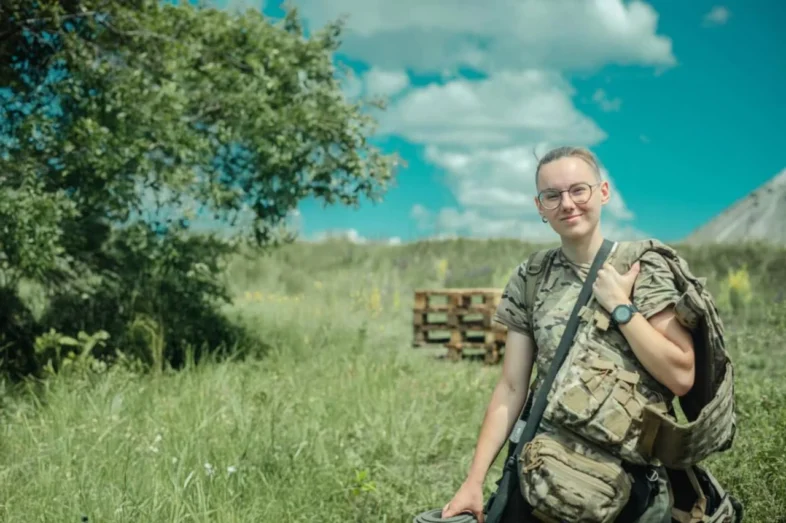
Photo: Alex Zakletsky
Mariya quickly bonded with Ales. Both were Belarusians, both had lost their homeland—they connected on a deeper level. They shared a car, worked in the same unit, and even rented a place together.
“We’re Belarusians, so we didn’t really have a place to store our stuff. We had to carry everything with us,” Ales says with a smile.
Mariya had always dreamed of having a dog, but as a child, she never had one. So, she got a puppy. The little dog was a handful on the journey from the battalion’s base to Kharkiv, getting sick and trying to climb onto the steering wheel while Ales drove. Ales joked that usually, people come back from war with a dog, but Mariya did the opposite. Yet, she managed to fulfill that childhood dream.
In Donbas, they lived together, sharing bunk beds. “Masha was remarkable. She picked up things quickly,” says Ales. “People often say soldiers don’t get enough training—that 90 days isn’t enough. But in reality, even a year isn’t enough. Nor are three.”
You can never truly prepare someone for war; you only learn to adapt. But when you go to war knowing there’s no other option, you teach yourself.
That’s why working with Mariya was easy. She’d return from shooting practice, change clothes, and head straight to tactical medicine training. She threw herself into the cause. She wanted to be useful. Always bright and cheerful.
Mariya’s fluency in English made her a natural bridge between English-speaking foreigners and Ukrainians, or even Georgians, in the Legion. It placed her at the heart of everything—everyone knew her, always with a smile and a friendly word.
Ales had an agreement with the battalion commander: he would set up the medical service and then return to the front lines.
“Masha said she wanted to go to the front too. After all, a medic is just as much a soldier—they just know a bit more about medicine. In battle, every second after an injury matters. So does the confidence of the person providing aid. Mariya never panicked or lost her nerve. The commander didn’t want her going to the zero line. We argue about it now—who had more responsibility. But she carried herself with incredible confidence on the front.”
On her very first day at the zero line, Mariya grabbed a sapper shovel and said, “Well, boys, let’s start digging. If it has to be done, it has to be done.” As one comrade recalled, when she started digging, the rest of the group felt too embarrassed to stand idly by.
Freedom is something a person either has or doesn’t
After being wounded in the arm, Mariya could have taken a discharge. But she refused. This happened in early autumn 2023, and by January 2024—on her birthday—she was back on the front lines.
“Mariya always believed she could do more,” says Ales. “And she always pushed for it. For her, the most important thing was to be useful. Freedom is something you either have inside you or you don’t. She was a free person. She couldn’t understand how anyone could just attack a country like that. She saw the photos from Bucha and Irpin. She couldn’t accept it.
Yes, she fought for Ukraine. But I think, no matter where this had happened, she would have gone there to help. Most foreigners in the Legion joined after seeing the atrocities. We have a guy from Taiwan. He probably didn’t know much about Ukraine’s history, but when he saw the horrors, he couldn’t just stay home. He came.
And, of course, it also mattered that she had been forced to leave Belarus. They pushed her out. You’re twenty years old, just starting out in life with basic ideas about human rights, and then they crush it all and tell you you’re a slave. Go to work and keep quiet. She couldn’t accept that.”
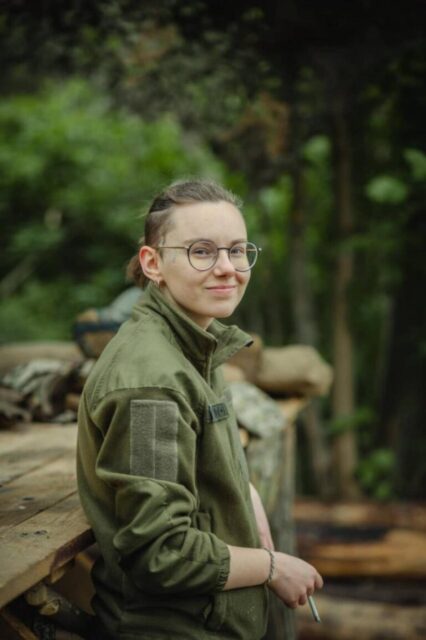
Photo: Alex Zakletsky
Mariya always believed that the only way to free Belarus from dictatorship was to help Ukraine, says Alex (name changed), one of her closest friends in the Legion.
“If Belarusians failed in 2020, then we all had to put everything into helping Ukraine,” he reflects. “She was deeply principled. She fought for freedom, against imperialism. She had a rare empathy and took the news of Russian war crimes to heart.”
When Mariya was wounded in the arm, Alex stayed by her side in the hospital. “I asked her about the future after the injury. She said she wanted to return as soon as possible. Her motivation never wavered, even when her body was struggling.”
Mariya’s story is a powerful testament to how to stand against dictatorship. Nothing was impossible for her. Even after being wounded, she kept fighting. Krystsina Shyianok recalls how Mariya took a keen interest in the Belarusian Latin alphabet, often using it, and spent time studying Belarusian history and traditions.
“People in Belarus now say it’s hard to be born a Belarusian given the circumstances, but you can become one when you make a decisive choice,” Krystsina reflects. “Mariya didn’t need anyone to tell her what to do; she did it all on her own. That was incredibly inspiring. She was so young, yet I never felt the age difference. She was mature—emotionally and intellectually.”
Her voice trembles as she continues, “But, of course, she struggled with post-traumatic stress. Would she have gone to war if 2020 hadn’t happened? If there hadn’t been a dictatorship in Belarus?”
Mariya is the first Belarusian woman to die as a soldier, and her legacy will be etched into Belarusian national memory in that role. But beyond the military-heroic aspect, for me, she is the young woman who championed equal rights and fought for feminist ideals.
Had it not been for Russia’s invasion in 2022, I’m certain Mariya would have dedicated herself to civil society work, pushing for progress. Belarus still has a long way to go toward democracy and understanding of equal rights, and Mariya was a true progressive. People like her are the ones who move society forward. To me, she will always remain a close and cherished friend, someone with whom I shared three remarkable years.
Mariya’s parents wanted her burial to be free of any ties to Lukashenko’s electoral manipulations. And on February 2 (the farewell in Kyiv took place on February 3), is the spring holiday of Gromnytsia [a holiday marking the symbolic meeting of winter and spring, representing a time of renewal, hope – ed.] It’s said that this day marks the meeting of winter and spring, symbolizing hope. Mariya’s death is a national tragedy for us, but I hope it becomes a rallying cry for Belarusians who may be feeling disheartened. There is always room for a heroic act that can change everything.