
The evolving demands of remote warfare have prompted significant advancements in naval weaponry development. In response, the United States, NATO allies, and several other nations are actively working on designing and deploying new unmanned maritime systems, both surface and underwater, for a range of operational purposes. These systems are initially expected to operate with semi-automated remote control, with full autonomy anticipated in the future, reducing the reliance on extensive onboard equipment and personnel. A key benefit of this shift is the enhanced cost-effectiveness it offers.
Unmanned platforms will be distinguished by their versatility, capable of performing diverse missions such as covert maritime patrolling, surveillance, reconnaissance, mapping, mine-laying and clearance, target designation for other combat systems, and even executing autonomous strikes against enemy targets.
For Ukraine, a nation flanked by two seas and whose economy depends on maritime exports, the development of unmanned systems takes on particular importance. Confronted with open aggression and lacking its own fleet, Ukraine faced the looming threat of a maritime blockade. At the onset of Russia’s full-scale invasion, the aggressor, having seized Zmiinyi (Snake) Island, proceeded to block or capture all major Ukrainian ports on the Black and Azov Seas.
Russia’s next move was set to be the landing of a strategic amphibious force in the Odesa region between February and March 2022. To this end, Russia had already concentrated a formidable amphibious group in the Black Sea, comprising ships from three fleets—the Black Sea, Baltic, and Northern fleets—totalling 13 large landing ships. This force was intended to coordinate with ground assault units advancing towards Odesa and with Russian troops stationed in Transnistria, effectively cutting Ukraine off from the sea and compelling it into capitulation.
In this context, the need to counter the Russians at sea became increasingly urgent. Even after the sinking of the missile cruiser Moskva on 14 April—an event that stripped the Russian landing force of air cover—and the Ukrainian Armed Forces halted the enemy’s advance near Voznesensk, the maritime threat remained. To neutralise it beyond the 300-kilometre range of Ukraine’s land-based cruise missiles, a longer-range strike capability was essential.
This ‘long arm of the Ukrainian Navy’ took shape as remotely operated unmanned surface vessels (USVs), which were rapidly developed using civilian technologies and global advancements in the field. According to the Security Service of Ukraine (SBU), Brigadier General, who goes by the call sign Hunter, proposed the concept of strike-capable unmanned surface drones. His innovative solution involved equipping the USV with a Starlink terminal to establish a satellite communication and control channel.
At the SBU’s (Security Service of Ukraine – ed.) request, Vice Admiral Oleksiy Neizhpapa, Commander of the Ukrainian Navy, assembled a team of experts to help develop the first prototype of the strike-capable unmanned surface vessel and its remote control system.
The design drew inspiration from a Canadian civilian jet ski, powered by a robust Rotax gasoline engine and featuring a water-jet propulsion system at the stern. The drone’s hull was crafted from lightweight aluminium and plastic, ensuring agility and durability. Its bow housed an explosive charge—either a 100- or 250-kilogram aerial bomb—fitted with two contact detonators that triggered upon impact with an enemy ship’s hull, detonating the warhead. The remote control system was designed to guide the 5.5-metre drone towards its target from distances of up to 400 kilometres, enabling precise long-range strikes. The first prototypes were tested as early as July 2022.
In parallel, Ukraine began training operators and established the world’s first specialised units dedicated to the combat use of unmanned maritime platforms. Initially, these units were part of the SBU and the Defence Intelligence Directorate (Group 13). By August 2023, the Ukrainian Navy formalised this initiative by creating the 385th Separate Brigade of Special Purpose Maritime Unmanned Complexes.
The first operation involving Ukraine’s new unmanned maritime weapon was set for the night of 17 September 2022, targeting the flagship frigate Admiral Makarov in Sevastopol Bay. However, just as the drones entered the operational zone, the Starlink system’s signal unexpectedly vanished, severing communication and control. According to those leading the operation, this disruption was allegedly the result of an order from SpaceX CEO Elon Musk, who reportedly instructed that the system be disabled, citing his reluctance to “participate in an operation against the Russian fleet and escalate the war.”
While the Pentagon later pressured Musk to restore Starlink coverage over Crimea under an existing multimillion-dollar contract, the initial attack was effectively thwarted. In addition, one drone was shot down by enemy aircraft and detonated at sea, while another lost control and ran aground near Sevastopol, falling into Russian hands. It is likely that the Russians carefully examined this unexpected capture and drew important lessons from it. Faced with the increased risk of maritime threats, the enemy was expected to bolster defences around Sevastopol, prompting Ukraine to accelerate preparations for a more extensive strike.
On the night of October 29, 2022, the world saw a historic moment—the first-ever coordinated attack involving both aerial and maritime drones on a heavily fortified naval base. While nine airborne drones drew attention and created confusion, seven unmanned boats stealthily targeted Russian vessels anchored off Sevastopol. In a highly precise manoeuvre, two or three of these boats slipped into North Bay, launching direct strikes on ships docked at the piers.
Footage of the attack, released by Ukraine’s Ministry of Defence, offers a clear view of the operation’s impact. The maritime drones caused significant damage, hitting at least three ships, including the frigate Admiral Makarov, the minesweeper Ivan Golubets, and a landing ship. The footage also captured a fire at a fuel and lubricant storage facility.
The real success of the Sevastopol attack lay not in the material damage inflicted but in the strategic message it sent—one that forced the enemy to confront a new and urgent threat. By 17 November, a Ukrainian maritime drone had even reached the port of Novorossiysk, further underscoring the growing reach of the threat.
In response, the enemy was compelled to take swift action. Aviation, including helicopters, was effectively deployed against maritime drones, while physical defences around Sevastopol and other key ports were reinforced. Each sortie or return to base by the Russian fleet became a comprehensive operation, involving aircraft and combat boats to secure its vessels.
Advancing drone design
Following the initial deployment of maritime drones, it became clear that several key improvements were needed, including addressing the insufficient warhead weight, limited operational range, and the need for enhanced stealth capabilities in the hull design. These considerations were quickly incorporated into subsequent models, which were adopted by units of Ukraine’s Defence Intelligence (Magura V5) and the Security Service (Sea Baby).
The Magura V5, measuring 5.5 metres in length and 1.5 metres in width, has a displacement of 1,000 kilograms. It cruises at a speed of 22 knots, with a maximum speed of 42 knots and an operational range of 833 kilometres. With a payload capacity of 320 kilograms and an endurance of up to 60 hours, the drone is equipped with advanced navigation via automatic GNSS, inertial, and visual channels, and can transmit up to three HD video streams.

Magura V5, displayed at the National Military-Historical Museum of Ukraine. Photo provided by the author
Developed in November 2022 by SpetsTechnoExport, the Magura V5 is designed not only for strike operations but also for observation, reconnaissance, patrol, search-and-rescue, and counter-mine missions. Its key advantages lie in its stealth, manoeuvrability, and the simplicity and innovation of its design. Even the enemy has taken note: two Magura V5s were captured in November 2023 and May 2024 under various circumstances, underscoring the effectiveness of the platform.
The Sea Baby, a versatile unmanned surface vehicle (USV) developed by the SBU, distinguishes itself with slightly larger dimensions—six metres in length and a displacement of up to five tonnes. It carries a warhead weighing 860 kilograms. The platform offers multiple configurations, including versions equipped with four RPV-16 flamethrowers, six launch tubes for Grad multiple rocket launch systems, a remotely operated 12.7-mm machine gun, and systems for transporting and deploying two non-contact bottom-laid naval mines. Its control and navigation systems mirror those of the Magura V5, providing a consistent operational framework.
In addition, the SBU has developed the high-speed USV Kozak Mamai, also measuring six metres in length. Featuring a bulletproof hull and a 450-kilogram warhead, the Kozak Mamai is not only a formidable strike asset but can also serve as a relay station for reconnaissance or as a launch platform for other weapon systems.
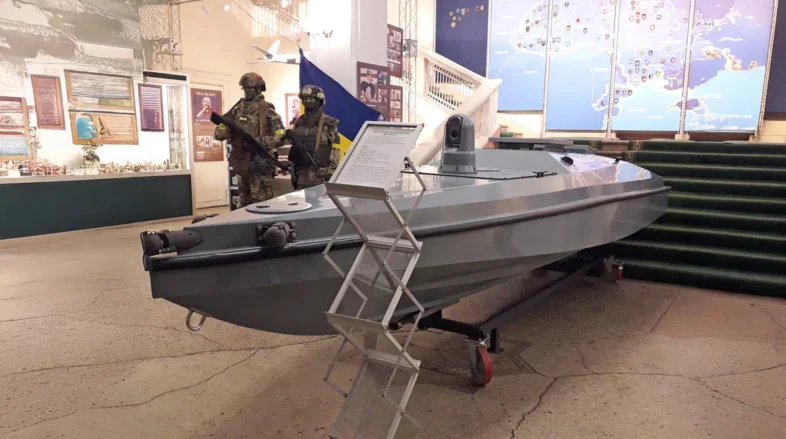
Magura V5, on display at the National Military-Historical Museum of Ukraine. Photo provided by the author
In early June 2024, details emerged about the Stalker 5.0, a new unmanned surface vehicle (USV) with a five-metre length, over 1.2 metres in width, and a 60-horsepower engine. With a maximum speed of 40 knots and a cruising speed of 30 knots, it boasts an operational range of 600 kilometres. Its warhead weighs 150 kilograms. The Stalker 5.0 is versatile, capable of functioning as a logistics platform for delivering weapons, equipment, and supplies, as well as conducting reconnaissance and patrolling coastal areas and rivers. While its specifications fall short of the Magura V5, it offers significant cost advantages, priced at $270,000—almost five times cheaper.
On 6 March 2024, General Hunter unveiled another innovative unmanned platform, the Avdiivka. Larger in size and capable of carrying various types of weaponry, its payload capacity exceeds 1,000 kilograms, with an operational range exceeding 1,000 kilometres. Although the exact details remain undisclosed, it is likely that this platform is designed to carry FPV drones, as suggested by a video released by the Ukrainian Navy in December 2024.
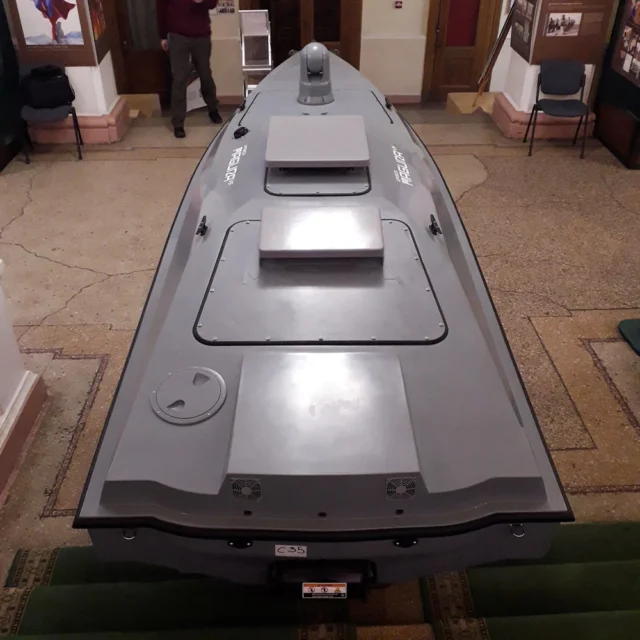
Magura V5, exhibit at the National Military-Historical Museum of Ukraine. Photo provided by the author
British naval expert H. I. Sutton, drawing on available footage from the Ukrainian Navy, has reconstructed the design of Ukraine’s new unmanned platform. This “pocket aircraft carrier” or “drone carrier” is capable of carrying four FPV drones, stored in a hangar located at the centre of the hull. Retractable hatches enable copter-type UAVs to launch directly from the hangar and return after completing their mission.
The stern features a dedicated compartment for powerful explosive charges or naval defensive mines, and the platform can also be equipped as a kamikaze drone, as indicated by the contact detonators in the bow section.
With the introduction of maritime platforms capable of carrying FPV drones, the scope of selective targeting extends beyond enemy ships to other critical assets such as radar stations, air defence systems, coastal airfields, and even helicopters that pose a threat to Ukrainian attack boats. Furthermore, the geographical reach of these strikes will not be confined to temporarily occupied territories.
Drones on the offensive
Within a year of the first combined air-naval operation against Sevastopol, expert estimates suggest that Ukrainian maritime drones launched 52 attacks, 8 of which were considered successful. The scope of these operations expanded across nearly the entire Black Sea region.
On May 24, 2023, three unmanned Magura V5 boats targeted the Russian reconnaissance ship Ivan Khurs near the Bosporus, successfully damaging it. This marked the first attack on a manoeuvring target capable of returning fire. Despite this, one of the boats successfully struck the Ivan Khurs on its port side.
On July 17, three Sea Baby drones detonated, causing significant damage to the Kerch Bridge supports. Initially, the strike group consisted of five drones, which could have intensified the attack. However, three of them were redirected to target the frigate Admiral Essen, which unexpectedly entered the operational area. Unfortunately, the drones failed to catch up with the frigate, having exhausted their fuel. As a result, they were unable to participate in the strike on the bridge or return to base, leading to their destruction at sea via detonation.
Sea Baby is also credited with carrying out the world’s first successful remote mine-laying operation at sea. According to General Hunter, the operation involved a specially modified unmanned boat designed to carry two bottom mines. Operating under the cover of night between its base and the Crimean coastline, the boat secretly mined the approach channels and even the outer raid of Sevastopol. During one mission, the boat was detected by three Raptor patrol boats. After striking one with a grenade launcher, it managed to successfully evade pursuit.
According to The Wall Street Journal, a significant minefield of 15 mines, each containing 180 kilograms of explosives, was set up off Sevastopol. These mines were responsible for damaging four Russian vessels in 2023: the missile corvette Samum (September 14), the patrol vessel Pavel Dzerzhavin (October 13), the rescue tug Professor Nikolai Muru (October 13), and the mine countermeasure ship Vladimir Kozitskiy (October 27).
Foreign sources report that Ukrainian maritime drones have also targeted the central part of the Black Sea, notably the route known as “the Syrian Express.” This route is used to supply the Russian expeditionary force in Syria and to transport ammunition from Syria to Crimean ports.
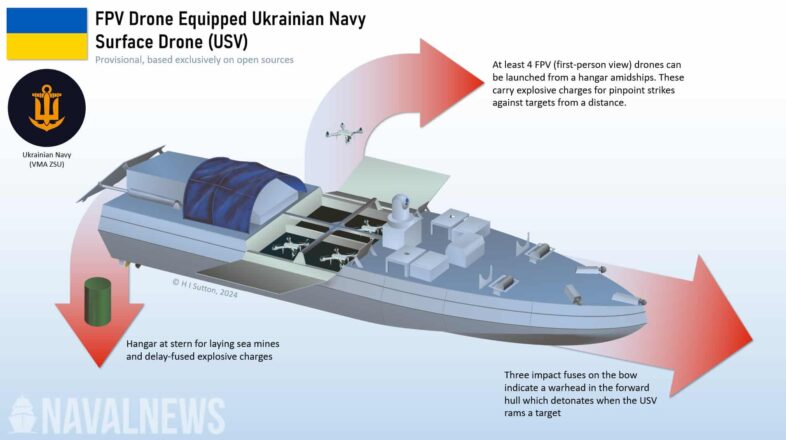
The appearance of the new Ukrainian maritime drone carrier for FPV drones, graphic by H.I. Sutton
On August 1, Ukraine’s Defence Intelligence Directorate boats struck the patrol ship Vasily Bykov in this area, which was escorting the vessel Sparta IV from the Syrian port of Tartus to Sevastopol.
On August 4, the new Kozak Mamai maritime drone launched an attack on the Novorossiysk port raid, severely damaging the RoRo ship Olenegorsky Gorniak. The vessel was saved from sinking only due to its proximity to the port, where rescue boats swiftly arrived and towed it to safety. The following day, on August 5, another Kozak Mamai detonated near the sanctioned tanker Sig in the Kerch Strait, causing significant damage. The Sig had been supplying aviation fuel to Russian forces in Syria.
On August 17, Russian forces reported an attack by Ukrainian boats on the frigate Pytlivyy, which was escorting a cargo ship arriving from Syria. Then, on September 14, in the same region, Ukrainian boats struck the patrol ship Vasily Bykov once again.
The night of September 24 saw a more decisive strike, as Magura V5 drones sank two Russian landing craft in the port of Chornomorsk on the western coast of Crimea, along with their crews and equipment.
By 2024, Ukrainian maritime drone operations saw a sharp rise, with tactics evolving in bold new directions. Operators from the Defence Intelligence Directorate’s Group 13 shifted from simply damaging enemy ships to fully destroying them. Each combat group typically now consisted of 5 to 6 Magura V5 drones.
On the night of February 1, 2024, near Lake Donuzlav, Ukrainian maritime drones successfully attacked and sank the large missile boat Ivanovets. Two weeks later, on February 14, they struck the landing ship Cezar Kunikov in open waters near Alupka. Then, on March 4, they hit the patrol vessel Sergey Kotov near Kerch.
In all three incidents, the attacks were carried out at night from multiple directions, targeting moving vessels that were manoeuvring and returning fire. This approach forced the enemy’s onboard fire systems to divide their efforts, reducing the risk of being hit by the attacking boats. The first blows were aimed at the sterns of the ships, where the propeller-rudder complex is located, causing a slowdown or complete stoppage of movement. Subsequent drones targeted the damage caused by the initial strikes, ultimately sinking the ships.
In addition to these attacks, maritime drones have been deployed for a variety of combat roles. Since May 23, 2024, several Sea Baby boats, equipped with six launchers for the Grad multiple rocket launch system, have been providing fire support for Ukrainian naval infantry, launching missile strikes on enemy positions at the temporarily occupied Kinburn Spit.
On the night of December 6, 2024, the Sea Baby boats, armed with 12.7mm machine guns with remote automatic targeting, opened fire on Russian planes, helicopters, and Raptor-class boats in Kerch Bay, which were attempting to intercept them. At least one Russian helicopter was damaged, and crew casualties were reported.
On December 7, 2024, a group of Ukrainian Navy unmanned boats launched a targeted strike on three stationary gas extraction platforms in the Black Sea, off the coast of temporarily occupied Crimea. These platforms had been used by the enemy to deploy reconnaissance equipment, including radar and electronic warfare systems. What marked this attack as a significant development was the use of FPV drones, launched from the decks of at least two new types of maritime drones.
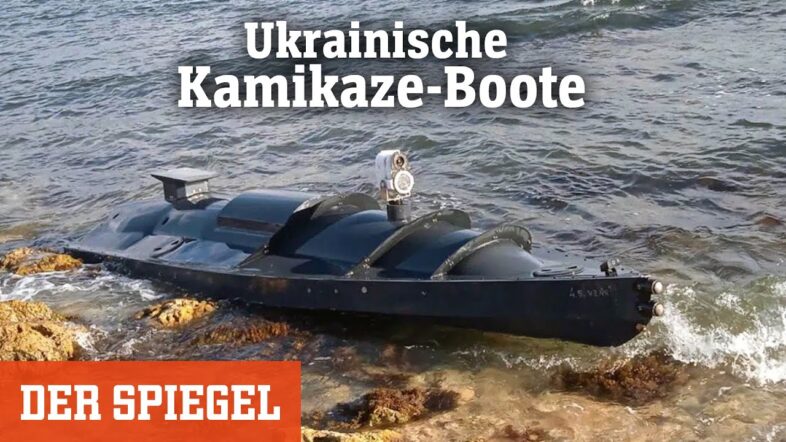
“Ukrainian Kamikaze Boat” – the cover of the German magazine Der Spiegel
The first platform was destroyed by two kamikaze drones, which detonated near the supports. The second platform was hit by a single drone. For the third, a combination of strike methods was employed. Initially, an FPV drone equipped with an airburst system targeted Russian soldiers on the platform who were attempting to return fire with small arms. After this, the platform was destroyed, though reports differ on the exact method: one version suggests explosive charges were used, while another points to a kamikaze drone. In each case, powerful explosions ignited fires and led to the collapse of the structures into the sea. Drones sent into the air also captured footage of the aftermath.
On December 31, 2024, on New Year’s Eve, Ukrainian boats—this time a modified version of the Magura V5, each equipped with two short-range P-73 surface-to-air missiles—successfully destroyed two Russian Mi-8 helicopters near Cape Tarkhankut, along with their crews. This outcome was a significant achievement for the developers of the modification, addressing the critical challenge of protecting surface drone groups from enemy aviation.
The success came after a failed attempt in May 2024, when the first use of surface-to-air missiles from a maritime drone ended in disappointment. Following an unsuccessful missile launch, the drone targeted a Ka-27 helicopter with its machine gun but sustained damage and was ultimately captured by the enemy in a semi-destroyed state.
Future prospects
According to leading foreign experts, Ukraine is increasingly poised to emerge victorious in its maritime confrontation with the enemy, largely due to the widespread deployment of maritime drones, which have had a profound impact on the overall operational landscape. The weakening of the enemy’s fleet has, in turn, enabled Ukraine to break through the naval blockade and successfully restore its crucial maritime exports—particularly grains and industrial goods.
Since March 2024, the threat of maritime drone attacks has forced Moscow to abandon its Black Sea route to Syria, dealing a significant blow to Russian logistics. Now, all shipments along this route are being diverted on much longer detours, bypassing Europe and travelling through the Baltic and Barents Seas instead.
The design and performance of Ukraine’s maritime drones are attracting keen attention from leading foreign experts, including those in the United States, who have awarded them high praise. The proven success of Ukrainian-made military equipment, including these drones, suggests strong export potential for the sector. The Magura V5, recently showcased at international defence exhibitions and now available for export, could mark the beginning of this promising development.
At the same time, the war continues, and new challenges require the further development of forces and capabilities. It is logical to assume the possibility of equipping maritime drones with torpedoes, including anti-submarine weapons, strike cruise missiles, reconnaissance tools, and electronic warfare systems, which would increase the effectiveness of their use as part of drone operations.
An important objective for Ukraine’s Defense Forces is neutralising enemy missile-carrying vessels, particularly submarines. Following a traditional approach, the fight against these threats, involving various forces and aviation, should begin at the enemy’s shores—specifically from Novorossiysk. In this context, Ukrainian underwater drones like “Marychka” or “Toloka,” which were first reported in development in 2023, are expected to play a crucial role. These underwater strike drones offer a more covert means of operation, allowing them to launch surprise attacks on enemy vessels as they enter or exit their bases, where they are more vulnerable than in open waters—particularly in areas involved in Kalibr missile launches.