
In 2021, Ukraine was a global leader in grain exports, ranking among the top five countries. Ukrainian farmers were equipped with modern machinery, grain ports were being upgraded, and new silos were rising in the fields. Ukrainian grain once reached far and wide, from Spain to China, with the country serving as a key supplier of bread to several African nations. But since the full-scale invasion, wheat exports have dropped to a ten-year low. At the same time, Russian forces continue to sell stolen grain from occupied territories while systematically destroying vital agricultural infrastructure.
The attacks on ports, elevators, and power plants, the blockade of ships, and the occupation of a fifth of Ukraine’s agricultural land have been part of Russia’s strategy to disrupt global grain supplies.
The impact was immediate: grain prices surged globally, and a promising grain deal was signed. Yet, just one day after the agreement to create a safe maritime corridor was made, Russia attacked the port of Odesa. Soon after, the Kakhovka Hydroelectric Power Station and irrigation system were destroyed, followed by further strikes on the newly built river port in Izmail. Ukrainian grain has become a prime target for the Russian military. As the war drags on, Ukraine has lost some of its key markets, with Russian grain pushing Ukrainian exports out of Africa.
Nevertheless, farming businesses continue to operate in frontline areas. Agrarians are returning to deoccupied cities, rebuilding their operations, and tackling the immense challenges—destroyed equipment, mined fields, and staff shortages—in order to keep going.
Partyzanske
The village of Partyzanske, situated 50 kilometres east of Mykolaiv, endured eight months of relentless shelling, leaving most of its houses, the school, and the cultural centre damaged or destroyed. The barrage came from the frontline to the south, including from the village of Blahodatne, where Volodymyr Pradun’s farm — the hero of this story — is located.
The bus to Snihurivka, which left the Mykolaiv bus station at eight in the morning, was nearly empty. Transport like this is rare in these parts. The well-maintained road to Snihurivka stands in stark contrast to the nearby stop, its walls pocked with holes from a former checkpoint. Behind it, once-vibrantly painted iron gates now stand rusted, riddled with bullet holes and shrapnel marks. Beyond the gates, the skeletal remains of rooftops emerge, some patched with plastic and boards. The buildings’ walls are scarred, and the edges of the streets are torn up, pitted with holes and mounds of earth. In the yards, the twisted remnants of burned tractors and vehicles lie scattered.
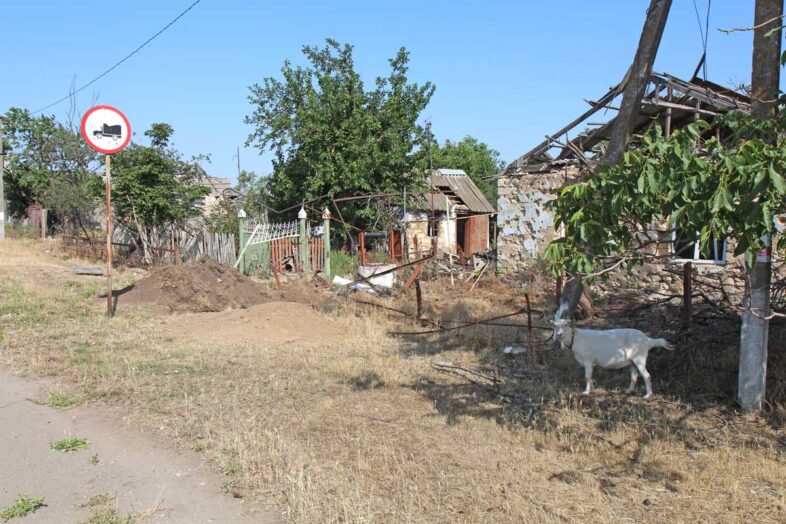
At first glance, Partyzanske seems deserted. Behind a collapsed fence, a dog barks, and in the shade of the remaining trees, goats seek refuge from the sun. Further down the street, a well-kept yard stands out—its houses repaired and a flower bed by the fence still thriving. A man watches cautiously from behind an old car, eyeing the surroundings for a long time. In another yard, a pile of grain and a tractor in use signal that some form of life continues here. Fields stretch out from all sides, with vast expanses of sunflowers and grain.
Once neighbouring villages now divided by the frontline
Beyond the village, the ground is pockmarked with shell craters. The houses give way to storage buildings, their remains scattered across uncultivated land, with tall grass and ruins. Amidst this, a new white power pole rises, stark against the yellowish backdrop of dry grass and weathered walls. To reach Blahodatne, another six kilometres on a dirt road remain.
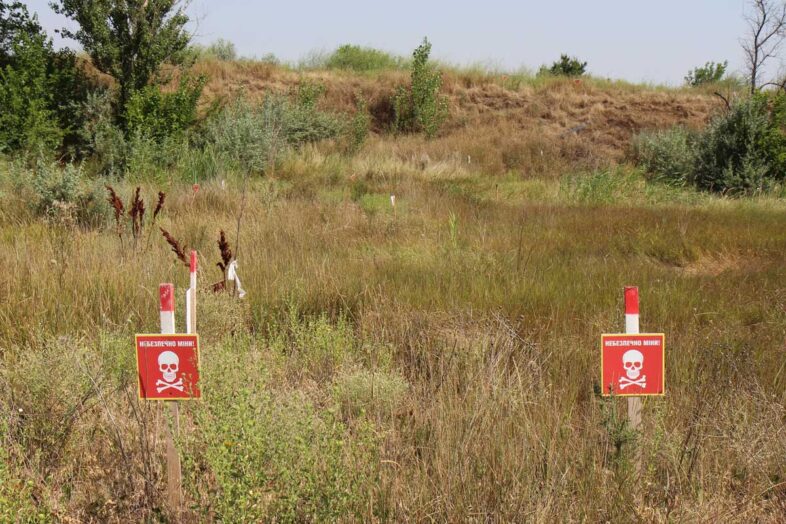
The edge of the road is flanked by sunflower fields, with a plantation marking the beginning of a “Danger, mines!” sign, warning of the high grass and dense undergrowth ahead. These signs are posted along the road, a constant reminder of the dangers lurking in the landscape. After 40 minutes of walking, the first sign of life appears—two tractors with tanks making their way towards the highway. On the back of one tractor is another “Danger, mines!” sign, perhaps repurposed from a nearby post, carried by the driver as though it were a badge of honour, a mark of having navigated these perilous areas.
The plantation ends at a canal, spanned by a new bridge. A sign beside it explains that this strategically important bridge was destroyed by Russian forces in April 2022. But by May 2023, soldiers from the 36th Road Restoration Konytup Regiment had rebuilt it. The sign concludes with a message of gratitude for the servicemen and everyone contributing to the rebuilding of Ukraine.
It was just after nine in the morning, yet the sun blazed relentlessly. Beyond the bridge, an old Moskvitch sat with its hood up, while two elderly men tinkered with the engine. Both had grey hair, deep tans, and the kind of calm resilience that comes from enduring harsh sun and years of experience. To them, the heat didn’t seem as threatening as it did to the car.
As we approached Blahodatne, the number of mine warning signs grew. Remnants of rockets and twisted metal littered the grass, and the charred remains of trees lined the roadside. The traces of battle were especially evident on the straight stretch between Blahodatne and Partyzanske, where the road and fields stretched out flat, making it difficult to approach unnoticed.
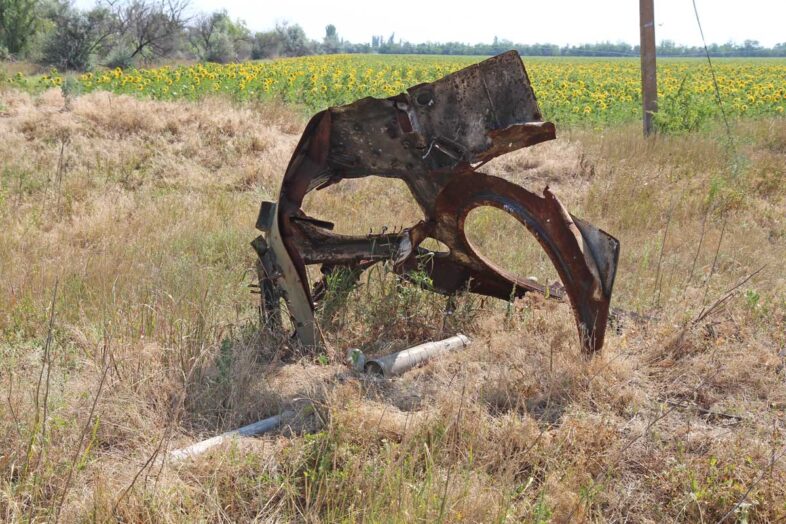
Two kilometres from the village, a military vehicle’s remains lay abandoned by the road. A charred piece of metal stood out, its hatches marked by deep circles, with scattered shell casings on the grass. The village finally came into view. The flatness of the land made it feel as if there was no way to approach without being seen—no place to hide from a bullet on this open terrain.
Blahodatne
Blahodatne was occupied in August 2022. The fierce battles that followed left their mark, damaging or destroying every building in the village. The bridge that connected it to the road to Mykolaiv was ruined, local farmers’ equipment was burned, and the fields were mined. The village was finally liberated on November 9, 2022.
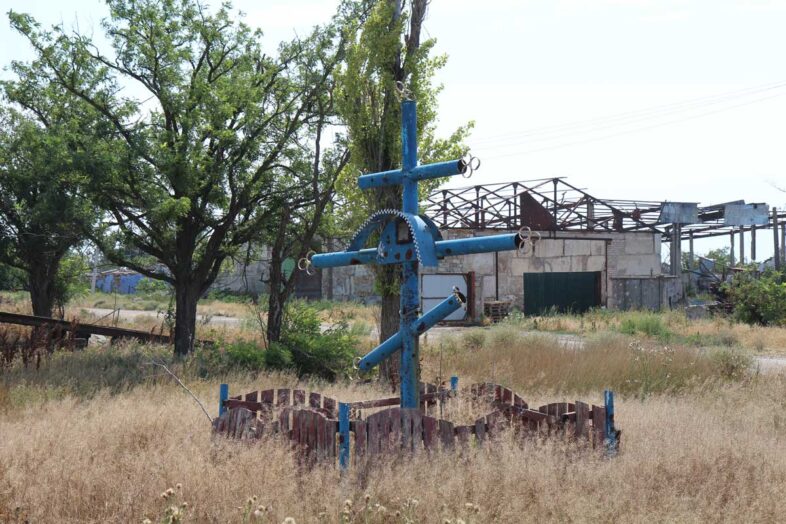
As we approach the village, a sudden grinding sound breaks the stillness. It’s a rhythmic, high-pitched noise—metal scraping against metal. At first, it sounds like someone is working in the village. Near the entrance, a metal cross stands. Its surface is pockmarked, and the canopy, intended to protect the icon from the elements, creaks and sways in the wind.
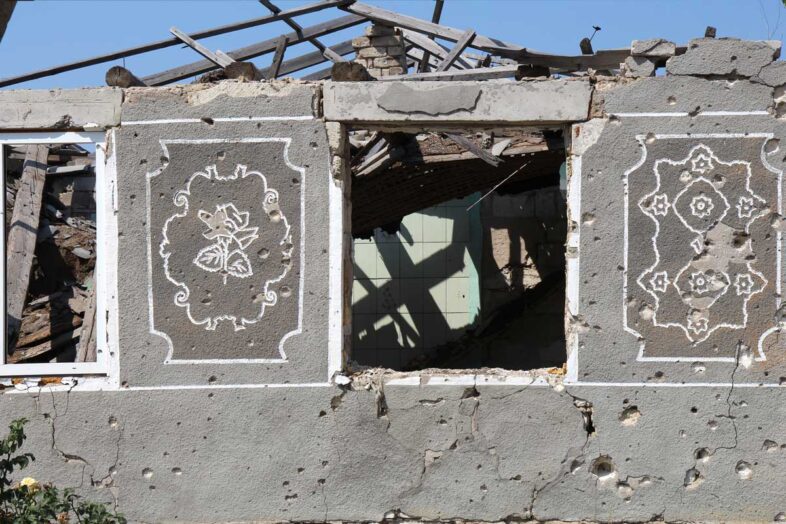
Blahodatne is in a worse state than Partyzanske. The houses don’t just have damaged roofs; some have none at all, with entire walls missing. In the most devastated parts of the village, only the charred remains of fences and fragments of walls remain to mark where homes once stood. Yards are overgrown with tall grass and weeds. At the village’s edge, burned-out equipment and vehicles are gathered in a grim pile.
There’s no surviving equipment or signs of farmers’ activity, but scattered grains lie on the ground. As I walk through the village, a few newly built and repaired small houses come into view. There are no mine warning signs here. The locals explain that where the grass has been trampled, it’s safe to walk, but in other areas, it’s better not to take the risk.
The first to enter the liberated village were the deminers from Ukraine’s State Emergency Service (SES). Locals say they arrived, cleared the mines, and showed farmers how to handle the situation. They explained which shells and fragments could be safely removed and which ones should be left untouched. Once the SES finished their work, the electricians arrived. “We didn’t think they’d be able to restore power, but they did an amazing job — everything was fixed quickly,” says one farmer. Against the backdrop of charred ruins, a new transformer stands as a stark reminder of the village’s resilience.
Blahodatne’s most resilient farmers
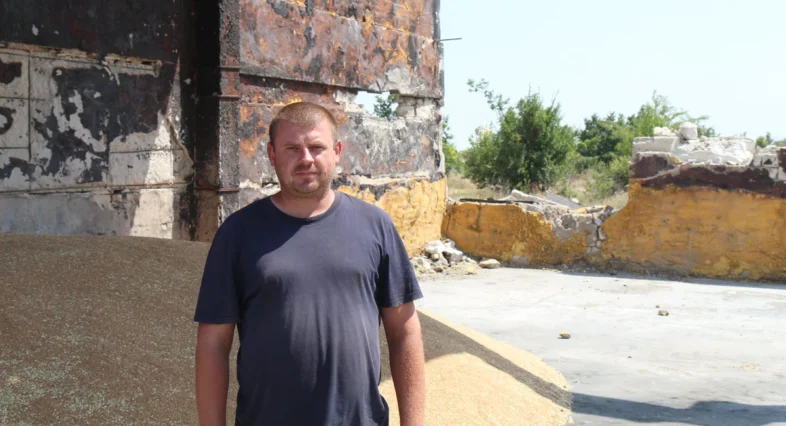
Roman Pradun runs the agribusiness with his father, Volodymyr, a farmer of 15 years. On the day we met, the Praduns were in the midst of harvesting wheat. It was around 10 AM when they returned from the field—not because they were finished, but because their machinery had broken down, and they needed to quickly repair it. Before the Russian invasion, Volodymyr and Roman had managed to amass a fleet of their own equipment, which they used to independently cultivate and irrigate vast areas. But none of it survived the occupation. Roman gestured toward the piles of scrap metal in the yard and said, “That’s all that’s left.” The machinery they managed to buy after the occupation, funded by hastily gathered resources, is already falling apart and in need of repairs.
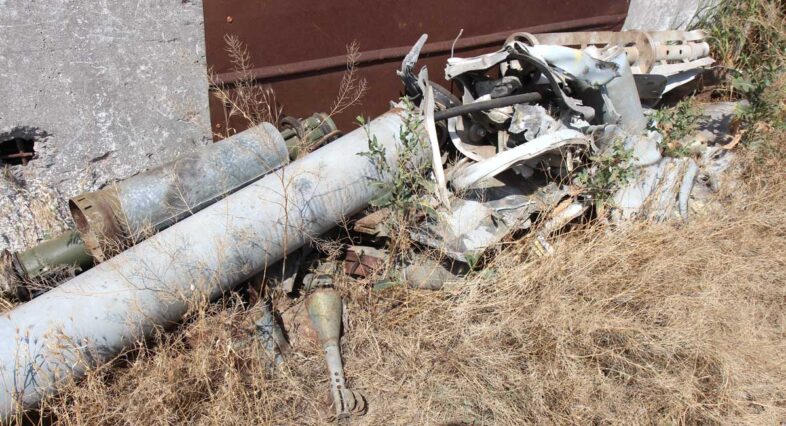
Near the warehouses, charred equipment sits in heaps. Among the wreckage of several destroyed tractors, there’s a burned-out Russian armoured personnel carrier. Roman points to piles of shells near a damaged fence, where fragments of Russian Kalibr missiles lie next to remnants of other rockets, shells, and tank mines. The special services have taken the engine, but the missile hull is still lying under the fence.
Roman speaks highly of the demining team from the State Emergency Service (DSNS), recalling how they taught him and his father the proper way to handle explosives and what not to touch. Despite the guidance, there were still times when they had to clear mines by hand, pulling out mortar shells, Russian Smerch rockets, and Grad missiles. Some shells detonated, but Volodymyr shrugs it off, saying, “Thank God, we only lost two tyres and a window from those explosions.”
Roman and his father tackled the demining together, carefully clearing the fields by hand. He shows me a video on his phone of them gingerly lifting warhead shells they’d dug up, and another clip where they’re pulling a rocket out of the ground, inch by inch, using a rope. Without proper equipment or refrigerators, the Praduns have learned to adapt to power cuts. They have a generator—a gift from English volunteers—that helps them keep things running when the grid fails.
But the real challenge is getting drinking water. The wells that once served Blahodatne are now destroyed, though volunteers have begun efforts to restore them.
Beyond the charred machinery, the ruins of a hangar stand, nothing left but a skeletal frame with perforated gates. Russian soldiers once used it as a hideout. Volodymyr discovered remnants of their equipment and rations. When Roman speaks of the enemy, his anger is unmistakable—these are not just some faceless and nameless invaders to him. He recalls finding an abandoned enemy drone in the grass. The memory card contained conversations and faces of the Russian soldiers. Roman handed the drone over to the Security Service of Ukraine (SBU), knowing it could help identify them.
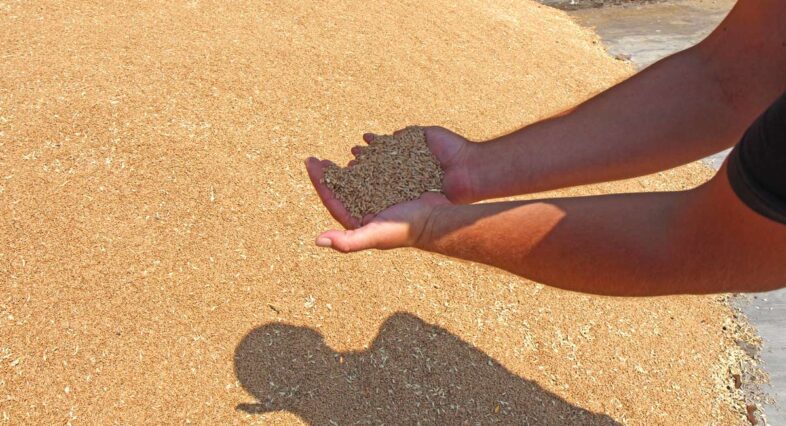
We walk from the hangar to the ruined vegetable warehouse, a place that holds special significance for the Praduns. Roman speaks of it with particular sorrow. He and his father built the structure with their own hands, designing it with thick walls and proper ventilation to store perishable crops. It allowed them to weather price fluctuations and increased their income. Now, near the destroyed walls, a pile of freshly harvested grain sits, waiting for the next planting season.
Those same sturdy walls were used by the Russians. Inside the warehouse, Roman found remnants of both Russian and Ukrainian soldiers’ equipment. He points to scratched words on the charred wall: “Fuck you Nazis, ZOV” [three capital Latin letters Russians use to identify their military vehicles – ed.] — a message left by the Russians. Roman’s voice hardens as he says, “This is all they’re capable of. It’s not scary. We’ll rebuild. And we’ll rebuild it better, in spite of them.”
Other farmers have had more luck, Volodymyr says. They’ve received equipment through American grants. When asked if they had tried borrowing equipment from others, he responds, “Everyone’s dealing with their own problems.” Today, the lack of machinery to irrigate the land is a growing concern, especially with the threat of a record-hot summer. There’s also a shortage of workers. Before the war, Volodymyr employed 30 people from the village. Now, his team consists of just two locals and a combine driver. Roman recalls that before the war, the village was full of life and growth. Thanks to the farmers, there was work year-round. No land went uncultivated. Now, the area is overtaken by wild grasses, with red signs warning of mines at every turn.
We move from the warehouse toward the nearby wheat field, where work is still in full swing. The combine is harvesting the last 30 hectares of grain. Volodymyr’s father briefly pauses to speak with me before returning to his task. Roman, too, steps aside every so often to take calls about the harvest. With the end of July’s work in sight, there’s a lot to do. The grain the combine collects must be weighed and transported to the elevators. As the day wears on, the sun climbs higher, its heat intensifying.
On top of the combine sits a young man, the driver’s assistant. He only climbs down when it’s time to unload the grain, but for the most part, he stays perched high above, bathed in waves of scorching air.
Throughout our conversation, Roman frequently mentions Ukrainian soldiers—expressing gratitude for those who defended the area and sorrow for the wounded and the fallen. “Our workers, those who have been wounded, those we no longer hear from,” he says quietly. Many former workers, now fighting, have expressed a desire to return to work after their service.
Many residents of Blahodatne took the opportunity to leave when housing certificates for Mykolaiv were offered, leaving the village with a shortage of people to help rebuild. This stands in stark contrast to the neighbouring Partyzanske, where recovery is more underway.
In the background of our conversation, the distant sound of explosions punctuates the air. The front line lies just 40 kilometres from Blahodatne. The Praduns not only have to remain cautious of unexploded ordnance left behind by the Russian occupation but also of new threats from incoming shells. “Many pieces of metal in the ground appeared after the occupation,” Roman says, his voice calm but resolute. When I ask him about the progress since returning to Blahodatne, he simply replies, “The main success is being alive and healthy.”
The Praduns offer to give me a lift to the main road, sparing me an hour and a half’s walk through the field in the sweltering heat. As we say our goodbyes, Volodymyr shakes my hand. His palm is large, dry, and warm, like soil that’s been baked by the sun. We part ways, and Volodymyr dives into the tall grass at the field’s edge. A moment later, he emerges, water dripping from his face. “There’s a canal behind the grass,” Roman explains. Refreshed, Volodymyr returns to his work.
The Praduns lament the low prices for grain. With the warehouses destroyed, they can’t sell their harvest gradually for a better price. Instead, all the grain must be sold immediately to the elevators. They hope the profit will be enough to cover debts, repair equipment, manage the winter’s potential blackouts, and prepare for the next season. Beyond the risk of running an unprofitable business, there’s also the ever-present danger to their health and lives—working in de-occupied areas just 40 kilometres from the front line.
By November, Roman reflects on the harvest this season. It’s been a tough year, he admits, with grain prices still stubbornly low. The need for new equipment and support—currently only coming from volunteers—remains urgent. On the bright side, all of the Praduns’ farmland has been demined, though there are still plenty of dangerous areas on the outskirts of Blahodatne. Roman and Volodymyr are already preparing for the next season: over 200 hectares of winter wheat have been planted, and in the spring, they plan to grow onions, beets, potatoes, and pumpkins.
Farming while Russian forces continue to shell ports and elevators takes courage. But will farmers in the Mykolaiv region continue to take that risk? The piles of grain destined for planting in a destroyed warehouse, and the freshly cultivated hectares surrounding it, suggest that they will. Is this grain needed? “Yes,” answer both the Russians—who had sold a billion dollars worth of stolen Ukrainian grain by the fall of 2024—and the Ukrainians, who are striving to boost exports despite the ongoing war. Amid it all, the Praduns continue to rely solely on their own strength and resources to sustain their business.
***
The material was published as part of a joint special project by The Ukrainian Week and the School of Journalism and Communications at UCU.