You won’t find much coverage of Kharkiv in the French, Spanish, German, or British media. The city remains largely invisible because it’s difficult to comprehend how its residents manage to carry on with their daily lives and cultural pursuits amidst the constant backdrop of death, the destruction of homes, and the reality that some must seek refuge in subway stations. This stark reality is hard to grasp from a distance. In late spring, just before Ukraine’s largest book festival, Book Arsenal in Kyiv, Kharkiv’s Factor-Druk printing house fell victim to Russian missiles. This facility, among Europe’s largest with a complete printing cycle, served nearly all Ukrainian publishers. The assault tragically claimed the lives of 7 employees, injured 22 others, and obliterated over 50,000 books. Initial estimates suggest Ukrainian book production could plummet by 30-40% as a consequence.
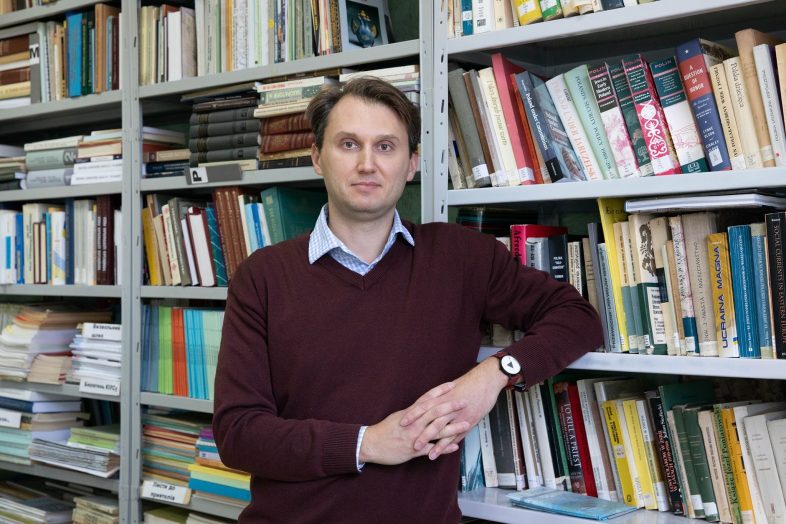
For The Ukrainian Week, I interviewed Oleksandr Savchuk, a publisher based in Kharkiv and the founder of his own publishing house. We delved into how he continues his work amidst ongoing attacks, the cultural legacy of the 1920s, and the resilience needed to live and work in Kharkiv without losing hope.
Fortress City
According to Oleh Syniehubov, the head of the Kharkiv Regional Administration, over the past six months, Russians have launched 100 missile attacks on Kharkiv city and nearly 2,000 strikes on the region, including 750 guided air bombs.
What would someone drinking coffee in Paris or Milan feel if they heard, saw, or read about this? These attacks on Kharkiv happen almost daily, yet the city and its residents carry on living. This is not a metaphor; the people of Kharkiv continue to live. Neither pain, losses, fear, rage, nor another ruined part of the city simply disappear. They remain, often as wounds inside, which Kharkiv stitches up as it continues to fight, again and again.
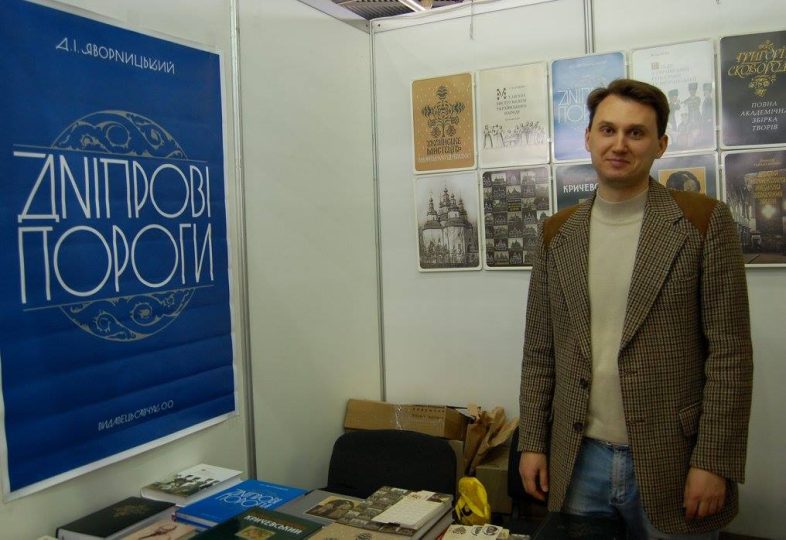
Publisher Oleksandr Savchuk caught my attention long ago due to his active participation in the city’s cultural processes. The books he publishes often address forgotten or censored topics in Ukrainian history and culture, philosophy, cultural studies, the history of Kharkiv and its region, and other parts of Ukraine. He is also someone who creates a true meaning through the books and projects he undertakes.
As he describes it, “The mission of the publishing house is to revive the golden names of Ukrainian science, culture, and art from oblivion.”
How the publishing house Oleksandr Savchuk Publisher was created
– In 2010, I started the publishing house, the Oleksandr Savchuk Publisher. It all began because, as a teacher, I needed certain books for my personal use that weren’t readily available. There was some ethnographic work that required numerous trips to the library. By 2005, I had already been working as an editor for various publications, not just designing but also editing and preparing books. Although I’m a polytechnic engineer by training, this may sound strange to some, but publishing isn’t just about proofreading new texts. It’s about being a cultural manager. I was also fortunate that I wasn’t focused on the commercial aspect. What mattered the most to me was that the book existed, and I immediately engaged in the process. This is not a typical story in that regard.
Many publishing houses aimed to have scientific departments but achieved little. The Krytyka and the Rodovid had funding. There are also university-based publishers like Laurus and Akta.
“Non-market books” in the book market
– There is sometimes support from sponsors for certain projects. But overall, I’m fortunate that no one dictates what I should do. Sometimes I miss things, sometimes, I make mistakes, and sometimes I regret not doing something. These are all very dynamic processes.
Essentially, the market doesn’t dictate to us, but we rely on it. Books need promotion, and I don’t know how to do it. I’ll probably never learn how to make all these TikToks and videos. I had a hard time getting into Instagram. I thought it was unnecessary, but over time, it has yielded results. Actually, we don’t have a PR manager either. I do everything myself.
Over time, we’ve reached a critical mass. I call it the “golden thousand readers.” If they exist, then I know there’s a market for the book. If you include working with archives and sending people on business trips, it’s also a self-sustaining process. I mostly did it myself. I don’t know how I managed it. Now, looking back, I realise I was lucky to have an apartment and supportive parents. Knowing I wouldn’t go hungry was also a form of support. And that’s how it went. These books turned out to be long-lasting. We’ve even had to reprint some editions.
On expansion and new editions
– A new generation is emerging. Yet, it all started with books that I personally felt were lacking—a common story in business. Around 2015, I noticed a crucial moment when the “The World of Slobozhanschyna Region” series, focusing on the Kharkiv region, was severely limited. Few in Kharkiv were reading Ukrainian studies literature, and two local publishers focusing on regional topics had closed.
That’s when I understood the need to broaden our scope. It was a significant step forward, seeing books on Hutsul culture, Kyiv, and more being published in Kharkiv. It felt like I was affirming my own sense of integrity. Remember the slogan “Ukraine is united” in 2014? People started rallying behind it, offering their own projects in support. Authors began to join us, sharing our vision for what could be achieved together.
Today, it’s all coming together, gradually proving that Kharkiv isn’t just a region that does something—it thrives culturally. While Lviv and Kyiv host numerous cultural events, Kharkiv’s focus is primarily on book publishing.
Of course, there are always challenges and uncertainties about what comes next. Currently, several projects are nearing completion, prompting me to think ahead about what to do next.
How to plan when missiles are flying over our heads
– In general, having a plan is crucial for our survival. Long-term planning significantly extends our lifespan. I realised the importance of various collaborations and having a team to work with. There are times when I feel overwhelmed, unable to keep up with everything I need to read, see, and follow.
I have individuals handling technical tasks, and I hire proofreaders and designers. Most book layouts are done by me, which saves a lot of time. For critical projects, I now hire additional help. We don’t operate from a traditional office where everyone gathers, which simplifies matters greatly. However, today, this can also be a drawback. In the past, during survival mode, it worked well. In the current context of war, remote work might not be a bad idea either.
Moving forward, we need fresh ideas and younger individuals who understand current interests. Currently, this balance is somewhat skewed. Hiring full-time staff could disrupt this delicate equilibrium. So, for now, I negotiate with myself that this approach is likely optimal. Sometimes I dive deeper into projects, other times I rely on previous publications to sustain us.
On the personal wellbeing and working under attacks
– The entire workflow shifts dramatically during wartime. Our printing house has been frequently targeted; our car was damaged, and there were moments when I narrowly avoided being hit myself. Sometimes, all plans are disrupted—you intend to go somewhere, but circumstances prevent it, leaving you reluctant to venture out. Instead, you find yourself sitting at home, gathering your thoughts. That’s the impact of war.
However, communication remains crucial. We can source paper or materials from Italy, ensuring the printing house continues to function. Initially, it was dormant for 2-3 months, but it resumed operations around May or June. While we initially hesitated to transport materials to Kharkiv, we managed to overcome those obstacles. There were memorable moments, like bringing a book on February 22 and then restarting operations by June. It proves that work can continue despite challenges.
Art residencies in Kharkiv
– Since 2021, a literary residency has been established in Kharkiv through joint efforts, starting at the apartment of the prominent linguist Yurii Shevelov. Another residency has opened in the “Slovo” building, originally a residence for writers built in the 1920s. Both residencies are managed by the team from the Kharkiv Literary Museum, with writer Serhiy Zhadan (currently serving in the Armed Forces of Ukraine) and publisher Oleksandr Savchuk also involved. The Naboka family, Kharkiv businessmen, have generously supported these projects by purchasing both properties.
And what about Shevelov’s apartment now? I remember when you opened it. How is the process going now?
– It continues, with some new residents joining us. The Kharkiv Literary Museum, a co-founder of the apartment, has played a central role in this initiative.
And with the «The Word» House as well, right?
– Yes, that’s right. These two residencies are currently 99% managed by the Kharkiv Literary Museum. They secured grants for this and meticulously scheduled residency terms throughout the year. They’ve handled all the logistics and operational management. Zhadan and I offer our support through technical assistance and occasional consultations. The Literary Museum deserves credit for their outstanding work in managing these residencies. Tetyana Pylypchuk, the museum director, shows exceptional dedication—I would even say he’s passionate about it.
Many say that Kharkiv is the publishing capital of Ukraine. Can you say that?
– This statement is somewhat conditional because, firstly, the publishing houses in Kharkiv aren’t exclusively local; they operate as national publishers. We produce numerous books distributed throughout Ukraine. Comparatively, in Lviv, there are many smaller publishers focused on Lviv and Western Ukraine. Kyiv, on the other hand, serves as a major administrative hub with numerous large publishers.
While Kharkiv can be considered a publishing capital, this doesn’t necessarily mean it is the primary centre of book publishing in Ukraine. However, it stands out as one of the most significant hubs on Ukraine’s book publishing map.
Have you ever found yourself feeling pessimistic about Kharkiv’s future? It’s a city where evacuations are underway, which is alarming, and yet there are also significant artistic projects, breakthroughs, and people who choose to stay and continue living actively. Have you ever woken up and pondered the possibility that your city might cease to exist? Or do you actively resist such thoughts?
– No, I haven’t found myself dwelling on such thoughts thus far. However, I’ve begun to recognize areas where we may have vulnerabilities. What concerns me may not necessarily resonate with others. This particular aspect doesn’t weigh heavily on my mind. I have other questions I ask myself, especially as long as I see opportunities to continue our work.
We all understand our reasons for remaining in Kharkiv. While one can envision promising prospects in Kyiv, our long-standing presence here gives our existence a deeper meaning. I’m aware that we are under scrutiny—not just our publishing house but also the state of culture, education, theatres, and other institutions. This scrutiny indicates that Kharkiv hasn’t merely transformed into a military outpost but retains elements of a classical city, where deeper significances persist despite challenges. Recently, we discussed whether one could strip away essential components of a city and still consider it a city. It appears that as long as the cultural institutions endure, hospitals and utilities remain essential but secondary. However, personally, the absence of a philharmonic, theatre, museum, or bookstore feels like a significant loss in the city’s fabric.
Surviving on basic needs might suffice, but fundamentally, this isn’t about your essence, nor about Oleksandr Savchuk Publisher…
– Yeah, I’ve also thought about this, how it somewhat contradicts Marx’s concept of the superstructure and the base, that this cultural component is implicitly present, at least for people born now.
For me, all these basic things have always been instrumental in supporting my work in this cultural sphere. That’s how I see myself. I understand not everyone views it this way. Sometimes, we forget that we’re either reproducing or creating something and need to keep that in mind constantly. Like someone attending a book fair once a year, buying five books, and maybe that’s all they read. Or others who don’t read at all. Or maybe they never go to the cinema, not even for a film like ‘The Slovo House,’ which explores the 1920s generation in Ukraine and how the Soviet government largely wiped them out.
Let’s discuss the generation of the 1920s-30s, whom we refer to as the Executed Renaissance. Do you sense a cyclical nature in history? Have you pondered this? Do you get that feeling—of repetition, perhaps? And can you envision an alternative history for these individuals? Was there a possibility, under those circumstances, for them not to trust the Soviet regime and to choose not to come to Kharkiv? It was often a matter of collaborating with the regime or disappearing in some form. How does the situation compare today?
No, I don’t see such cyclicality. It appears to me more of a linear progression, and currently, we don’t witness such a pattern. It’s true that certain aspects of Russia’s actions today echo those of the past. My perspective on this is rather straightforward.
After 1991, the so-called right-wing idea gained prominence in Ukraine, which portrayed fighters for independence as heroes who sacrificed for the nation, while those who collaborated with authorities were deemed villains. This simplified narrative is unfortunately reflected in films like “The House of Slovo.” As a result, I see that period as far more complex. Socialism was widely embraced during that time, and many people openly embraced leftist ideologies they saw as viable. For many, being part of the Soviet republics represented a form of formalized Ukrainian identity. Les Kurbas, for instance, was among those who could be seen as advocating for Ukraine’s independence. There may be hints of this in his final diaries, and there were many others like him. Therefore, I believe there were numerous aspects that were not fully understood at that time—a period filled with many unknowns and complexities.
In November, we had a meeting with Yaryna Tsymbal, who researches the generation of the 1920s, and we discussed Terentiy Masenko, a poet, journalist, and author who wrote memoirs about the Executed Renaissance. Despite surviving, he authored several books, including works on Ukraine. I asked Yaryna how he managed to survive, and she simply said he wrote good poetry, leaving aside the details of his collaborations or circumstances. Interestingly, his daughter, Larisa Masenko from Kyiv-Mohyla Academy, is still alive.
During times of war, people often portray themselves as patriots, but motivations can vary greatly depending on their psychological makeup and how they perceive themselves. Phrases like “dying for Ukraine” carry profound weight. I recall when I began learning ‘kobzarism’ [playing the kobza, a traditional Ukrainian instrument – ed.] and visited a master to craft an instrument, he solemnly remarked that a war with Russia would inevitably come, and we might find ourselves wielding machine guns while he carved a bandura. It was a stark reminder of differing perspectives. Indeed, there were those who viewed such scenarios as imminent realities, and this readiness had its significance. Yet, how individuals behave in such critical moments reveals much about their character and personal circumstances, such as family dynamics.
Over time, I’ve refrained from harshly criticizing the events of the 1930s without fully understanding the context. Whether examining literary, philosophical, artistic, or biographical aspects, people prove to be far more complex than simply black or white.