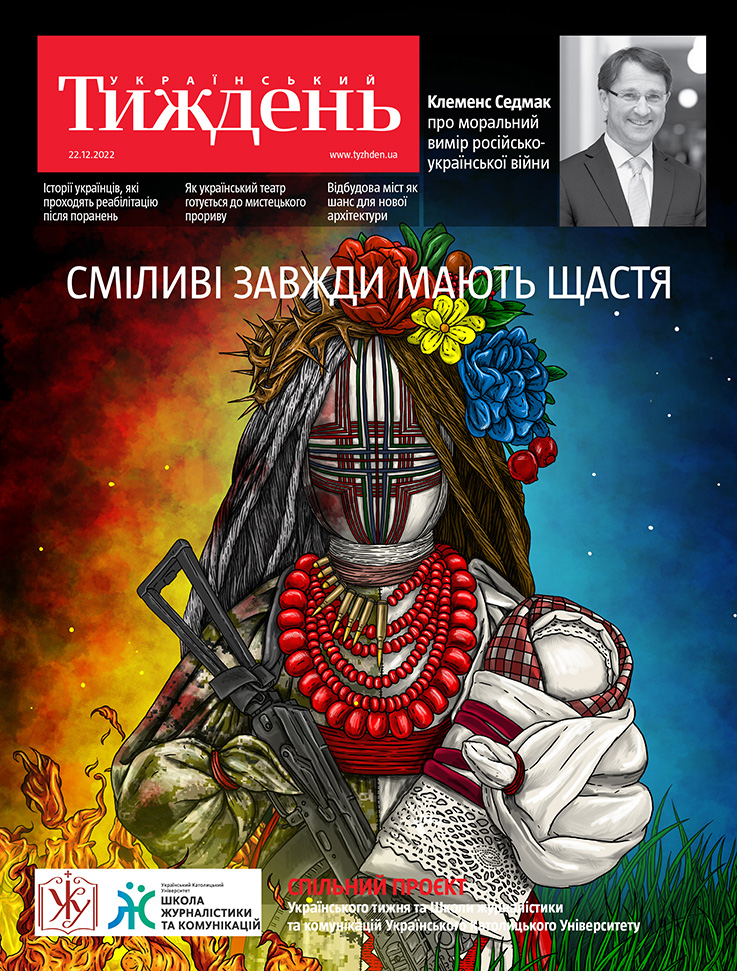
“You, Fortune, be kind,
For your game is but a pastime —
To bloom, to embrace,
Though I must tell you —
I do not seek the yoke of love,
For my age is still young…”
— Anna Stanisławska,
from “Transaction, or The Description of the Whole Life of One Orphan”, 1685
These are the words of the so-called “Kyiv Witch” — a lady-in-waiting at the court of King Jan III Sobieski of the Polish-Lithuanian Commonwealth. Her real name was Anna Stanisławska, and by the end of the 17th century, she had become a recognised poet with a reputation as colourful as her verse.
The nickname “Kyiv Witch” clung to her throughout her life, largely thanks to her origins and a string of ill-fated marriages. Her father, a Polish noble, held the ceremonial title of voivode of Kyiv — a post that outlived the Commonwealth’s actual control over the city. It’s unlikely that Stanisławska ever set foot in Kyiv, but the association stuck, woven into the myth of her identity.
She was branded a witch not for any arcane dealings but for the scandal that seemed to follow her. She married three times, and each union ended in misfortune. Her first husband, according to contemporaries, lost his mind — it was the king himself who intervened to arrange a divorce and free her from the marriage. Her second and third husbands died soon after their weddings. In the eyes of society, it was tragic — but also irresistibly dramatic. This air of sorrow and mystery only added to her literary allure.
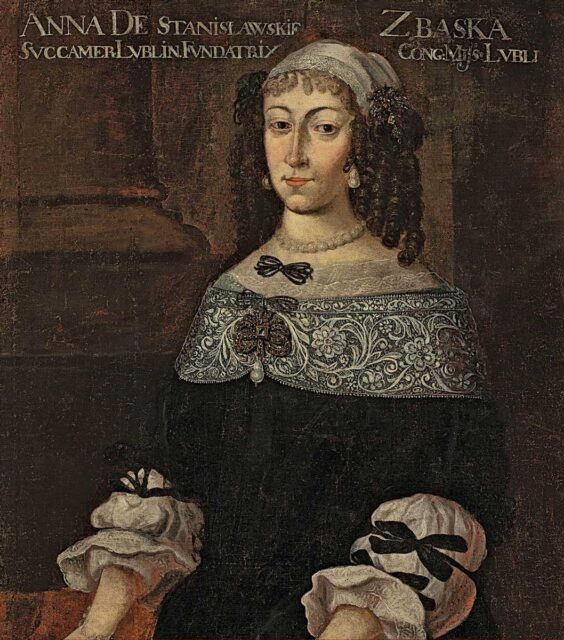
A fourth marriage was unlikely. Under the rules of the Commonwealth, remarrying after three failed unions would have required special permission from the Church. Instead, Anna came under the protection of Queen Maria Kazimira, which gave her the freedom to focus fully on her writing. Her most celebrated work, Transaction, or the Description of the Entire Life of One Orphan, first published in 1685, secured her place among the most accomplished poets of the Polish-Lithuanian Commonwealth — a woman whose verses captured both the personal and political entanglements of her age with rare precision and passion.
The Ukrainian presence in female Baroque literature is far more substantial than often recognised. Many of the next generation of women writers either came from Ukrainian lands or had Ruthenian roots. These were not anonymous voices — most published under their own names, and many belonged to prominent, well-established noble families.
Their chosen language was Polish, the lingua franca of the royal court and a gateway to influence. Writing in Polish not only broadened the reach of their work but also underscored their place within the elite cultural circles of the time. While questions of national or ethnic identity were far more fluid in the 17th and 18th centuries, and these women may not have fully defined themselves in those terms, what they did claim — with clarity and confidence — was the right to write. In a literary world dominated by men, that in itself was a powerful act of defiance.
“A beauty that time cannot erase”
Those were the words of Hetman Ivan Mazepa at the christening of Franciszka Urszula Wiśniowiecka-Radziwiłł — a girl born in the shadow of the Great Northern War, with a future no one could yet imagine. Mazepa, Ukraine’s formidable Cossack leader became her godfather, though the ceremony was far more than a family affair. Ursula’s father, Janusz Antoni Wiśniowiecki, and her grandmother, Princess Anna Dolska — a sharp-witted 45-year-old and agent of the Swedish King Charles XII — used the occasion for political manoeuvring. Amidst the festivities at the palace in Bila Krynytsia near Dubno, secret negotiations began between Mazepa and the Swedish crown, with Princess Dolska serving as the go-between. It’s unlikely Mazepa ever laid eyes on his goddaughter again. But his words proved prophetic: Ursula’s beauty — and more importantly, her intellect — has not faded with time.
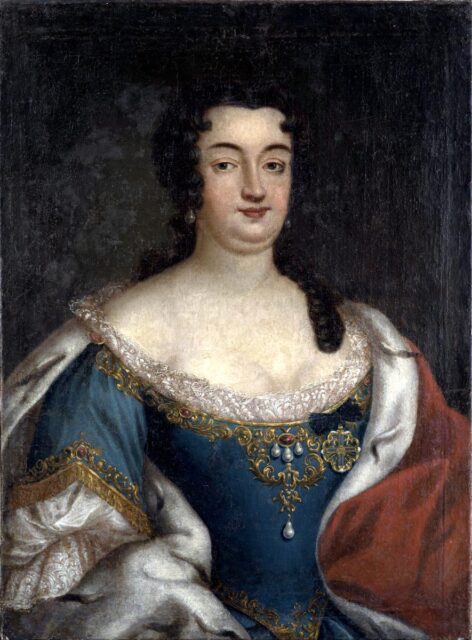
Franciszka Urszula Wiśniowiecka-Radziwiłłwould go on to become the first known female playwright in the history of Ukraine, Poland, Lithuania, and Belarus.
Sixteen comedies in the tradition of commedia dell’arte are attributed to her, and she even founded a theatre in Nesvizh, now part of Belarus. Her literary gifts may have been inherited. Her father, Janusz Antoni, was the author of the Diariusz, a vivid and revealing chronicle of noble life in the Polish-Lithuanian Commonwealth. The only daughter of Janusz Wiśniowiecki and Teofila Leszczyńska, Franciszka Urszula was raised in luxury and surrounded by attention. Suitors lined up to marry her, but the young woman was selective — throwing tantrums and even fainting to avoid a match. Everything changed when the eloquent Michał Radziwiłł appeared among her suitors. He too had a flair for literature, and won the heart of the twenty-year-old princess with his heartfelt letters. They married in 1725, and their correspondence suggests that, at first, both found the match satisfying.
In the early 20th century, publicist Berthold Merwin wrote of Franciszka Urszula: “Nature was stingy with her beauty; instead, she made up for it with sharp intellect and aesthetic sensitivity.” She had a gift for words, and her wide-ranging knowledge allowed her to take on ambitious projects. Franciszka Urszula was fascinated by Molière’s plays and translated them from French into Polish. She also wrote poetry on various subjects. In her salon, which drew members of the artistic elite, she often recited her own verses. Her works included pious advice for teenage girls and songs about modesty and decorum. Yet she also wrote witty poetry about how men should attend to their wives’ pleasures, both in the bedroom and beyond. Polish publicist and historian Alojzy Sajkowski believed that Ursula “held rather coarse views, and it was surprising that the girls in the salons could listen to her without embarrassment.”
Such a promising start to married life was soon undone by the harsh realities of the early 18th century. Even for a princess, life was far from easy. Franciszka Urszula suffered around twenty miscarriages, and only four of her children survived. One of her sons died aged just three. Meanwhile, Michał Radziwiłł took a keen interest in other women, earning himself the nickname “Rybeńko” — a term he used for all the ladies who surrounded him.
His wife found her own way to retaliate. At Nesvizh, the Radziwiłł family’s main residence, she set up a theatre where she staged plays that often included a character unmistakably based on her husband, with plots that mirrored his romantic escapades.
The theatre stood apart from the palace, tucked away in the park and reached by winding paths and leafy avenues. Performances were staged around ten times a year. The first, in 1746, was Witty Love, a pastoral comedy in the style of Italian commedia dell’arte, written by Franciszka Urszula herself and featuring songs and ballet. Her most popular work was Gold in the Fire. The theatre quickly became the focal point of Radziwiłł family gatherings, which contemporaries described as lavish affairs complete with carousels, banquets, fireworks, masquerades and dancing to the music of the court chapel. Aristocrats and clergy watched from comfortable sofas, while lesser nobles and officers from the Nesvizh garrison stood at the back.
The actors were often cadets from the local knight academy, with Captain Fryczyński of the princely army serving as chief director. Musicians and dancers were recruited from Radziwiłł estates, all professionally trained by the finest masters.
Franciszka Urszula also paid close attention to the library: thanks to her efforts, the collection grew to nine thousand volumes, and she became the chief patron of the Nesvizh printing press. The ever-restless writer even dreamed of composing opera music, though she never had the chance. She died in 1753, aged 48, in Putsevichy near Novogrudok (now in Belarus). A year later, all her plays were published. Franciszka Urszula Wiśniowiecka-Radziwiłł left behind eighty poems. Today, her Polish-language works have been republished several times in Poland and translated into Belarusian. Yet, sadly, the work of Ukraine’s first-ever playwright has still not been published in Ukrainian.
Elżbieta Drużbacka, the poetess of Sarmatism
Elżbieta Drużbacka was of Polish descent but spent many years among the Ukrainian nobility. Her maiden name was Kowalska, and she was likely born around 1695, though historians remain uncertain about her exact birthplace and the names of her parents. By the late 17th century, many Kowalski nobles were spread across the Polish–Lithuanian Commonwealth, so the identity of Elżbieta’s parents remains largely a mystery.
At a young age, she was fortunate to enter the court of the magnate Sieniawski — a stroke of luck akin to drawing a winning lottery ticket. Nobles competed fiercely to have their daughters placed in prestigious magnate households. Princess Elżbieta Sieniawska ran a court that rivalled the royal one. This was because, under King Augustus II the Strong, there was no official queen. His wife, Christiane Eberhardine of Brandenburg-Bayreuth, refused to abandon Protestantism for Catholicism and remained in Saxony, which Augustus also ruled. As a result, the monarch imposed a scandalous new court role on the nobles of the Polish–Lithuanian Commonwealth — that of an official royal mistress.
It quickly became clear, however, that Augustus did not limit himself to a single favourite. His number of lovers grew, and the nobility flatly refused to send their daughters to the royal court. Seizing the opportunity, Elżbieta Sieniawska welcomed girls from less affluent families and created a rival court where young ladies could appear without fear for their reputations.
At Sieniawska’s court, the young Elżbieta Kowalska studied French, classical literature, history and music, acquiring the refinement expected of court life. She began composing poetry and reading it aloud in the princess’s salon.
Elżbieta is regarded as one of the finest representatives of Sarmatism poetry — a movement that linked all things Polish and Ruthenian to the ancient Sarmatians, whose unique identity was described by classical writers and historians. Within this Sarmatism tradition, the Oriental style also gained popularity. Later, she would write poems and fairy tales such as The Story of Prince Adolf, Heir of Roxolania, Praise of the Forest and The Story of the Christian Princess Elefantina of the Euphrates.
Girls like Elżbieta at a magnate’s court could expect not only a first-rate education but also advantageous marriages. Where else could one find so many brides from the social elite as in the circle of the most influential lady in the Polish–Lithuanian Commonwealth, Princess Sieniawska? She owned palaces in Warsaw, estates across Polish lands and castles in Ukrainian territories — including one of the largest, in Berezhany (now in the Ternopil region). Her salons hosted musical evenings, dances and theatrical performances where young people expressed themselves freely.
It was probably at the Sieniawska court that Elżbieta met her future husband, Kazimierz Drużbacki, treasurer of Żydaczów. They married in 1720 and moved to the village of Żemen, then part of Red Ruthenia, now within Poland. Elżbieta and Drużbacki had two daughters — Marianna and Christina. But when the girls reached their teens, Elżbieta’s husband died, and the family faced financial difficulties.
The poetess turned to the Sieniawski princely family for support and was offered the position of companion to the only child of Princess Elżbieta and Prince Adam — Maria-Sophia. Elżbieta became involved in the young princess’s romantic affairs and even played a key role in arranging the courtship between Maria-Sophia and the young Michał Radziwiłł — the same Michał who would later become known as Rybeńko. Since the Sieniawskis and Radziwiłłs were related, the marriage required the Pope’s permission. The negotiations with the Vatican were long and ultimately successful — the pontiff blessed the union, but the timing slipped, and the wedding never took place. In the end, Michał Radziwiłł married the poetess Ursula-Francisca Wiśniowiecka.
The Sieniawskis valued Drużbacka for her loyalty and discretion, especially in keeping the many moral failings of the princess and her mother under wraps. Not once did she reveal Elżbieta Sieniawska’s numerous adulteries. In gratitude, Drużbacka and her daughters were allowed to live on any of the princess’s estates. The princes also financed the printing of Drużbacka’s books, enabling her to publish poems and verses steadily.
Drużbacka was also close to other magnate families — Sanguszko, Lubomirski, Czartoryski, Krasiński and Branicki — who gifted her generously and offered financial support. Her manners and tact, hallmarks of the writer, were widely admired. She captivated audiences during recitals of her work in the salons. Drużbacka’s poetry holds a distinguished place in Polish literature. “Our Elżbieta drew inspiration directly from the female soul, which ardently loved God and truth…” wrote the Polish publicist Severyna Dukhinska in the 19th century.
However, the poetess’s life was not without its shadows. The first great blow came with the death of her patroness, Princess Sieniawska, followed by the loss of her daughter and six grandchildren. In response, Elżbieta chose to enter a convent, settling at the Bernardine monastery in Tarnów, Poland. The city was owned by the Ukrainian princess Sanguszko. Princess Barbara Sanguszko-Dunina, another writer of Ukrainian descent and a friend of Drużbacka, supported her during this time. Together, they helped plan the construction of a church at the monastery. Elżbieta Drużbacka died in Tarnów on 14 March 1765. Her descendants remained in the lands of Galicia, among them the Ukraine’s Greek Catholic Metropolitan Andrey Sheptytsky.
“A certain lady” in Polish–Lithuanian Commonwealth literature
Her contemporaries respected her for her principles and steadfastness; her works were widely read, and her advice heeded. She became the heart and mind of a country hurtling, despite her warnings, towards the abyss. On the horizon loomed the wild rococo era, which would ultimately bury the Commonwealth. Yet this “certain lady,” as Barbara Sanguszko-Dunina signed her works, continued to carry forward the brilliant feminine baroque tradition.
This certain lady shared her experience freely—and she had plenty of it. Barbara, from the Dunin family, became an orphan early: her mother died when she was just seven, and her father passed away when she was twelve. She and her brother were raised by their stepmother, the granddaughter of Wacław Potocki, one of the country’s most celebrated baroque poets. Perhaps this helped kindle the young woman’s love of literature.
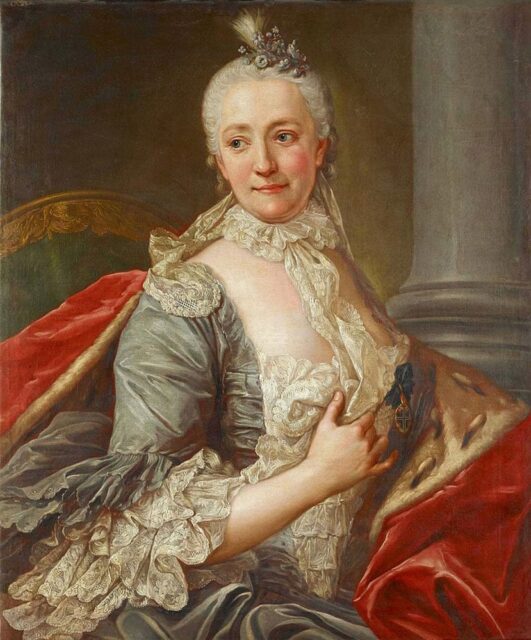
She received a good home education and spent several years being raised in a monastery in Warsaw. Girls of her rank read religious literature, biographies of notable figures, and, of course, French picaresque novels. It’s clear she dreamed of a young fiancé, but her stepmother arranged her marriage to a much older prince Sanguszko—a favourable match for a seventeen-year-old girl: the fifty-eight-year-old Paweł Karol Sanguszko. He had already been widowed twice. The elder Sanguszko was at odds with his only son and unwilling to leave his estates to him, so he sought a young wife who could bear many obedient children.
What Barbara felt about marrying a man so much older, or whether she bore ten children of her own free will during their twelve years together, remains unknown. Four of those children died in early childhood. Presumably to escape reality, Barbara immersed herself in literature. She lived and created in Volhynia, in the town of Zaslav (now Iziaslav). She successfully translated two French and Italian religious treatises into Polish — a groundbreaking achievement in the country. Such work could have sparked outrage among the clergy. Yet Barbara’s husband supported her and was immensely proud of his wife for completing such a difficult task. The prince died in 1750, leaving the “certain lady” a vast fortune. At last, Barbara tasted the joys of life.
She left Volhynia and set up a literary salon in Poddębice, Poland, often visited by the future king Stanisław August Poniatowski. Another frequent guest was the Ukrainian poet Celestyn Czaplic, who was deeply in love with Barbara and dedicated poems to her. The princess did not respond publicly to the nobleman’s advances, though she herself began writing poetry. Some of her work was published during her lifetime.
Barbara was also an active author of treatises, publishing them in Lviv. She often stressed that her books were written for her own children and grandchildren, hoping to pass on her experience so their lives might be easier than hers had been. She became involved in political affairs, inspiring the Bar Confederation, which was ultimately crushed by the Russian army. Content with a full and active life, she died aged seventy-three, having divided all her property among her children beforehand.