For Ukrainian refugees after the Second World War, Europe wasn’t exactly defined by the beauty of Gothic cathedrals, Baroque churches, Rococo palaces, or quaint houses with tiled roofs. Instead, Austria and Germany greeted them with the stark reality of wooden barracks encircled by barbed wire fences, watchtowers, and guards. Ukrainians, alongside refugees from Central and Eastern Europe, are regarded as a lesser group, kept apart from Germans and Austrians by physical barriers. Yurii Sherekh-Shevelov, a prominent Ukrainian intellectual of the 20th century who experienced life as a displaced person (DP), vividly describes the conditions of the transit camp in Strasshof, Austria. Here, two-storey wooden bunks offer hard, uncomfortable straw mattresses. Finally, a place to rest becomes a luxury after the dangers, escapes, losses, constant explosions, and planes overhead.
Despite facing daily inconveniences and enduring unsettled lives, Ukrainian writers and artists found themselves steadfast in one commitment: as representatives of a stateless nation, they were compelled to carry forward the torch of Ukrainian literature.
Home, where they saw no future, left them no choice but to continue their work in a free Europe. The rhetorical question “If not us, then who?” echoed resolutely. In September 1945, amidst war-torn and impoverished Germany, the most proactive among them established the Artistic Ukrainian Movement (MUR), an organisation of Ukrainian writers in exile.
According to Yurii Shevelov, the undisputed leader of MUR, the formation of the organisation was somewhat serendipitous. His statement, possibly tinged with modesty and reflecting hindsight, implies that establishing a writers’ group became imperative to ensure access to Ukrainian fonts and the printing of Ukrainian publications. In the Bavarian town of Fürth, fate brought together Yurii Shevelov with writers and poets like Ihor Kostetskyi, Viktor Petrov-Domontovych, Leonid Poltava, Ivan Bahrianyi, Ivan Maistrenko, and Yurii Kosach. They collectively recognised the critical need to print Ukrainian books, newspapers, and magazines, leading them to found the organisation known as MUR. Throughout its three-year existence, MUR actively convened congresses and conferences, published almanacs, journals, and books, and attracted large audiences to its literary evenings, thereby establishing a robust literary infrastructure.
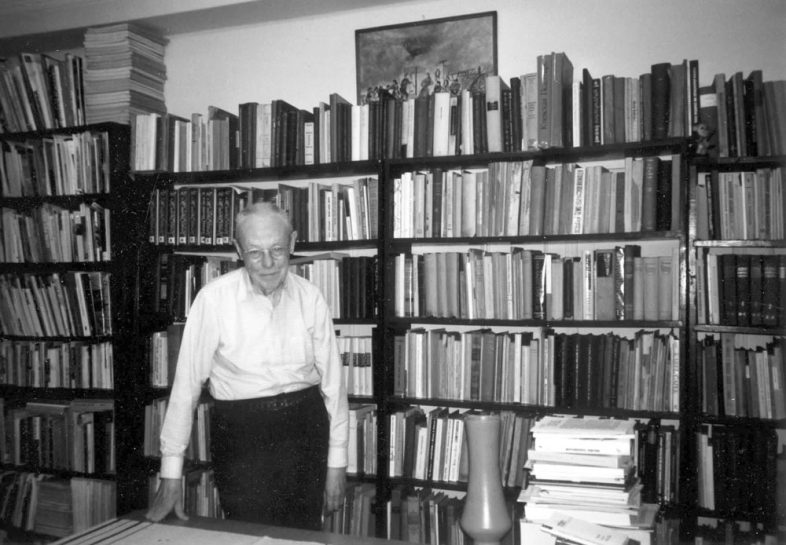
Yurii Shevelyov at his residence on 39 Claremont Avenue, 1995. Photo is courtesy of Serhiy Vakulenko.
MUR embraced a vision articulated in its program: “to all figures of the word, brush, and stage who write on their banner the slogan of perfect, ideologically and formally mature, and eternally seeking art.” These Ukrainian exiles aspired to establish a robust European Ukrainian literature, aiming for excellence despite their statelessness, which consigned their homeland to political and cultural invisibility. Their ambition was lofty: “The times demanded and continue to demand of Ukrainian art the task to which it is called: to serve its people in a highly artistic, perfect form, and thus to win a voice and authority in world art.”
Internally, MUR faced its own challenges. Officially led by Ulas Samchuk, a writer from Volhynia, the organisation found its ideological impetus in Yurii Shevelov, a linguist and critic from Kharkiv. This juxtaposition was unique, bringing together Ukrainians from diverse regions to forge Ukrainian culture in post-war Europe. Yet, their differing historical and cultural backgrounds often hindered mutual understanding rather than fostering unity.
Creative Fever
Shevelov was MUR’s most passionate advocate, driven by the vision of uniting scattered Ukrainian literati across Germany and Austria. Concurrently, he produced compelling literary criticism that engaged with new texts from the MUR era and explored earlier epochs of Ukrainian and global literature.
The texts penned and published during MUR’s tenure are indispensable to Ukrainian literary history today. They include Ivan Bahrianyi’s The Hunters and the Hunted, Dokia Humenna’s Children of the Chumak Way, Viktor Domontovych’s Doctor Seraphicus and Groundless, Yurii Kosach’s Aeneas and the Lives of Others, Todos Osmachka’s Senior Groomsman, and Ulas Samchuk’s OST and The Youth of Vasyl Sheremeta, among others. These works are pivotal to understanding the literary landscape shaped by MUR.
Amidst their creative peaks, the artists of MUR grappled frequently with interpersonal conflicts and misunderstandings. Shevelov, assuming the role of confessor and mediator, sought to navigate the turbulent dynamics within the group. Reflecting on his role, Shevelov acknowledged the writers’ profound need for recognition, understanding, and harmony, describing it as a challenging yet necessary task. Despite Samchuk’s efforts to maintain a serene atmosphere and Shevelov’s attempts at fostering unity, internal conflicts proved crucial in defining MUR’s trajectory. Among the most contentious figures were Yurii Kosach and Todos Osmachka, known for their dramatic departures from MUR sparked by personal and artistic disagreements. Shevelov’s efforts to reconcile these rebellious figures often felt akin to taming wild horses rather than leading poets, he mused.
“Great Literature”
Shevelov claimed that “MUR is an alliance of those dedicated to Ukrainian national art.” However, interpretations of national art within MUR varied, with our writers offering diverse visions for the essence and evolution of Ukrainian literature.
During the inaugural MUR congress, Ulas Samchuk coined the slogan “great literature,” underscoring culture and literature’s pivotal role in the post-war era. His emphasis was on cultural survival while viewing literature as a vehicle for enlightenment. Samchuk presented numerous impassioned reflections yet offered no definitive blueprint for realising his vision. “Let’s demolish the vestiges of barbarism within our souls. Let’s forge a society of grandeur, resilient spirits, and unwavering characters. Then, as creators of our literature, we needn’t fear being forsaken by fate; our creativity will fuse with life and imbibe it with wisdom, necessity, and greatness. Thus, we’ll naturally integrate into the broader creative dialogue of our planet’s cultural spheres…”
Samchuk’s address brimmed with justification, rallying cries, and hyperbole, but its formula remained ambiguous. Other writers interpreted the notion differently, leading to continual debate and scrutiny of the concept of literary greatness. In his essay “Thoughts about Literature,” Ivan Bahrianyi contemplates the role and mission of Ukrainian literature in the current historical context.
He argues that Ukrainian literature has a significant message to convey to the world and sees the cultural endeavour as intricately tied to the political one. Bahrianyi asserts that “great literature” and culture overall cannot be separated from “the struggle for the self-assertion of the entire Ukrainian people across time and space.”
He emphasises, “We stress—not the self-assertion of literature itself, but the self-assertion of a forty-five-million-strong nation, where literature must serve as a means to this assertion if it aspires to be great Ukrainian literature.” Bahrianyi concludes, “The path of struggle is the path of every great literature.”
In his essay “Free Ukrainian Literature” (presented at the First MUR Congress), Yurii Kosach proposes advancing the direction set by Mykola Khvylovyi in literary discourse. Kosach writes, “Europe, only Europe, is our source of salvation and renewal,” referring to “this majestic continent that possesses the mysterious power of renewal and revival after the most barbaric eras.”
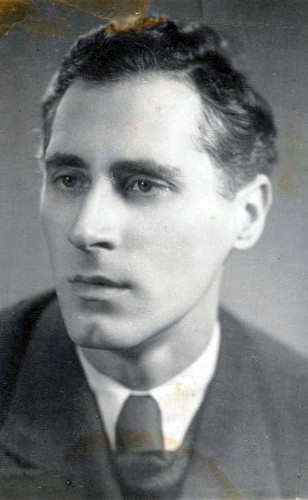
Source: Internet Encyclopedia of Ukraine
Understanding the trajectories of Ukrainian literature, particularly through the lens of emigration and life outside the homeland, is pivotal for this writer. He asserts, “The desert of foreign lands—perhaps the greatest reason for our hope in the great future of our literature. From longing for freedom, we found ourselves in the desert; let us nurture the ideal of freedom in art. We need liberated Ukrainian literature. Free not in the sense of censorship or sufficient material support for its practitioners, but free in its ideological and internal sphere, in its methods of discovering truth.”
Yurii Shevelov articulated his theory while analysing his contemporaries. Based on the origins of style apparent in each writer’s works, he categorised the MUR writers into “organists” (Bahrianyi, Domontovych, Kosach, Kostetskyi) and “traditionalists” (Barka, Osmachka).
From the discussions and debates, it becomes clear that MUR members lacked consensus regarding the purpose and direction of literature. Indeed, “great literature” was not assured but rather an aspirational ideal with an uncertain and elusive path towards it. Furthermore, this concept, as perceived by MUR members, was intimately entwined with Ukraine’s political circumstances and its future.
Witnesses
Despite the end of the Second World War, peace remained a distant dream for Ukrainians in the displaced persons camps. Shevelov vividly recalls how the Americans kept watch on “German collaborators,” aiming to expel all who had collaborated with the Germans. Simultaneously, the Soviets monitored their own people, eager to repatriate them “back home.” According to agreements between the USSR and the victorious Allies of World War II, individuals who were citizens of Soviet republics as of 1939 were obliged to return home after the war ended. Writers lived in an atmosphere fraught with fear, uncertainty, and danger. Among them was Ivan Bahrianyi, who carried a vial of potassium cyanide in his pocket in case they attempted to “repatriate” him forcibly.
In a bold protest against such arbitrary measures, Bahrianyi actively championed the cause of Ukrainians and authored an influential pamphlet titled “Why I Don’t Want to Return to the USSR?” In this work, he eloquently articulated that Ukrainians were refugees not only from the ravages of war but also from the crimes and terror of Bolshevism-Stalinism. These themes not only served as a battleground for vigorous political resistance but also became central in literary discourse.
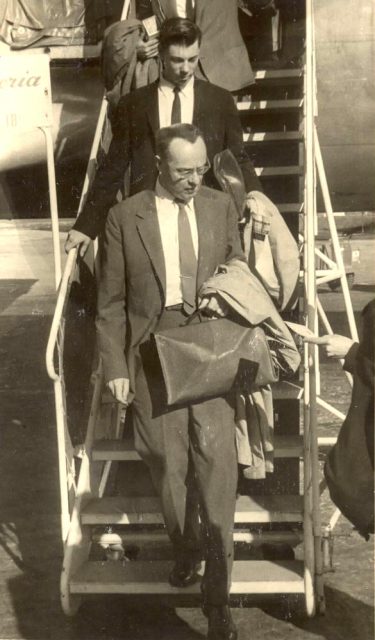
Yurii Shevelyov upon his arrival in Madrid, 1960. Photo courtesy of Serhiy Vakulenko.
Literary critic Hryhoriy Hrabovych introduced the concept of the survivor complex to analyse the literary works of MUR writers—a profound set of emotions characterised by “intense anxiety, often suppressed and concealed,” compelling Ukrainian artists to express themselves and “bear witness.” He discusses the “inescapable sense of guilt for surviving and escaping to freedom while so many perished or were left behind.” This emotional and intellectual climate profoundly shaped the literary output of MUR members.
Yurii Kosach’s novella Aeneas and the Life of Others exemplifies these themes. Serving as a pivotal text in the inaugural MUR almanac of 1946, it delves into Ukraine’s tumultuous history in the first half of the 20th century, grappling with the painful loss of Ukrainian statehood. The novella also confronts the contentious issue of emigration and its enduring impact on post-war Ukrainian historical narratives.
The text captures Kosach’s and his generation’s frank reflections on their relevance and contribution to Ukraine: “…we are destined to be deracines—uprooted, isn’t that so? Driven by the unyielding will of fate, we resign ourselves—we cannot claim a homeland, and even if we could, we would remain strangers to it…”
Similarly, Ivan Bahrianyi articulates the impossibility of living in Ukraine in his novel The Hunters and the Hunted, published by the Prometheus publishing house. He vividly portrays the methods of Stalinist terror in Ukraine and the efforts of his fellow countrymen to establish their Ukraine in northern Russia. Bahrianyi’s subsequent novels further expose the atrocities committed by various regimes against the Ukrainian people (Garden of Gethsemane, Man Runs Over the Abyss). Furthermore, Dokia Humenna’s family chronicle novel Children of the Chumak Path recounts the World War II era and serves as a testament to the recent past experienced by Ukrainians.
The works of MUR writers were written from the perspective of Ukrainian survivors from the ‘bloodlands’ (as Timothy Snyder described them) of the 20th century. They struggled as witnesses to statelessness in the cultural shadows, but the power of their dreams for Ukraine and its “great literature” provided them with creative and personal strength to hope for a brighter future.