On May 29, the Ukrainian Diaspora Museum commemorated its 25th anniversary. Over the past 25 years, the museum has become a global leader in showcasing crucial aspects of Ukrainian history and culture outside Ukraine. Celebrating its milestone, the museum received warm congratulations and valuable gifts, including publications and artworks, enhancing its esteemed collection. Founded in the 1990s, it remains dedicated to preserving and promoting Ukrainian diasporic heritage.
The beginnings
The Ukrainian Diaspora Museum began forming its collection in the 1990s, coinciding with Ukraine’s independence and the establishment of connections with Ukrainians abroad. Ukrainian emigrants worldwide started reconnecting with their homeland, locating their families and long-lost relatives, visiting Ukraine, and donating personal archives. The Commission on the Return of Cultural Values to Ukraine, operating under the Ministry of Culture and the Cultural Heritage Department of the Museum of the History of Kyiv in the 1990s, played a crucial role in bringing back numerous artworks, documents, and personal archives of the Ukrainian diaspora. This effort led to the establishment of a branch of the Museum of the History of Kyiv on May 29, 1999, initially named the Museum of Cultural Heritage and later renamed to the Ukrainian Diaspora Museum in 2015.
In 1994, Olexa Bulavytsky, a Ukrainian artist from Uman who has spent most of his life in the United States, donated 40 artworks to Ukraine, laying the cornerstone of the Ukrainian Diaspora Museum’s collection. The oldest Ukrainian newspaper in America, “Svoboda,” covered the event in July 1994: “A remarkable and moving event occurred in Minneapolis at the end of May. Numerous members of the Ukrainian community gathered at St. Michael’s Church to witness Olexa Bulavytsky, a renowned Ukrainian artist, donate forty of his finest artworks to Ukraine. […] Oleksa Bulavytsky is widely recognised beyond the United States; his paintings have been exhibited worldwide over the past half-century, with 112 solo and group exhibitions. Until recently, his works were unknown in Ukraine. Now, the canvases of this talented artist rightfully grace the Diaspora branch of the Museum of the History of Kyiv”. Today, Bulavytsky is revered as the ‘godfather’ of the Ukrainian Diaspora Museum.
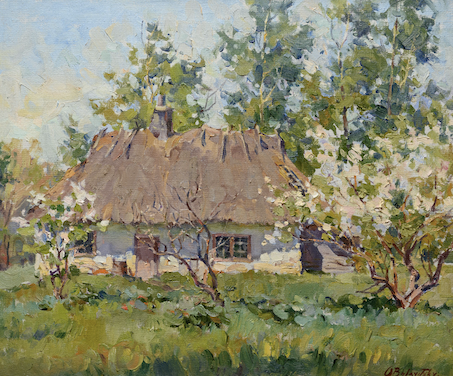
Image: Olexa Bulavytsky, “Apple trees in bloom”, Manitoba, Canada, 1970 | Museum of Ukrainian Diaspora
In the 1990s, Petro Kravchenko, a Ukrainian artist from distant and exotic Australia, bravely ventured back to his native Kyiv after the fall of the Iron Curtain. Forced to leave during World War Two, he returned to Ukraine, playing a pivotal role in bringing his own works and those of fellow Ukrainian artists in Australia, along with their archives, back to their homeland. Thanks to Kravchenko, the Ukrainian Diaspora Museum now houses a rich collection from the third wave of Ukrainian Australian emigration, featuring works by Stepan Chwyla, Volodymyr Savchak, Tymothy Messak, Leonid Denysenko, and Peter Kravchenko himself. This collection formed the foundation for the 2017 project ‘Artist Ambassadors: Ukrainian Australiana,’ supported by the Australian embassy in Ukraine. Although Peter Kravchenko passed away before the exhibition’s opening, his son Pavlo has continued his father’s legacy in Australia. Invited by the Museum of the Ukrainian Diaspora, Pavlo Kravchenko personally attended the exhibition’s launch, donated additional works by Ukrainian Australians to the museum, and, importantly, brought his father’s ashes to Ukraine for reburial in Kyiv.
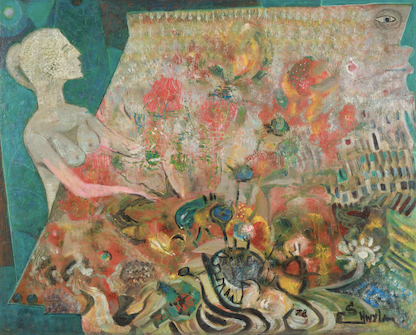
Image: Stepan Chwyla, “Composition”, 1978 | Museum of Ukrainian Diaspora
Over the past decade, the Ukrainian Diaspora Museum has significantly expanded its collection of historical and artistic artefacts through the personal networks of its leadership and research team with Ukrainians abroad. One notable recent addition, marking the museum’s 25th anniversary, is the donation of works by Ukrainian artist Viktor Tsymbal, who lived in exile in Argentina and the United States. The artist’s great-grandson, Anton Tsymbal, residing in Ukraine, personally contributed these pieces to the museum.
Among the donated artworks are graphic caricatures dating from the late 1940s to early 1950s, which candidly depict and challenge the myth of ‘happy Soviet life’. Unfortunately, these caricatures of Stalin have regained relevance today. In one poignant drawing by Tsymbal, the dictator is depicted with angel wings, holding a peace dove in one hand while cynically trampling on the graves of his victims.
“As we face Russia’s full-scale invasion of Ukraine today, this caricature resonates deeply, reminding us that whether under Stalin or Putin, Russia’s objectives remain consistent: aggressive warfare and the subjugation of conquered peoples,” explains Oksana Pidsukha, Director of the Ukrainian Diaspora Museum.
The museum’s highlights
The Ukrainian Diaspora Museum houses a collection of unique archival documents, including membership and insurance certificates, that vividly depict the activities of the earliest Ukrainian mutual aid societies in America during the early 20th century. One prominent example is the Concord of Olyphant Societies, established by Ukrainian immigrants in Olyphant, Pennsylvania, in 1914, when Ukrainians constituted nearly half of the town’s population.
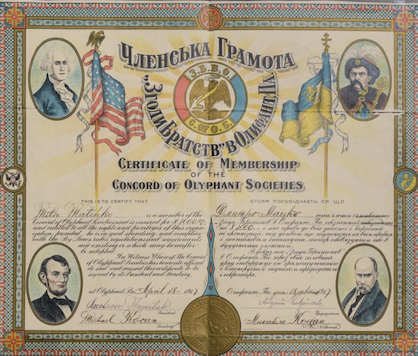
Image: Dmytro Matsko`s membership certificate in the “Concord of Olyphant Societies” mutual benefit society”, 1917 | Museum of Ukrainian Diaspora
A particularly noteworthy artefact is a 1917 certificate verifying the membership of Ukrainian immigrant Dmytro Matsko in the Mutual Aid Society. This document is adorned with Ukrainian and American symbols, including the national flags of both countries, portraits of esteemed figures such as Ukrainian poet Taras Shevchenko and Hetman Bohdan Khmelnytsky, as well as American Presidents George Washington and Abraham Lincoln. The detailed design of the certificate, coupled with its sophisticated security features for the time, reflects the substantial efforts and financial resources invested in its creation, underscoring the robust financial standing of the Concord of Olyphant Societies.
The Ukrainian Diaspora Museum houses a rich art collection showcasing works, photographs, and documents from the renowned Ukrainian artistic dynasty of the Krychevskys, whose members were dispersed across France, Venezuela, and the USA.
This collection was initiated in 1993 when Kateryna Krychevska-Rosandich, granddaughter of Vasyl Krychevsky and herself a Ukrainian-American artist, travelled to Ukraine to donate her family’s works to Ukrainian museums. Kateryna carefully preserved the legacy of her grandfather, Vasyl Hryhorovych Krychevsky, her father, Vasyl Krychevsky (Junior), and her uncle, Mykola Krychevsky, ensuring their works and archives found homes in various Ukrainian museums throughout the 1990s and 2000s.
Thanks to Krychevska-Rosandich’s efforts, the Ukrainian Diaspora Museum now boasts architectural sketches, ornamental designs, and book cover drafts by Vasyl Krychevsky; landscapes painted in Ukraine, Germany, and America by Vasyl (Jr.); lyrical watercolour landscapes of Paris, Venice, and New York by Mykola Krychevsky; as well as Kateryna’s own watercolours of America and Paris, sketches, and festive postcards. The collection also includes unique family photographs and documents that have facilitated in-depth research into the works of this distinguished dynasty, resulting in the publication of albums such as “Mykola Krychevsky. Artist and the World” (2018) and “Kateryna Krychevska-Rosandich. Roads. Straßen. Roads” (2021).
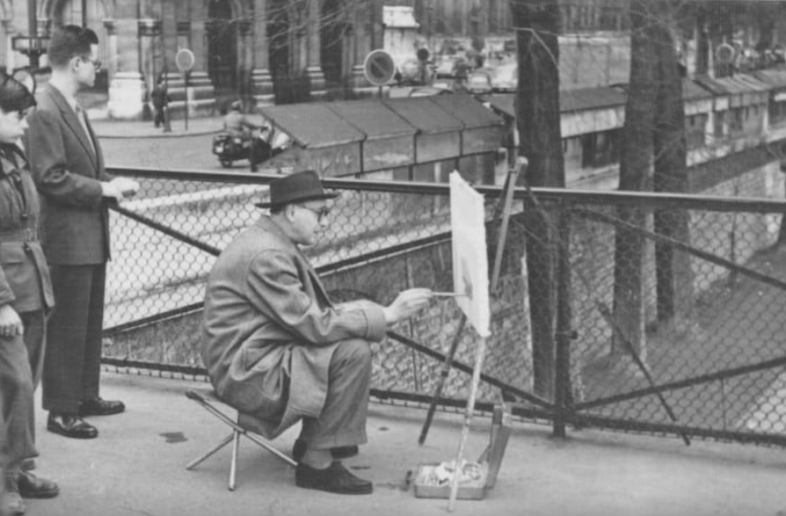
Photo: Mykola Krychevsky while working; The Seine embankment, Paris, 1950 | Museum of Ukrainian Diaspora
The Ukrainian Diaspora Museum preserves the personal effects and legacy of Mark Paslawsky, an American Ukrainian who was awarded a Hero of Ukraine and who died defending Ukraine in the Russian-Ukrainian war. Born in the United States to Ukrainian emigrant parents, Mark returned to his ancestral homeland in 1992. With a background in economics and military education, he initially established his own business before dedicating himself to defending Ukraine. Paslawsky played pivotal roles in the Orange Revolution and the Revolution of Dignity. He obtained Ukrainian citizenship in 2014 and volunteered with the Donbas Battalion, adopting the call sign “Franko” in homage to a famous Ukrainian writer. Tragically, he lost his life on August 19, 2014, during the liberation of Ilovaisk.
The Paslawsky family generously donated his personal effects to the Ukrainian Diaspora Museum, including clothing, books, and documents. Notably, among these artefacts are items associated with his alma mater, the American Military Academy at West Point, where he graduated in 1981, such as his uniform, insignia, and yearbook. These items are prominently featured in the museum’s anniversary exhibition titled “I Will Return to My Homeland…”.
“I Will Return to My Homeland…”
To celebrate its 25th anniversary, the Ukrainian Diaspora Museum has launched a significant exhibition titled “I Will Return to My Homeland…”. The exhibition takes its name from the famous 1946 pamphlet by Ukrainian writer and political émigré Ivan Bahrianyi, reflecting his sentiments about not returning to the USSR.
This expansive exhibition delves into the history and artistic legacy of Ukrainians worldwide, spanning from the earliest Ukrainian settlers in the late 19th century to the third wave of emigrants who left during World War II and their descendants. Displayed across eight rooms, the artefacts include treasures from the collections of the Ukrainian Diaspora Museum, the National Art Museum of Ukraine, and various private collections. Curated by art historian Oksana Pidsukha, with contributions from historian Nazar Rozlutskyi and art historian Hanna Leksina, the exhibition highlights a diverse array of exhibits.
Noteworthy among them are personal items and documents belonging to Hetman Pavlo and Hetman Danylo Skoropadsky, Mykola Plaviuk (the last President of the Ukrainian National Republic in exile), Mark Paslawsky (Hero of Russian-Ukrainian war), paintings and graphic works by Ukrainian artists of the Paris School, artworks by the Krychevsky dynasty and Ukrainian-Australian artists, and pieces that shed light on the activities of the Ukrainian Republican Capella under Oleksandr Koshyts, Plast, and the World Congress of Ukrainians.
The exhibition’s second section, titled “Ukrainian Manhattan,” presents an extensive collection of paintings and graphics by members of the Association of Ukrainian Artists in America, prominent figures in the post-World War Two Ukrainian art scene in the United States. Featured are American landscapes by Oleksa Bulavytsky, graphic animalistic works by Yakiv Hnizdovsky, symbolic sculptures in bronze and terracotta by Petro Kapshuchenko, Greek landscapes by Lyudmyla Morozova, exotic landscapes by Arkadiya Olenska-Petryshyn, enamel landscapes by Iryna Tverdokhlib-Banakh, glass sculpture by Mykhailo Chereshnovsky, and more. Visitors can also explore recently donated graphic caricatures by Viktor Tsymbal.
The year 2024 marks a jubilee for the Ukrainian Diaspora Museum, and its exhibition “I Will Return to My Homeland…” is just the beginning of celebrating its 25th anniversary. The museum’s research team continues to explore Ukrainian diaspora communities worldwide, forge new connections, and develop upcoming exhibition and publishing projects. They are currently preparing the museum’s first printed publication based on its collection, featuring compelling stories about historical and artistic treasures.
Moreover, during the Russian invasion of Ukraine in February 2022, the Ukrainian Diaspora Museum launched a scholarly and educational web. Its mission includes preserving and showcasing digitised collections from the Ukrainian Diaspora Museum and its Ukrainian and international partners while also promoting awareness of Ukrainian diaspora issues to a global audience.