Ukraine has made the decision to shift the date of its Christmas celebrations, moving it from 7 January to 25 December. This change highlights the country’s determination to distance itself from Russian influence, including shared holiday traditions. On 14 July 2023, Ukraine’s Verkhovna Rada [Parliament – Ed.] passed a law officially changing the date. Since then, a significant portion of Ukrainians has embraced celebrating on 25 December, aligning with much of the world. However, there are still some who plan to stick to the traditional 7 January date.
In Ukraine, Christmas wouldn’t be the same without the vertep—a lively street performance that brings the story of Christ’s birth to life—and the traditional carols known as koliadky. Though, over time and influenced by urbanisation, the vertep has become less common during the holiday season, it remains a cherished symbol of Ukrainian culture.
Today, both vertep and koliadky are closely linked to the ritual customs of the Orthodox and Greek Catholic churches, particularly in Ukraine. Yet, their roots stretch back long before the rise of Christianity and beyond Ukraine’s borders. The puppet nativity scene, at the heart of the vertep, traces its origins to ancient Greece, with the art of puppet theatre later spreading to Rome.
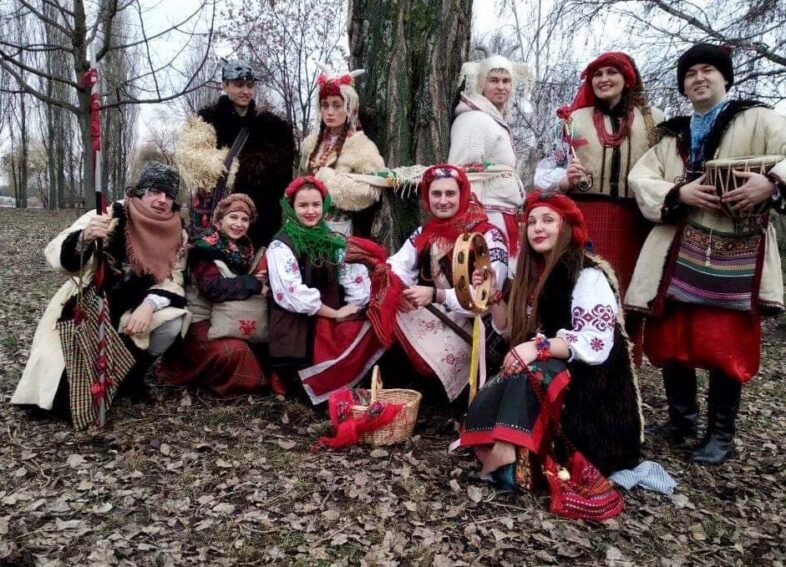
In Ukrainian lands, the tradition of Christmas folk performances in town squares has been established since the 16th century. The first historical mention of the vertep dates to 1667. The nativity theatre was a two-story wooden structure: the upper level featured a Christmas drama, while the lower level hosted a satirical interlude. The ‘sacred’ part followed a fixed composition, while the content of the interlude varied according to local traditions and the performer’s skill.
The celebrated Ukrainian writer Ivan Franko often referenced the vertep, particularly in his 1885 work The Ruthenian Theatre in Galicia, where he wrote: “Our people have long cherished theatrical performances, as evidenced by the remnants of living verteps and the widespread popularity of church hymns, which flourished under the influence of the old religious theatre during the 16th and 17th centuries, at the first stirrings of our national awakening.”
The word vertep, rooted in Old Slavonic, means a cave or a hidden place. Nativity theatres, or puppet shows, emerged not just in Ukraine but also in Catholic countries across Europe. In England, they’re called “Nativity scenes,” while in Germany, they’re Weihnachtskrippen. In Poland, they’re known as Szopka (from the German Schoppen), and in Transcarpathia, they’re called betlehem. In Italy, it’s belen, derived from Bethlehem itself. Yet, it was only in Ukraine, particularly during the Soviet era, that the vertep became a powerful symbol of resistance and a fight for cultural identity. Moscow took note of this, cracking down on folk performances and arresting participants, as it did in Lviv and Kyiv in 1972.
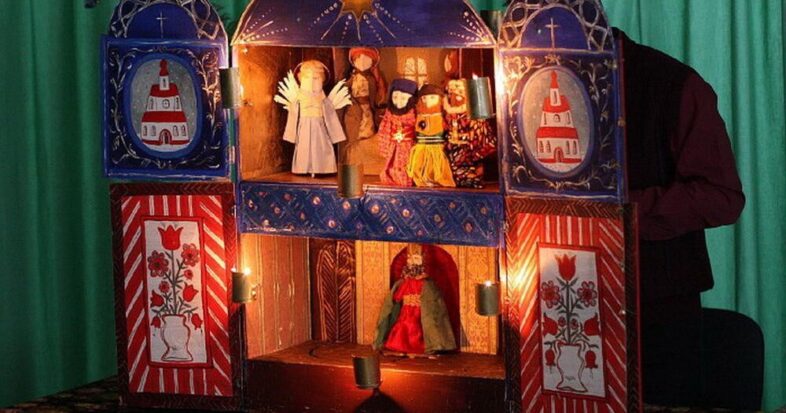
The spirit of resistance that defined the vertep has helped it endure in Ukraine, where it remains a living tradition not only in rural villages but also among urban youth. Humorous improvisations, often drawing from everyday life, have become a distinctive feature of Ukrainian performances. While the spiritual elements of the “vertep” sometimes fade, leaving only the secular side, the performances still feature a wide range of characters, including the angel, shepherds, the three wise men, the devil, death, King Herod and his soldiers, and the Cossack.
Singers of koliadky are usually rewarded with treats or money. The most elaborate performances take place on New Year’s Eve, or Malanka, celebrated on 31 December. On this day, people organise a “goat parade” featuring dances and the symbolic “death” and “resurrection” of a goat, representing the eternal cycle of life, death, and rebirth.
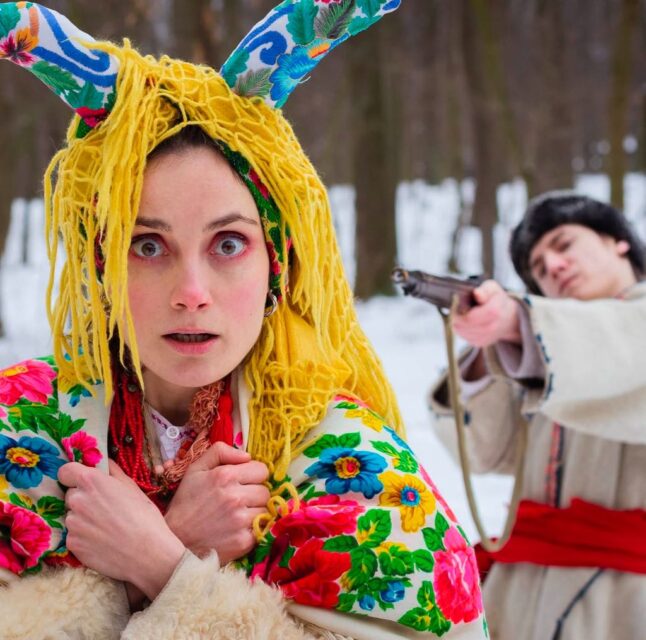
Photo: Inna Tonkoshkura. Ukrainian vertep – a “goat” aimed at by the “hunter”
Koliadky hold a special place in Ukrainian culture. These folk songs, which date back to pagan times, evolved with the arrival of Christianity, becoming a symbol of the celebration of Christ’s birth.
Originally, pagans celebrated a festival called Koliada, which took place on the night of 24 to 25 December. This festival marked the beginning of the new year and the transition from winter to spring, as after the winter solstice on 21 December, the days slowly began to lengthen. With the arrival of Christianity, the celebration was transformed into a sacred evening, now observed on Christmas Eve—24 December on the Gregorian calendar and 6 January on the Julian calendar.
On Christmas morning, attending church was customary, while the evening was dedicated to singing koliadky, spreading good wishes to hosts, and receiving a reward in return. The children typically sang first, followed by the adults. Boys and girls were divided into two groups and sang separately, each with its own leader and a “bearer of the Star of Bethlehem.” This special person carried a star, knew the songs best, and had the strongest voice, guiding the group through the night’s festive serenade.
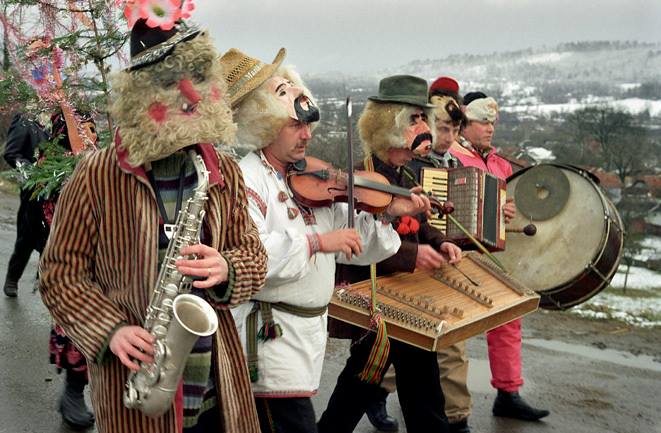
Photo credit: Ukrainemania | Facebook
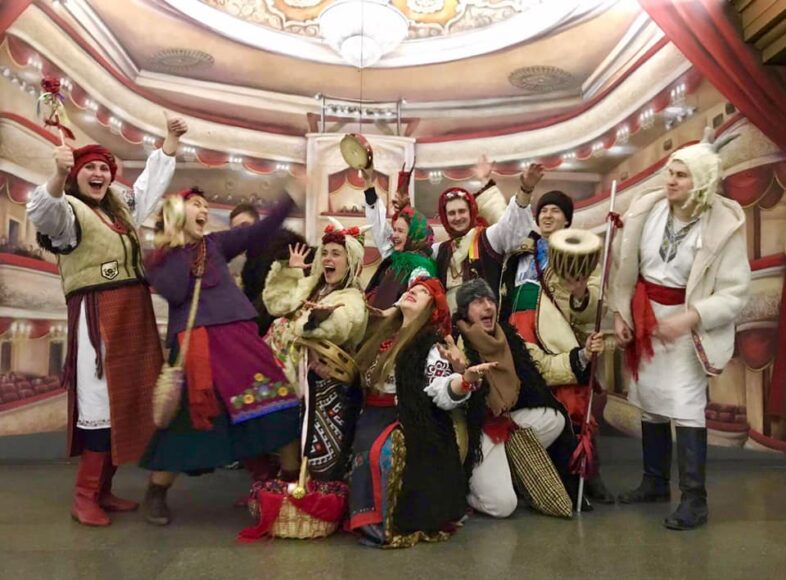
Today, koliadky, like the vertep, are more commonly performed in villages. However, during the New Year period, they can also be heard and seen, especially in the Kyiv metro, as shown in the photo.
And what about Christmas trees? They remain very popular! Despite the war, Ukrainians continue to set up Christmas trees in the central squares of cities and villages because the ability to find joy despite hardship is also a matter of resilience, strength of spirit, resistance, and dignity.
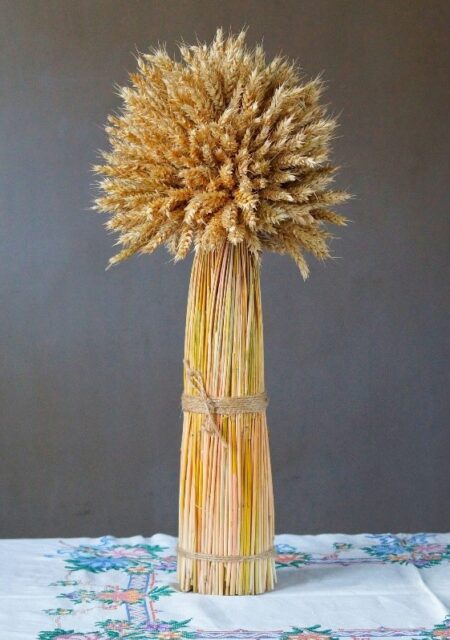
The didoukh
In Ukraine, as in many countries worldwide, decorating homes for the winter holidays is a cherished tradition. While the Christmas tree is widely regarded as an international symbol, the Ukrainian version of this festive decoration is the didoukh—a sheaf of harvested crops, typically wheat, rye, or oats, embellished with ribbons, flowers, or dried herbs.
The didoukh represents the spirit of ancestors, who, according to tradition, returns home on Christmas Day. Originally, it was a simple bundle of crops, but over time, it became adorned with straw flowers. Today, didoukhs are intricate works of art, yet the material remains the same—straw. In the past, Ukrainians believed that the souls of their ancestors rested on the “branches” of the didoukh during the holiday. As such, it was important for the sheaf to be sturdy and large enough to honour these spirits properly.
Ukrainian researcher Iryna Savchuk explains that the didoukh was used as a sort of talisman, although it wasn’t referred to as such. It was believed to protect the family’s well-being and harmony. “Efforts were made to craft it from the first sheaf of the harvest. Didoukhs varied, even from one village to another, with traditions passed down orally, adapting to the artisan’s preferences or the customs of a particular community. This is why it’s impossible to say whether they are made ‘correctly’ or not! No precise standards were set, and folk art knows no boundaries,” she notes.
The tradition of placing didoukhs inside homes stretches back to pre-Christian times, when people believed a sheaf of grain housed spirits that protected the family and ensured prosperity. Over time, the didoukh took on new significance, symbolising family unity in honour of Christ’s birth. Traditionally, the didoukh was placed in a position of honour within the home, often near the icons. On Christmas Eve, it would be brought inside with words of blessing, thought to bring goodness, peace, and prosperity for the year ahead.
Today, the didoukh is not only a decorative piece for homes but also a highlight at Christmas fairs and festivals. Artisans craft true masterpieces from wheat, rye, and straw, often embellishing them with ribbons, dried flowers, and other decorative elements. Despite these artistic flourishes, the didoukh’s symbolism remains at the heart of the tradition: it represents a deep connection with the land, ancestors, and spiritual heritage.
For modern Ukrainians, Christmas is more than just a religious holiday. It is a time for family to come together around the table, singing carols, sharing joy and warmth, and keeping ancient traditions alive. It’s a moment to affirm that life always triumphs over death and that light inevitably returns after the darkest days.
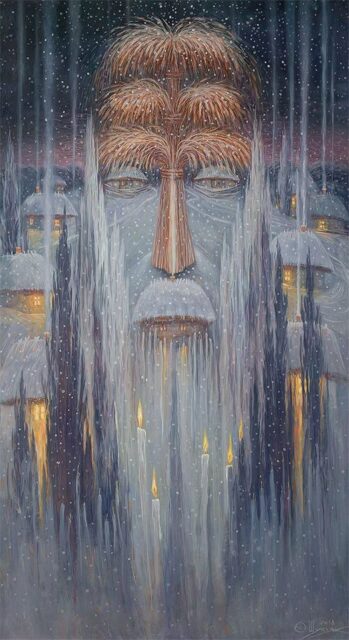
Artwork by Ukrainian artist Oleh Shupliak, Didukh – the Spirit of the Grandfather, 2018