Thirty-year-old American Joe Hill has already earned five Emmy Awards for producing the documentaries The Dark Side of Manga (Inside the Pedophilic Manga Industry in Japan) (2023) and Return of the Taliban (2022). This year, he made his directorial debut with a Ukrainian-themed film — inevitably about the war, but approached through a surprising lens: contemporary dance as a way to break free from the paralysis of trauma. He presented Match in a Haystack in Kyiv at the Odesa International Film Festival.
Joe brings seven years of experience at Vice News, reporting from some of the world’s most dangerous conflict zones and witnessing wars and crises up close. He has turned those experiences into stories that hit home for audiences. Seeing Ukraine through his eyes offers a fresh perspective: are the world’s eyes really on us, or are our stories slipping through the cracks? And if they are, how do we make them impossible to ignore?
He sits in front of his computer, hoodie pulled over his head, the soft light of Long Island spilling through the window behind him. Just the night before, his team had screened Match in a Haystack here. For Joe, it marked the end of a globe-spanning tour — after New York, there were screenings in London, Los Angeles, Washington, Kyiv, and soon, Canada — and a return to the work he loves most: making films.
There’s something about him that suggests a restless energy, the kind of risk-taker who never felt at home in the predictable rhythms of American life. He credits theatre, which he has been involved with since childhood, for shaping that impulse:
— My first encounters with people and the world came through play and storytelling. In high school, I studied art — and honestly, it saved me. I met other driven students, and together we realised we could make something that mattered. I’ve always been drawn to moments of conflict and crisis, moments when societies are forced to confront who they truly are.
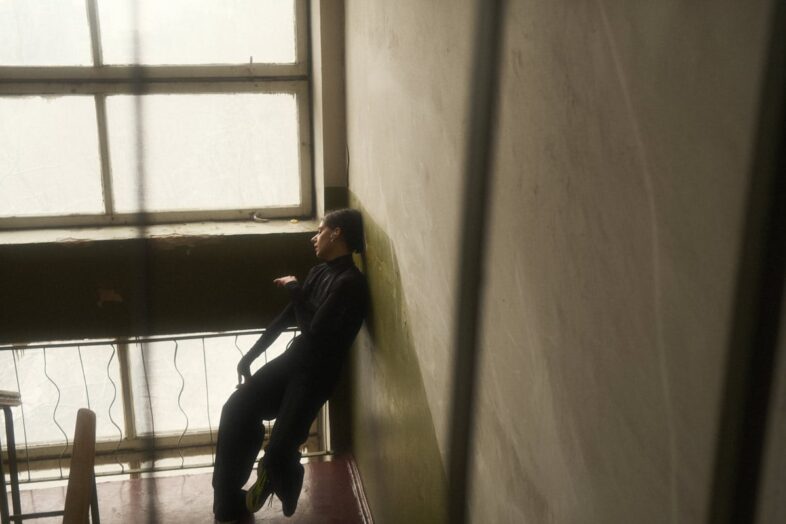
Photo: Dangerous Company
Joe Hill studied directing at the Carnegie Mellon University School of Drama, one of the most prestigious in the United States. By the age of 18, he had launched his own production company: with money borrowed from his girlfriend’s grandfather, he bought a camera and started filming music videos, later moving on to educational films for community projects.
— That was the first time I travelled outside the US, which is pretty unusual for Americans, — he recalls. — I’m not even sure my parents had passports back then. In India, we filmed a story about a local school; in Ethiopia, we lived in a deaf community. My first real experience in journalism came in Chile, where I was studying Spanish and photojournalism. I was photographing a protest when anarchists attacked me and took my camera. That’s when I really began to rethink the dangers of the work I was doing.
— You need a compelling reason to put yourself and others in danger. For me, it’s the need to capture a historical moment — to show people taking risks because they have no other choice, because that’s how their world is being shaped. That, to me, is what journalism is all about.
Joe’s appetite for risk — the willingness to take on dangerous assignments and turn them into gripping stories — led him to Vice News, producing content first for HBO and later for VICE TV and Showtime. Over seven years as a show producer, he travelled to some of the world’s most volatile hotspots: he was the first journalist embedded with US special forces fighting Al-Shabaab militants in Somalia; in Burkina Faso, his team captured clashes between the military government and Al-Qaeda; in Nigeria, they reported on negotiations with Boko Haram extremists over hostage releases; and they documented waves of refugees fleeing Afghanistan after the Taliban’s return.
— I learned how to report quickly and under extreme conditions. At the same time, I realised the importance of covering events the whole world needed to see, — Joe Hill recalls.
His experience in Chile was a turning point, showing him that journalists need specific skills and must be ready to act fast in dangerous situations. That’s where Hostile Environment Awareness Training (HEAT) comes in:
— In those trainings, you learn first aid, how to avoid abduction, how to navigate unfamiliar checkpoints, and how to plan extreme logistics. I quickly realised these skills weren’t just useful abroad — they mattered at home too. It was eye-opening to advise colleagues reporting on domestic political events who had been tear-gassed at protests.
Until 2022, Joe had never been to Ukraine, though he’d always intended to visit — Kyiv, he says, had long struck him as a city with real tourist appeal. But after Russia’s full-scale invasion, Ukraine became another stop on his professional journey.
— By that point, I had started rethinking my work, — he explains. — Our stories were always about suffering, conflict, death, and loss. They documented destruction — which is necessary — but I wanted to capture the opposite: creation amid destruction. I first began thinking this way while working in Nagorno-Karabakh, witnessing a reunion between two journalists who had lost each other in Stepanakert. The city had no power or communications, and we were hiding in a bunker during the fighting. Their meeting was an act of pure love. It didn’t make it into the film, but I’ll never forget that moment.
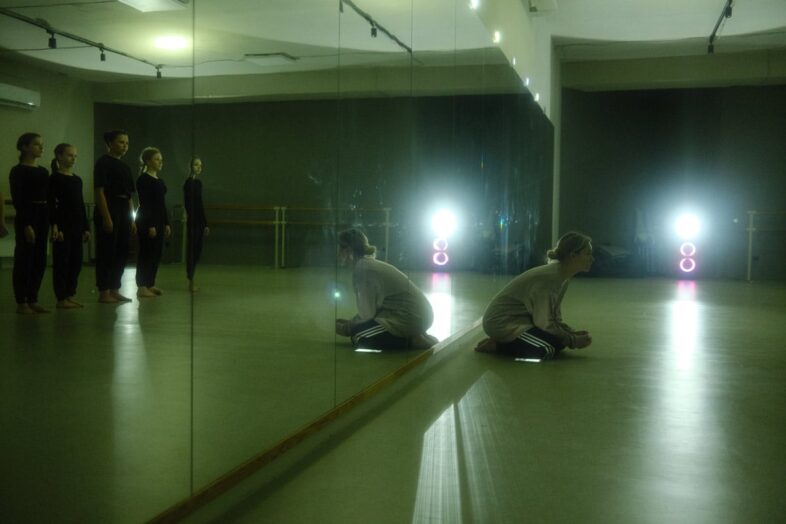
Photo: Dangerous Company
It was that very focus — creation rather than destruction — that Joe set out to explore while filming in Ukraine. His guide was Stephanie Noll, an American contemporary dancer and the daughter of Lidiya Lykhach, director of the art publishing house Rodovid. After dozens of calls and searches, they connected with Yulia Lopata, who decided to assemble a troupe to stage the first performance created during the full-scale war.
The Ukrainian film marked a turning point in Joe’s life:
— It was right around then that Vice News went bankrupt. I had to hire a lawyer just to secure the rights to my own film. The channel insisted that I set up a company to which they could transfer those rights. I jokingly called it Dangerous Company.
The film took three years to make — “a tenth of my life,” Joe reflects. It was released at a time when the world was already growing weary of the war in Ukraine. That, he believes, is part of the challenge:
— We’re showing these films to people who can’t even begin to imagine what war is like. Stories like this act as a mirror for society — they reflect what you’re living through and what the world needs to see. And yet, everything seems to be getting worse. It feels like living in a dystopia. Still, I believe in the power of stories — ones that are deep and meaningful.
There’s aesthetics, how something looks and feels, and there’s anaesthetics, what dulls your senses. I think humanity needs the latter right now, because it’s so hard to process what’s happening. But we shouldn’t be afraid to feel — otherwise, what’s the point of living?
The filmmakers dedicated the work to choreographer Volodymyr Rakov, an FPV drone pilot with the 24th King Danylo Mechanised Brigade, who was killed on 6 January 2025 near Chasiv Yar.
Now Joe is turning back to an American story — a feature film about a group of men in the 1850s who helped define the border between the US and Mexico. A border that, in his view as an experienced journalist, is “one of the ways people in the US exercise violence against those living on the other side.” His Emmy Awards are expected to help bring the project to life, from finding partners to securing funding. But it was the Ukrainian film that truly made Joe Hill feel like a filmmaker:
— It was something special. For the first time, I really understood what it means for people to watch your film. When I worked at Vice, we just uploaded content to YouTube, and the only interaction was through comments. Experiencing cinema on the big screen is completely different.
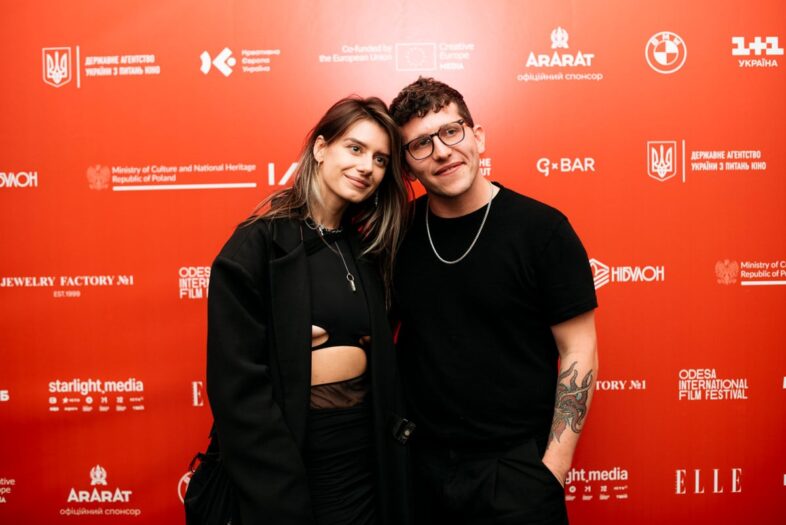
Joe with the film’s protagonist, Nadine Kupets. Photo by Olena Shkoda