Killed in combat at 39 while resisting the Russian invasion, David Chichkan was a leading figure in Ukraine’s anarchist movement and a respected painter. He represented the multifaceted reality of Ukraine’s armed resistance. French writers Anne and Laurent Champs-Massart, currently living in Kyiv, pay tribute to him.
On Monday, 18 August 2025, a procession of flags—black for anarchism, red-and-black for anarcho-syndicalism, purple-and-black for anarchist feminism, green-and-black for libertarian ecology, rainbow for LGBT, alongside Ukrainian national flags—made its way down Mykhailivska Street towards Maidan Square. Around 2,000 people had gathered to honour David, who had been fatally wounded ten days earlier while repelling an infantry assault in the Zaporizhzhia region, where he served with the 241st Territorial Defence Brigade.
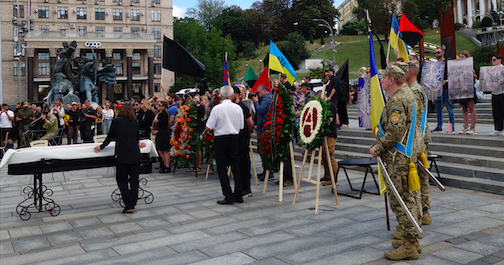
Ceremony in tribute to David Chichkan
When the coffin was lifted from the hearse by soldiers for the viewing, the crowd dropped to one knee. At that moment, the words of Makhnovshchyna — sung in French — echoed through the square. The song, written in the 1970s by Étienne Roda-Gil in homage to Nestor Makhno, the legendary anarchist who fought both Bolsheviks and White Russians during Ukraine’s War of Independence (1917–1921), resonated deeply. Some lines went: “In the spring, Lenin’s treaties / Delivered Ukraine to the Germans / Makhnovtchina / Your flags are black in the wind / They are black with our sorrow, they are red with our blood / Black army of our partisans / Who fought in Ukraine against the Reds and the Whites.”
On Maidan, grief and remembrance took many forms. People thought of David Chichkan as a son, a friend, a father — he leaves behind a two-year-old son, Nestor — as a soldier, an artist, an anarchist, or all of these at once. Through his life and his choices, Chichkan embodied the complex, plural reality of Ukraine’s armed resistance.
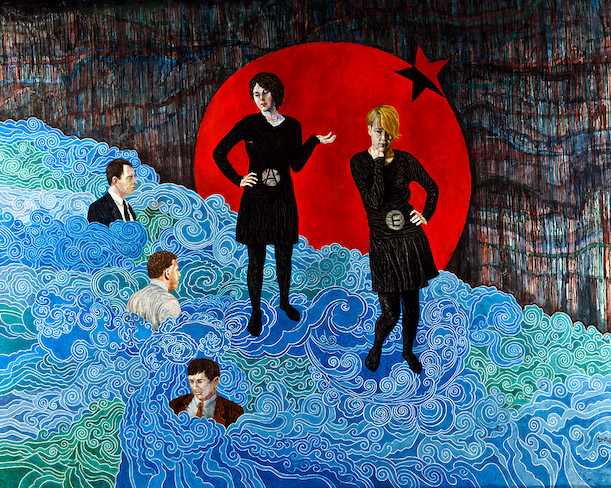
David Chichkan: The Flood
David Chichkan was born in Kyiv in 1986, into a family of artists. His great-grandfather Leonid, grandfather Arkadiy, father Illya and sister Oleksandra all have their place in the story of contemporary Ukrainian art. (During the Russian occupation of Kherson in 2022, Leonid Chichkan’s paintings from the city’s museum were seized in the large-scale looting of Ukraine’s cultural heritage. Some 13,000 works of art were stolen from that city alone.)
The family’s work has always been infused with nonconformism, satire, and a defiant spirit. It was in this creative and reflective environment that David developed his own painterly style, marked by soft colours, precise lines, and a focus on portraits of prominent Ukrainian figures — Lesya Ukrainka, Ivan Franko, and, of course, Nestor Makhno. His apparent candour belied a deep, probing unease. Largely self-taught, he read widely and developed his own thinking, which he wove inseparably into his art, both shaped by and inseparable from the anarchist convictions that guided his life.
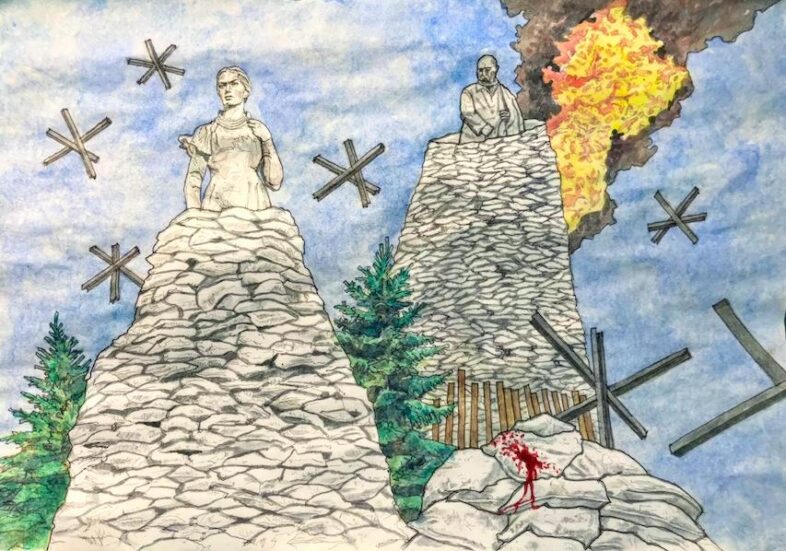
David Chichkan: statues of Lesya Ukrainka and Shevchenko
David Chichkan was 36 when Russia launched its full-scale invasion of Ukraine. He immediately sought to join the army — a choice that might at first have seemed surprising, given that anarchism, by its very nature, rejects the state, authority, and hierarchy, and thus, in theory, military service under the flag.
Yet this apparent contradiction — a contradiction on paper, so to speak — was quickly resolved in Ukraine, first in 2014 and almost entirely swept aside after 2022. Confronted with Russian aggression, with its totalitarian and genocidal character, many Ukrainians across the political spectrum were forced to reconsider principles that, though valid and admirable in theory, were powerless against the harsh reality: the destruction of an entire culture, a people, and a worldview. Devout pacifists, staunch anti-militarists, and radical anti-industrialists alike were compelled to set aside the purity of their ideals to defend, through arms, the very world in which such ideals could exist. One can only hope that other peaceful societies will never face such a stark collision between lofty ideas and brutal reality.
Many Ukrainian soldiers have reflected on the gulf that has opened between the convictions they held in peacetime and the harsh “test of reality.” Consider, for example, two writers-turned-soldiers: Arthur Dron, who recently published Hemingway Knows Nothing, and Artem Chapeye, who explores the same tension in Ordinary People Don’t Carry Machine Guns.
Their accounts are a stark reminder that Ukrainians did not choose this war—they are its victims. They would have preferred never to take up arms, never to face death, never to witness the deaths of others, never to endure injury, and never to see their cities flattened and their land laid waste. But they had no choice. They will keep fighting until the aggression ends, Ukraine’s territorial integrity is restored, the crimes committed are brought to justice, and the Russian Federation is rendered incapable of causing further harm.
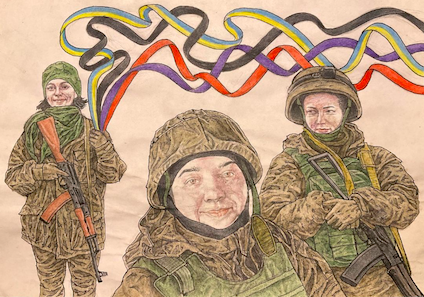
David Chichkan: anti-authoritarian defenders of Ukraine
For this reason, it was hardly surprising on 18 August 2025, at Maidan, to hear both revolutionary and traditional songs, to see military insignia alongside anarchist flags, crosses alongside raised fists, and even to catch sight of Kyiv’s chief rabbi—father of a son also killed in combat—who had come to pay tribute to David.
The Ukrainian army is made up largely of civilians turned soldiers. As such, it mirrors the full diversity of society, giving it a character that is strikingly different from the stereotypical image of a uniform, impersonal, and robotic military. Ukrainian soldiers—men and women of all ages, from every walk of life, including the working class, artists, athletes, activists, businesspeople, and farmers—are reshaping the army from within. It is gradually leaving behind the old Soviet-era model, long marked by disregard for human life, internal opacity, and propagandistic communication, in favour of a more humane, transparent structure that is increasingly, irreversibly, aligned with NATO standards.
Such is the multifaceted reality of those fighting for Ukraine’s independence and freedom—people whom Putin’s regime, echoed by its useful idiots, dismisses as “Nazis.”
In a 2024 interview, David Chichkan reflected: “The Ukrainian army is so different from Russia’s. Their army is impersonal, whereas with us fight Roma, LGBT people, feminists, people from both the right and the left.” This is why David could serve in the Ukrainian army as a mortar operator without abandoning either his personality or his convictions. Whenever he could, he continued to debate social and political issues and, of course, to draw. He captured what he saw: the faces of the soldiers fighting alongside him. Individuals—people exercising free will, defending that very freedom.
He gave his life fighting tangibly for our ideals. Ukraine’s sacrifice is all the greater because it is the nation’s best, its very flower, that is dying in such numbers. The opposite is true of the enemy’s forces. If an army reflects the makeup of its society, as noted earlier, then the overwhelming testimonies and evidence—too numerous to ignore—of looting, rape, the murder of civilians, executions of unarmed prisoners, torture, wanton destruction, and cultural plunder reveal the true face of the Russian world.
As one of the wreaths laid on your grave reads, dear David, we address you with the familiar acronym: “RIP.” In your case, it does not mean “Rest in Peace” but “Rest in Power.”