
To keep Ukraine’s battlefield momentum from stalling, the G7 — including the United States — is moving to step up deliveries of air-defence systems, additional interceptors and other long-range capabilities. At the same time, leaders signalled they are open to exploring licensing arrangements that would allow Ukraine to ramp up its own defence production. The focus is on long-range missiles and air-defence systems still built abroad and shipped to Ukrainian forces from stockpiles that are gradually being drawn down.
“We are all facing the problem of insufficient production capacity,” German Chancellor Friedrich Merz said. “This issue can be addressed by granting licences to companies that have the necessary manufacturing capabilities. Such companies exist both in Europe and in Ukraine.”
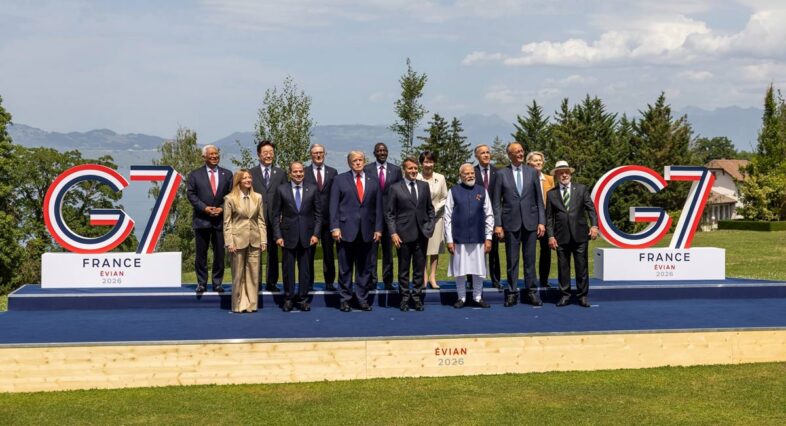
Merz added that this was the first time since US President Donald Trump took office that the G7 had issued a joint statement and found common ground on what he described as “the key foreign and security policy issues of our time.”
President Volodymyr Zelenskyy said Donald Trump had responded “positively” to the idea of supplying Ukraine with missiles and allowing licences for the production of US weapons.
“Production capacity in the United States is not sufficient to meet our needs. We need licences. We have different capabilities. Producing Patriot systems and missiles is difficult — I know this well, I have had many meetings and discussions with companies and I am deeply involved in this issue. But we still want production to increase, if they agree to it. And if President Trump supports this idea. So far, he has been positive. And when President Trump is positive, I hope that means ‘yes’,” he said.
What that could look like in practice
While many analysts see the G7 move as a first step toward something closer to a shared defence production space between Ukraine and its allies, turning that idea into practice is where things get complicated.
The first hurdle is security. Any manufacturing inside Ukraine would instantly become a priority target for Russian missile strikes. That, in turn, would likely push production either underground into heavily protected, bunker-style facilities, or — at least in the early phase — into neighbouring EU countries, with Ukrainian specialists embedded in the process.
Then there’s the question of technology. Modern air-defence systems depend on tightly controlled components that have been restricted for decades, from software and active radar seekers to radar systems, cryptographic protections and advanced composite materials.
And even if licences are approved, key parts of production could still stay with US or European contractors, leaving Ukraine tied into long, fragile supply chains. Add to that the more prosaic constraints — time and money — and scaling up high-end weapons production, alongside building the facilities to do it, looks like a slow and costly process.
Speaking to The Ukrainian Week, British military analyst Nick Reynolds, a land warfare researcher at RUSI, suggested that Chancellor Friedrich Merz and other officials may be getting ahead of themselves on timing — not least because any Ukrainian production sites would have to be heavily protected, dispersed and concealed to reduce the risk of Russian strikes.
He said licensed production is more likely to start in a narrower form, focused on components or final assembly, rather than anything close to a fully integrated production line. Questions around how companies handle the transfer of intellectual property, he added, are also likely to prove a sticking point.
Still, Reynolds argued the obstacles are manageable — provided the framework is set up in a way that makes cooperation genuinely mutually beneficial over the longer term for both European partners and Ukraine.