The Kremlin is not just laying the groundwork for a new escalation on Europe’s gas market — it is also preparing the narrative around it: the explanations, the scapegoats, and the so-called solutions. The explanation is framed around alleged sabotage risks to gas pipelines and turbulence in the global LNG market; the culprits are Ukraine, sanctions, and what Moscow calls the “ideological stubbornness” of Brussels and Berlin; and the solution, conveniently, is a return to the old lure of “cheap” Russian gas. In effect, Moscow is setting the stage not only for an energy squeeze, but for a political comeback as well.
Moscow tests Europe’s readiness to return to “cheap” gas
On 4 June 2026, on the sidelines of the St Petersburg International Economic Forum (SPIEF), Vladimir Putin publicly said Russia is ready to resume gas supplies to Germany via the Nord Stream pipelines, stressing that one branch of the sanctioned Nord Stream 2 remains operational and could be switched on “tomorrow”, delivering 28 billion cubic metres of gas: “I’m not joking – just press a button and the gas starts flowing. But for that, a decision from the government [of Germany – ed.] is needed.”
To carry that message into German domestic politics, the Kremlin leans on the far-right AfD, which translates Russian interests into the language of German industrial strain — high energy prices, competitiveness concerns, and “national pragmatism”, voiced by Markus Frohnmaier. The senior AfD official, the party’s foreign policy spokesperson in parliament, despite warnings from Germany’s Foreign Ministry, met Gazprom chief Alexey Miller and Putin’s special representative for investment and economic cooperation Kirill Dmitriev, after which he said: “Germany is caught in a severe economic downward spiral, and a key driver of this is the high cost of energy […] That is why all options must be put back on the table, including the recommissioning of Nord Stream and the resumption of trade relations with Russia.”
Putin suggests Berlin should “press the button”, Gazprom chief Alexey Miller points to decades of gas cooperation, while the AfD frames it as a call to “put all options back on the table”. It amounts to a summer flare-up of Russian messaging, which, against the backdrop of Europe’s gas storage injection season, is being channelled through the language of an “energy debate” and amplified by the far right — testing how far Europe can be pushed, and once again trying to separate Russian gas from Russia’s war.
The EU, meanwhile, has already locked in its course towards a full phase-out of Russian gas, adopting a regulation to gradually end imports of both pipeline gas and LNG from Russia. Under the REPowerEU plan, the strategic objective is to stop all Russian gas imports by November 2027. Against that backdrop, Putin’s and the AfD’s remarks are not just about sanctioned pipelines — they are part of an effort to blur the political irreversibility of that decision.
Energy crisis: 2022 vs 2026
The energy crisis on Europe’s gas market, linked to disruptions in the Strait of Hormuz, still hasn’t reached the alarming levels seen in August–October 2022 when viewed in hindsight (see Fig. 1), but all the conditions are there for it to do so. And that’s exactly the window Russia is looking to exploit — fuelling tensions in the Middle East, providing Iran with satellite intelligence and Alabuga-made Geran drones, and keeping pressure on global energy flows.
Back in 2022, TTF prices spiked to around €300–311 per MWh — a systemic shock driven by the sudden loss of Russian pipeline gas, panic-driven storage filling, and fears of physical shortages. Today, by contrast, TTF benchmarks sit in the range of roughly €48–60 per MWh, according to market data — several times lower than the 2022 peak, though still clearly above pre-crisis “normal” levels.
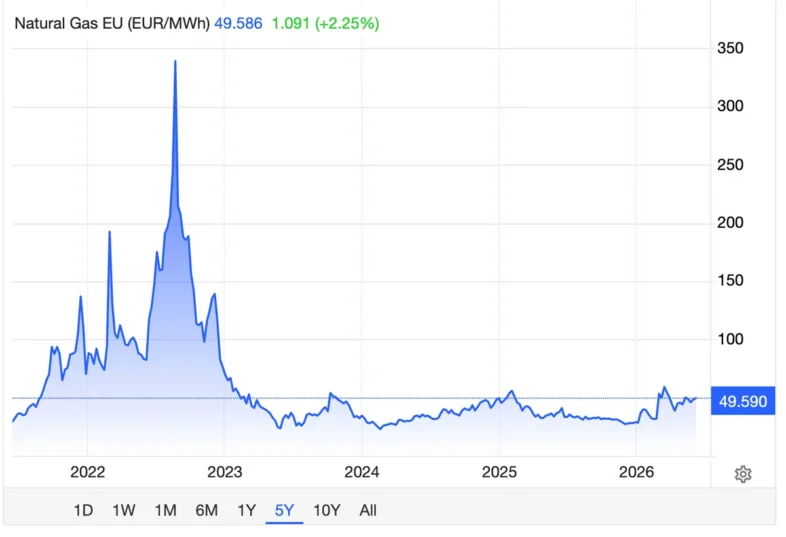
Figure 1. Price spikes at the Dutch TTF gas hub, August 2022 vs April 2026. Source: Trading Economics
The main reason the European gas — not oil — market has so far avoided the full impact of a months-long disruption in the Strait of Hormuz is simple: Hormuz matters far more for global oil and LNG flows than for Europe’s current gas supply mix. And the EU today is far less exposed to Qatari gas than it was to Russian pipeline gas before 2022, when it had to rapidly rebuild its entire supply architecture almost overnight.
It’s worth remembering just how sharp that shift has been. In 2021, Russian gas — pipeline and LNG combined — made up about 45% of Europe’s gas consumption. By 2025, that share had fallen to just 12%. Qatar, by contrast, plays a much smaller role in the EU’s import structure. According to European Commission estimates for 2025, Norway accounts for 31% of imports, the United States 26%, North Africa 13%, Azerbaijan 4%, and Qatar just 4%.
The Strait of Hormuz, however, still carries around a fifth of global LNG trade, and a large portion of Qatari and Emirati cargoes have no real alternative route to global markets. As of 9 June 2026, shipping through the strait has partially recovered — it’s not fully paralysed, but it’s still a long way from pre-war levels. Since the start of the war, only nine loaded LNG tankers have made the passage, five of them Qatari, compared with roughly 120–140 vessels of all types passing through daily before the war.
The current gas crisis is not a replay of August 2022. Back then, Europe faced the risk of running short on gas as Russian supplies dried up. Today, the challenge lies in a global LNG supply shock and intensifying competition for cargoes. The immediate threat to supply is lower, but the risks to prices, industrial competitiveness, and political resilience remain.
If some Qatari LNG volumes are taken out of the equation, Europe can still cover the gap — but only by paying up. That means pulling in US, African, or other spot cargoes that would otherwise head to Asia. The longer normal LNG flows through Hormuz remain disrupted, the more that global supply pressure builds — and the sharper the competition with Asia becomes. Back in 2022, it was exactly that Europe-Asia scramble for LNG that helped push prices to record highs.
One key difference this time is that the EU is entering the crisis in a better-prepared position. In 2022, it was still building out its crisis toolkit — mandatory storage targets, new LNG terminals, including in Germany, a more interconnected network of interconnectors, and formal coordination mechanisms. Much of that infrastructure is now in place. The storage regulation introduced in response to the 2022 crisis has since been extended through the end of 2027.
As a result, while the European gas market may appear less exposed in terms of physical supply security, it remains highly sensitive when it comes to price volatility, industrial competitiveness, and political resilience.
In his landmark report “The future of European competitiveness”, Mario Draghi frames Europe’s gas problem as a structural drag on competitiveness, largely because of its tight link to electricity prices: “…Natural gas was the price-setting fuel [for electricity — Ed.] in 63% of cases in 2022, despite accounting for only 20% of the electricity mix… While gas directly affects only a limited part of the economy (gas-intensive industries account for around 4% of total EU GDP), its role in electricity generation means that increases in natural gas prices can affect the entire economy.”
Draghi’s broader point — that the EU, as the world’s largest importer of liquefied natural gas, is overly reliant on spot pricing and therefore remains exposed to volatility — still holds. Russia’s interest lies in turning this structural vulnerability in Europe’s energy system, as Draghi describes it, into an argument against the sanctions policy.
It is precisely this vulnerability Moscow is now trying to exploit, pushing the gas question back into European politics through renewed talk of “cheap gas” as a supposed condition for restoring EU competitiveness.
The goal is to shift the debate away from security and sanctions and into the language of economic necessity. The argument is straightforward: if expensive LNG, spot-market swings, and high electricity prices are weighing on European industry, then Russian pipeline gas stops being framed as a political concession to the Kremlin and instead becomes a “pragmatic” way to cut costs for businesses and households.
If TTF prices jump again, if global LNG flows are disrupted — with Russia, in parallel, working to keep pressure on key routes such as the Strait of Hormuz — and if competition for cargoes with Asia tightens, Moscow is ready with a familiar message. Europe, it argues, has paid for cutting Russian pipeline gas with higher energy costs, weaker industrial competitiveness, and lower living standards. It’s a selective framing: it glosses over the security risks of dependency on Russia and the history of gas being used as leverage, while also nudging at the edges of the EU’s sanctions consensus. Even so, it still finds an audience in parts of Europe’s industrial lobby, among populist parties, and within political forces pushing for a “normalisation” of ties with Moscow.
Russian gas as a test of Europe’s political memory
The pattern of Russian behaviour during the 2022 gas crisis is worth keeping in mind. At Europe’s most vulnerable moment — as the EU rushed to refill storage ahead of winter — Gazprom began steadily cutting supplies. First came demands for payment in roubles and the suspension of deliveries to some buyers, followed by reductions in flows via Nord Stream 1, officially attributed to turbine issues and maintenance work.
On paper, these were presented as planned and unplanned repairs, Siemens turbine problems, sanctions-related constraints, or regulatory requirements. In practice, the market impact was clear: supply was squeezed precisely when Europe had little choice but to buy gas at almost any price to meet storage targets.
Put differently, Russia didn’t just use gas as leverage — it also worked out the perfect timing. It aligned supply cuts with the rhythm of Europe’s energy system, taking advantage of structural constraints such as mandatory storage targets (the EU set a goal in 2022 of filling gas storage to 80% by 1 November), the summer injection period, fears of winter shortages, and the tight link between gas and electricity prices.
This experience matters today. Any renewed debate about “cheap Russian gas” should be judged on more than price alone. It should also be viewed through the lens of Moscow’s ability to manipulate supply volumes, maintenance schedules, and public narratives in pursuit of political leverage over Europe.
Another sign of how Russia is positioning itself for a new phase of energy leverage is the rising rhetoric around alleged sabotage risks to the TurkStream pipeline, the last remaining route bringing Russian pipeline gas into Europe.
In February and March 2026, senior Russian officials began pushing this narrative in sync. Putin told a meeting of the FSB board that there could be a “possible explosion” of Russian gas infrastructure on the Black Sea seabed — referring to TurkStream and Blue Stream — and tied it to alleged attempts to derail negotiations. Within days, the claim broadened, with Putin alleging that Kyiv was preparing sabotage operations backed by Western intelligence services. By March, Dmitry Peskov and Maria Zakharova were amplifying claims of attacks on compressor stations linked to Black Sea pipelines, explicitly casting them as a threat to “international energy routes” and global markets.
This rhetoric matters not just as an information campaign against Ukraine. It also lays the groundwork for a convenient political frame: any future disruption or reduction in flows via the Black Sea route can be explained away as a “sabotage threat”, “security considerations”, or the need to protect critical infrastructure.
It’s a playbook Russia has used before. In 2022, cuts in Nord Stream flows were attributed to technical problems, maintenance work, and turbine issues, even as the market impact was to tighten supply and drive up prices during Europe’s storage injection season. Seen in that light, today’s talk of potential TurkStream sabotage shouldn’t be treated in isolation, but as a form of advance narrative-building — a way to soften the ground for weakening sanctions pressure and reintroducing Russian gas into Europe’s energy mix, including through the still-functioning branch of the sanctioned Nord Stream 2, which, as the Kremlin likes to put it, could simply be switched on by “pressing a button.”
Russia is already running what looks like a coordinated push — working with parts of Europe’s far right — to bring Russian gas back into the European political debate. The Kremlin is dangling a familiar offer: “cheap” pipeline gas, while pro-Moscow politicians inside the EU repackage it as consumer protection and a way to shore up industrial competitiveness.
The problem for that argument is that Europe can no longer plausibly ignore what sits behind the “cheapness”. Every cubic metre of Russian gas doesn’t just show up as lower wholesale prices — it also means hard currency flowing back to the Kremlin, helping fund missiles used against Ukrainian civilians, and, more recently, drones that have also reached targets inside the EU.