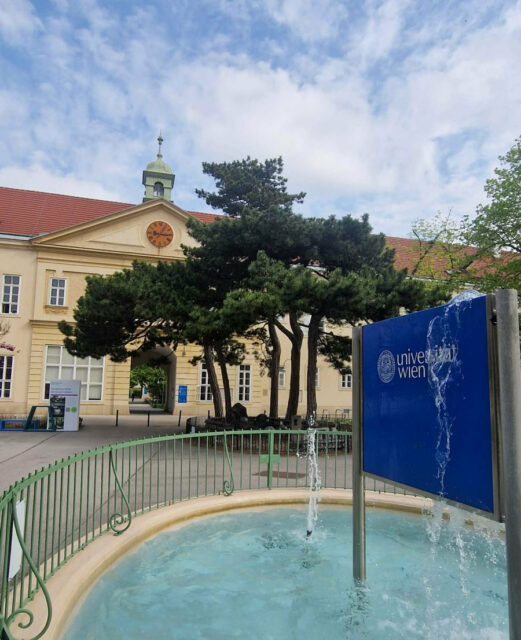
Michael Moser is one of the leading figures in Ukrainian language studies in the German-speaking world. He heads the International Association of Ukrainian Studies, has long been an advocate for Ukraine, and has just taken over as director of the Institute of Slavic Studies at the University of Vienna.
In this conversation, he talks about how Ukrainian went from one interest among many to the focus of his academic life, why Russia’s full-scale war against Ukraine forced a rethink of long-standing Western assumptions, whether Slavic studies is still struggling to shake off a Russia-centred lens, and how the role of the Ukrainian language is changing — inside Ukraine and far beyond it.
— Professor Moser, what initially led you to Ukrainian studies?
— In the early years of my Slavic studies, I already had a solid command of Russian and wanted to move beyond it — to explore other Slavic languages as well. That was when rather modest Ukrainian courses started appearing in our department. At first, Ukrainian was just one of several interests. But over time, it moved to the centre — especially from a scholarly point of view.
For my habilitation, I worked on Western influences on the Russian language, where Ukrainian — just like Polish — plays a key role. Gradually, that research shift became a personal one too: I moved from being primarily a Russianist towards becoming a Ukrainianist. I still work with and value other Slavic languages, but Ukrainian has taken the lead.
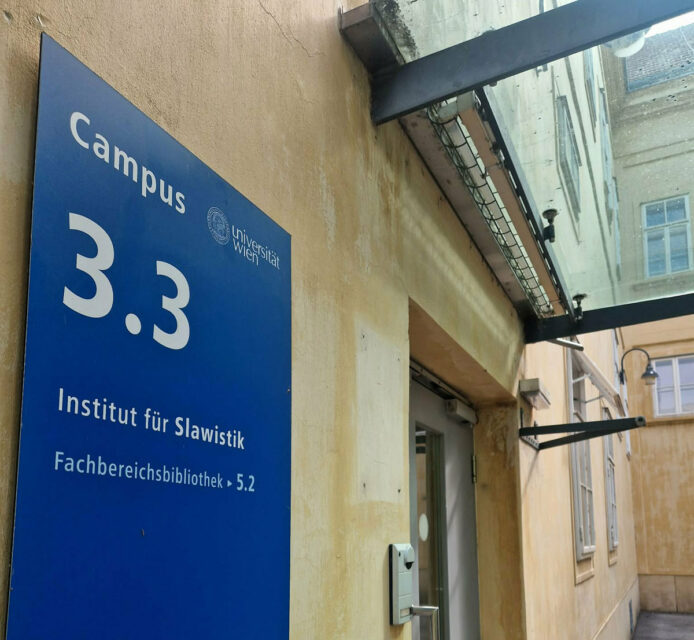
— How do you assess the place of Ukrainian studies in today’s academic landscape — particularly in German-speaking countries — and do you agree with the view that Western Europe understood Ukraine too late?
— Partly, yes, but the nuances matter. When the full-scale invasion began, there was indeed a very explicit acknowledgement in Western Europe of a lack of expertise on Ukraine — and for good reason. At the same time, it would be wrong to suggest that such expertise did not exist. It did, both in North America and across Europe. One only needs to think of the Harvard Ukrainian Research Institute or the Canadian Institute of Ukrainian Studies. Europe, too, has long had strong scholars working on Ukraine — in Italy, Austria, and Poland, among others.
Vienna, in particular, has historically been something of a special case: it has long been one of the centres of Ukrainian studies. Even before 2014, there were philologists and historians here who consistently worked on Ukrainian topics in a systematic way.
That said, if we look at the German-speaking world and Western Europe more broadly, the structural issue was elsewhere. Individual expertise existed, but institutionally Ukrainian studies remained relatively weak. There were very few places where it could be studied in a sustained, systematic way. So the issue is less a lack of knowledge per se than its marginal position. For a long time, Ukraine sat on the periphery of academic attention. That is now gradually changing. The key challenge going forward is to make Ukrainian studies not only more robust academically, but also far more visible and influential beyond the confines of specialist circles.
Overemphasis on Russia in Slavic studies is a long-standing problem
— Does a Russia-centred view still persist in European Slavic studies?
— Russia-centred approach wasn’t an accident; it was built into the system. For decades, “Slavic languages” were often treated as shorthand for Russian, while “East Slavic cultures” effectively meant Russia. Other languages and traditions were frequently sidelined or simply ignored. The result wasn’t just an academic blind spot — it shaped how an entire region was seen.
That legacy is still with us. While things are changing, the shift has been slow and uneven. It took Russia’s full-scale war against Ukraine to force many in the field to reassess long-standing assumptions — essentially when ignoring reality was no longer an option. Even now, Russian-centred narratives haven’t disappeared from academic spaces, though they are increasingly challenged.
The point, however, is not to abandon Russian studies. It is to rethink them. The discipline has to move away from reproducing imperial frameworks and towards a genuinely critical approach — one that can analyse Russia without inherited illusions.
— You were recently elected director of the Institute of Slavic Studies at the University of Vienna. What will your priorities be?
— To be honest, in academia this role carries a lot less weight than it might look like from the outside. I’ve held it before, so I know it’s not about a “strong hand” or any grand designs of power. It’s much more straightforward than that: the job is to run the institute well.
I’m not an autocrat by nature; I’m a democrat, so I’m not planning any big overhaul or trying to impose a personal agenda. The focus is on continuity — keeping things running smoothly, getting through the inevitable crises together, and maintaining a stable working environment.
In short, I’m not going to turn Viennese Slavic studies into an institute of Ukrainian studies — even if Ukrainian studies, of course, matter a great deal to me.
— Since 2022, the West has reassessed how it sees Ukraine. Is this a shift in perception, or is an image being built almost from scratch?
— Without a doubt, it’s both. Today, if you want to be considered broadly educated, you’re expected to have at least a basic grasp of the Ukrainian context. People are reading books on Ukraine’s history, discovering its literature, going to concerts, theatre performances, cultural events — and this is no longer limited to Ukrainian audiences. Interest in Ukraine and Ukrainian culture has clearly expanded across the West.
And as you rightly suggest, in many cases this is not simply a reworking of an existing image, but its formation from the ground up.
Where there was once a blank space, there are now contours, content, and meaning — though, of course, at an immense human cost. At the same time, it’s important to remember that this image is not shaped by Ukrainians alone. But among those who approach it in good faith, there is now a growing respect for Ukraine — for how it defends itself. Ultimately, Ukraine is its people: Ukrainian men and women, whose dignity, resilience and capacity for resistance have come to define how the country is seen today.
— One of the key themes here is language. How has the role of the Ukrainian language changed during the war?
— It depends how you look at it. I’m wary of taking every statistic at face value, but I do have friends and acquaintances across Ukraine — Kyiv, Sumy, Kharkiv, Odesa — and they describe the same shift: at the very start of Russia’s full-scale invasion, there was a clear surge in the use of Ukrainian. For many, language habits changed almost overnight.
You can see it beyond Ukraine as well. In Vienna, for instance, Ukrainian events are now conducted almost entirely in Ukrainian. And it no longer raises eyebrows when people from Mykolaiv or Odesa speak Ukrainian to each other. A few years ago, that would still have been the exception, not the rule.
— Should language policy be regulated by the state?
— The state already does that — and, in my view, quite rightly so. In Ukraine, there is an expectation that people know the Ukrainian language. That doesn’t mean other languages can’t be spoken, but the basic principle is straightforward: citizens are expected to know the country’s official language.
Overall, it seems to me Ukraine is moving in the right direction. I don’t have any fundamental objections to the way language policy is being developed. But beyond legislation, there is also the question of perception. For decades, Ukrainian was systematically downgraded — pushed into folklore, everyday speech, “low” culture. A high Ukrainian culture did exist, but it was often viewed with suspicion, sometimes even branded as “nationalist”.
Over the past decade, that has changed a lot — and that shift is, without question, an achievement.
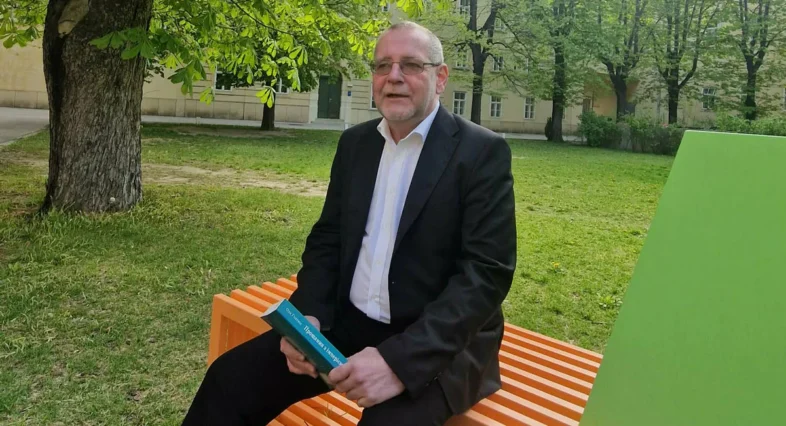
“Ukrainian language abroad needs systematic support”
— What can actually help sustain Ukrainian among Ukrainians abroad?
— I wouldn’t want to present myself as an authority on this — it’s not entirely my field. But I have tried to contribute in my own way. Back in 2022, together with colleagues, we planned to launch a programme in Ukrainian language and culture at the Institute of Slavic Studies for future teachers. Everything was ready, but the project wasn’t approved — we were told there was no demand.
I didn’t agree then, and I don’t agree now. The need was there, is there, and will likely remain for a long time. Not all Ukrainians will return after the war; some families will stay abroad, which means Ukrainian children need steady, structured support. I also view positively what is now being done to introduce Ukrainian in Austrian schools. And if that process continues, we will certainly try again to do what didn’t work out in 2022.
— Which Ukraine-related topics most urgently require researchers’ attention today?
— The central issue, let’s be honest, is the war. I continue to work on my long-standing research on 18th- and 19th-century linguistics, but at the same time I closely follow what is happening now. In recent years, my main focus has been Russia’s language policy in the temporarily occupied territories — a topic I’ve recently explored in a substantial two-part article.
What we urgently need to understand is what Russia is doing to language in these territories, and more broadly how the war is reshaping Ukraine’s linguistic landscape.
— Is there any real chance of preserving Ukrainian in the occupied territories?
— If we’re talking about the period of occupation itself, then I’m afraid not. It may be possible to restore the Ukrainian language after de-occupation, but during occupation, survival comes before any declarations. If I were in that situation myself, even as a strong supporter of the Ukrainian language, I would most likely not speak Ukrainian. I would want to survive.
After de-occupation, the picture would be different. But to be clear, the Russian linguistic and cultural footprint there is very strong. At the same time, even under occupation, there have been striking signs of resilience. A significant share of parents — 64% in the Kherson region and 46% in the Zaporizhzhia region — still demanded Ukrainian-language instruction for their children, even in those conditions. That was a direct response to Russian claims of an allegedly “democratic” approach to Ukrainian. On paper, Ukrainian may still exist, but in reality it is backed by violence and coercion.
“Ukraine is defending more than just itself”
— It’s often said that Ukraine is now driving the course of history. Do you agree?
— Absolutely. I have no doubts about it. I am not a military security expert, but as a humanities scholar familiar with Russian discourse, I can say quite clearly: Ukraine is defending not only itself, but also the broader framework of Western culture.
Those who still argue that Russia would never dare to push further west often simply misunderstand Russia. The same arguments were once made about Ukraine — that an attack was unthinkable. I, too, did not want to believe it until the very end. But reality proved otherwise. That is precisely why Ukraine’s role in European history today is so decisive.
— And finally: what would you like to say to Ukrainians, both in Ukraine and around the world?
— Let’s get through this together.