In recent years, pianist and ethnomusicologist Taras Filenko has spent much of his time travelling to countries where Ukrainians rarely go: India, Madagascar, Mexico, Costa Rica — and the list goes on. Each trip is a whirlwind of concerts, performances, and lectures, all carefully crafted to do more than just entertain. “You need a unique approach for every country,” Filenko told The Ukrainian Week. That’s how he prepares for his performances, whether in the so-called Global South or Western countries, especially the United States, where he has lived and worked for the past 25 years. His shows are deeply rooted in decades of research into Ukrainian musical culture, a passion he has devoted nearly his entire life to.
The Ukrainian Week spoke with Taras Filenko about bringing Ukrainian culture to the global stage, what resonates most when challenging defenders of Russian cultural dominance, and why Ukrainian music can’t be separated from questions of identity and politics.
— In the West and beyond, you often hear people talk about the so-called “great Russian culture,” and some say it should be kept separate from the war and atrocities Russia is committing. How do you respond to those who feel this way?
— It’s a difficult question because culture lies at the heart of national identity. But in wartime, we must resist the spread of a culture that fuels aggression—especially when it’s wielded as a potent propaganda tool to justify and whitewash the crimes of Russian fascism, and to promote the narratives of the so-called “Russian world.” This isn’t simply a conflict over land or resources; it’s a battle fought in the realms of culture, aesthetics, philosophy, history, and ideas. It’s a struggle over which values—especially spiritual and moral ones—will prevail.
At the same time, it’s crucial to highlight how the Russian imperial doctrine has appropriated and claimed vast swathes of our national heritage—much of it deeply rooted in Ukrainian culture. We must actively and professionally push back against this “cultural terrorism” and reclaim what was wrongfully taken. Many Ukrainian artists—composers like Vedel, Bortniansky, Berezovsky, Khandoshkin, and others—laid the very foundations of that heritage.
But over time, Russian culture became the dominant force of an imperial-colonial agenda. In this context, I believe Ukrainian culture must be presented as a kind of vaccine against Russian propaganda.
I’ve encountered resistance from this “Russian presence”, if you like, at my concerts in Mexico, Costa Rica, Africa, and India—and unfortunately, this sometimes extends to certain European countries too. That said, India stands out as a particularly fascinating and important country for Ukraine in many ways. On one hand, introducing Ukrainian culture challenges the culturally and politically Russian-leaning elite there. On the other, it offers an opportunity to establish Ukrainian culture on an entirely new level.
I believe performances should involve local artists—musicians, dancers, poets, ethnographers—to draw out the rich parallels between Indian and Ukrainian cultural heritage. Historically, our cultures share more common ground than one might expect. By highlighting these connections, we can make Ukrainian education, music, dance, and theatre more relatable and engaging for Indian audiences.
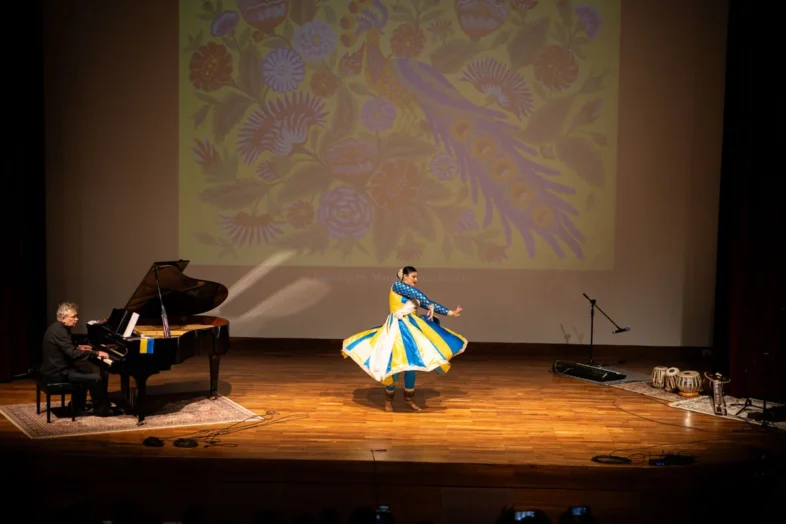
During the concert in New Delhi, March 2025, Indian dancer Nisha Kesari performed the traditional Kathak dance alongside musical improvisations by Taras Filenko. Photo: Abhineet Dang / Embassy of Ukraine in India
It’s telling that after one of my performances at a private educational institution in India, we were offered five scholarships for Ukrainian musicians. These scholarships provide opportunities for Ukrainian artists to teach and perform, with all living expenses covered by the Indian side. To me, this speaks volumes about their openness and eagerness to collaborate.
More broadly, when performing abroad—India especially—I often lean on associative comparisons to build bridges. For example, I highlight the shared values of tolerance between our countries. At the same time, I draw attention to the parallels between British imperial policy in India and Russia’s approach to Ukraine. I also explore more specific connections, from embroidery patterns and linguistic structures to the visual symbolism embedded in musical forms. Indian ragas and Ukrainian dumy, for instance, share remarkable similarities. At my concerts, I’ve invited performers to present both an Indian raga and a Ukrainian duma side by side, allowing audiences to hear the resonance between them. Some time ago, I even taught a course on Indian musical culture and anthropology at an American university.
— How do you think Ukrainian culture can be best presented alongside the West’s cultural traditions? And what aspects tend to resonate most with Western audiences?
— Each country demands its own unique approach. I carefully tailor every presentation to the specific audience, and my repertoire is always exclusively Ukrainian. I aim to offer a broad panorama of Ukrainian music, spanning composers from the Baroque era right through to the present day, covering the 18th to 21st centuries. Every performance is accompanied by visual aids—portraits of composers, historical documents, works by Ukrainian artists. Sometimes I include readings of Ukrainian poetry, both in the original language and in English. I time each concert down to the minute, because in a 90-minute performance, the audience needs to stay fully engaged with material that is often entirely new to them.
While I primarily perform piano works, I also play the organ and harpsichord when possible—I’ve even performed on all three instruments in a single concert. Once, I even mimicked playing the trembita, a traditional Ukrainian alpine horn. For each concert, I try to anticipate the audience’s background and the event’s purpose. A university demands one style of engagement; embassies or political gatherings require another. Every programme is carefully curated, with tailored visuals and commentary. It’s vital to speak, explain, draw comparisons, and show what life in Ukraine really looks like. The aim is not just to convey an emotional message, but also—crucially—to inform, depending on how familiar the audience is with Ukrainian culture.
I firmly believe that Ukraine should be understood within the context of European tradition. While Ukrainian culture was once superficially “linked” to Russian culture, it is in fact entirely distinct — historically rooted in Western cultural tradition, from the Baroque and Classical periods through to Romanticism.
In my performances, I always mention the Ukrainian-European traditions, where education, professional and cultural exchange, shared philosophical and aesthetic ideas, and fundamental democratic principles have been the driving forces of mutual development.
I also think it’s important to help audiences spot the historical parallels between Ukraine’s experience and those of other nations. Nearly every place I’ve performed has faced foreign invasion, oppression, or colonialism at some point. Ukraine’s current tragedy hits home more when people can relate it to their own history—whether it’s the destruction of Inca, Olmec or Maya manuscripts in Mexico, the Bengal famine in India, or the loss of traditional beliefs across South America. There are so many examples. In the US, for example, Indigenous musical traditions were almost wiped out, the Hawaiian language was harshly suppressed, and many northern tribes lost their rituals. These shared struggles help people understand the scale of what Ukraine is going through today.
It’s really important to draw analogies in the right way and to evoke the right emotions through music. For example, during my concerts, I show slides listing over 160 decrees that imposed bans on the Ukrainian church, culture, education, language, publishing, music—you name it. I don’t expect the audience to read through every single one, but I ask them to pick one or two to remember, so they can get a sense of the oppressive atmosphere Ukrainian composers lived and worked under, right up until quite recently. At the same time, I often invoke similar struggles from the countries I’m performing in—because every culture has faced some form of oppression at some point. This really helps people grasp what happened to Ukraine under the Russian Empire, and what’s happening now. Drawing these comparisons to historical and cultural experiences elsewhere is crucial.
Another key part is comparing musical genres or works within the same genre. The approach varies. Sometimes, I’ll play lesser-known pieces by Dmytro Bortniansky alongside works by his teacher, Baldassare Galuppi, and classical sonatas by Joseph Haydn—without telling the audience who composed what. Then I ask them to guess which is which. This often surprises people, making them realise that Bortniansky’s sonatas stand shoulder to shoulder with Haydn’s in artistic quality.
Or when I present rhapsodies, I might play those by Lysenko alongside Liszt and Brahms. Without any words, the music itself reveals the strength of Ukrainian musical culture—showing how the relatively unknown Lysenko matches up with giants like Liszt and Brahms.
— I recently found out that Dmytro Bortniansky’s music is played during the German army’s ceremony to thank the country’s top civilian leaders, including the Chancellor.
— Dmytro Bortniansky, like many Ukrainian musicians working within the Russian Empire, was educated at the Hlukhiv Academy. He had close ties with the celebrated Italian composer Baldassare Galuppi, who led the chapel in St Petersburg at the time. Galuppi took Bortniansky to Italy, where he composed three operas—some set to French texts—and staged them in prestigious venues, including the renowned Teatro San Benedetto in Venice. Bortniansky spent eleven years working there before being essentially forced to return to Russia, where he served for many years at the court of the heir to the throne. When the heir became emperor, Bortniansky was appointed censor of all Russian church music. This role gave him a unique opportunity to infuse contemporary compositions with traditional Ukrainian melodic styles and the polyphony of Ukrainian sacred music, which itself was influenced by European church polyphony.
In other words, Ukraine’s late Baroque and classical traditions became a cornerstone of Russian church music. Interestingly, after Bortniansky’s death, Pyotr Tchaikovsky spent several years editing his choral works, recognising him as a brilliant 18th-century composer and a singular figure in global choral music of that era. It’s crucial to keep emphasising that Russian culture is historically rooted in Ukrainian culture and education—and the name Bortniansky alone says a great deal in that regard.
In my view, these issues shouldn’t be confined to academic circles—they need to reach a much wider audience. From my experience, conferences or congresses usually draw about 20 to 50 people, while concerts attract far larger crowds. And these concerts should be educational on multiple levels—historically, politically, aesthetically, and musically. It’s also vital to spread the message beyond the stage: preparing thoroughly for media interviews and using every possible way to popularise Ukrainian culture. After one interview with a journalist from The Times of India, for example, I was told the paper’s readership is over 120 million, which shows the scale of the opportunity.
At my concerts, I always try to involve local artists who read Ukrainian poetry in Ukrainian, English, Spanish, and other languages. I ask audiences not to worry about understanding the Ukrainian language—most don’t—but to listen instead to the melody, the beauty, the ‘melos’ of the words and poetry. I also use 50 to 60 slides throughout my performances, showing Ukrainian painting, sculpture, photography—including powerful images from the war—as well as portraits of composers and poets, all woven into the musical experience.
— Why is Bortniansky talked about so much less than, say, Lysenko, despite all his achievements?
— Many of Bortniansky’s works have sadly been lost or destroyed over time. Outside of his choral compositions, only a handful of instrumental pieces have survived—and some of those were only recently rediscovered in libraries in France and Prague.
Today, Bortniansky is best known as a composer of sacred music, but his instrumental legacy hasn’t received nearly the attention it deserves. Often, his scores don’t specify dynamics, which is typical for Baroque music, and in my view, they invite interpretation—and even improvisation. I find it fascinating not to treat these works as fixed relics, like exhibits in a museum, but to bring them alive with a jazz-like spirit of improvisation. In fact, I often perform jazz improvisations based on Ukrainian themes.
At my last concert in India—which the Russians tried to block until just hours before, when we finally got police clearance in Delhi—I improvised on folk melodies, including the globally known “Shchedryk” by Leontovych. The presence of the US ambassador made the moment all the more significant given the current political climate. I also included improvisation on George Gershwin’s “Summertime,” a piece that is actually rooted in a Ukrainian lullaby. It’s a reminder that artists forced to leave Ukraine become part of our culture’s diaspora—planted in new soils. Gershwin’s grandfather was from Odesa, and he was familiar with Koshetz’s choirs and Ukrainian folk music.
These kinds of comparisons are crucial when it comes to representing Ukrainian culture abroad. Too often, Ukrainian musicians touring internationally include only one or two pieces by Ukrainian composers in their programmes, with the rest made up of familiar Western names like Brahms, Liszt, or Beethoven.
But I think the time has come to change that — to actively promote Ukrainian music that remains largely unknown outside our borders. Composers like Lyatoshynsky, Liudkevych, Stankovych, and Revutsky, as well as many contemporary artists, create work of exceptional quality that deserves a global audience.
Ukrainian culture should be showcased not just through musical excellence, but with an added layer of historical, political and cultural context. It’s not enough simply to perform a piece by Lysenko — it’s essential to explain the circumstances in which it was written. Sometimes, due to the political climate of the time, composers might never have expected their music to be performed widely or publicly. Bringing these stories to light makes the music all the more powerful.
Take, for example, the very different careers of Norwegian composer Edvard Grieg and Mykola Lysenko, who both studied at the Leipzig Conservatory. Grieg had the chance to work closely with symphony orchestras and opera houses during his lifetime — opportunities that Lysenko never had. Perhaps that’s why Lysenko’s output includes almost no full-scale symphonies; Ukrainian composers simply weren’t performed by symphony orchestras.
Lysenko wrote sixteen operas and two operettas, yet none were staged at professional opera houses while he was alive. His greatest work, the five-act historical opera Taras Bulba, went unheard in his lifetime. And yet, he was a brilliant composer — the only one in the world to set over 120 works to the poetry of a single poet, Taras Shevchenko. That kind of devotion has no parallel in global music history.
What’s more, Lysenko was a pioneer in bringing ethnomusicology into Ukrainian classical music — a milestone not just for Ukraine but for European and world musical history at the time.
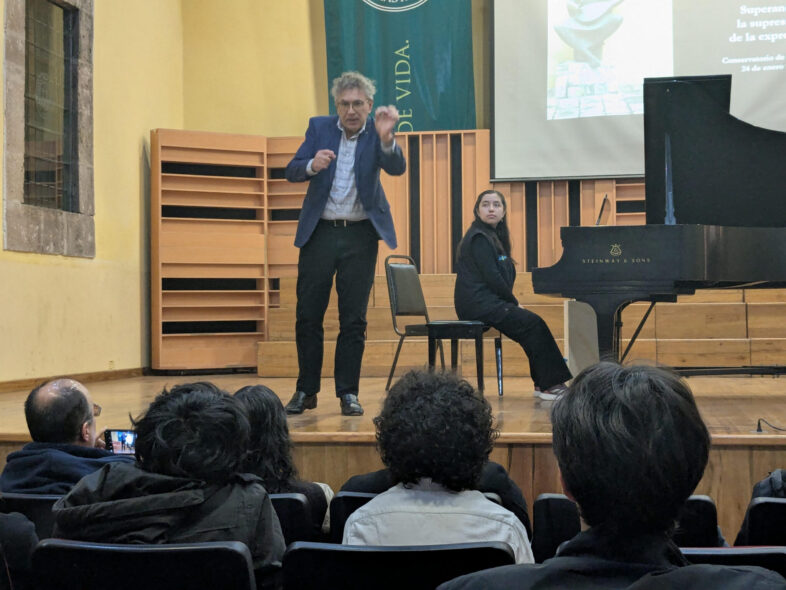
Taras Filenko leading a masterclass at the Conservatorio de las Rosas in Morelia, Mexico (January 2025)
— You’ve performed Ukrainian culture in places across the Global South — India, Madagascar, Mexico, and beyond. How challenging is it to organise concerts in these countries?
— It’s been a huge challenge, and an enormous amount of work. After the war started, I decided to leave teaching behind and focus entirely on concerts and educational talks to promote Ukrainian culture across America and beyond. Most of the support comes from colleagues, friends, and acquaintances. With the help of the diplomat Ihor Ostash, the Indian scholar and publicist Mridula Ghosh, and Ukrainian diplomats, I performed last year at the cultural centres of the French and American embassies in India. The US embassy had promised to back my future concerts, but when I arrived this year, a change in administration meant that support was withdrawn.
The weight of it all fell on our diplomats — especially the Ukrainian ambassador to India, Oleksandr Polishchuk, and embassy secretary Volodymyr Prytula. They pulled off the impossible. Over six weeks, we held concerts in Delhi, Mumbai, Kolkata, and across several states, including the remote Nagaland. We performed for a wide range of audiences: universities, colleges, schools, music academies, embassies, temples, and arts centres.
What really struck me was how warmly Indian audiences embraced Ukrainian music, especially when it was paired with Indian classical music and dance. I’m planning to return there in a few months. Places like China, India, and Africa are hugely important for Ukraine — not least because Russian propaganda operates so aggressively in these regions, using culture as a political tool to full effect.
From my experience, Russian embassies often create obstacles in countries like India, Madagascar, Mexico, and across South America more broadly. I was told that just days after my performances in India, Russian diplomats would visit the same venues, approaching Indian colleagues and musicians I’d worked with, offering collaboration—really, a way to exert ideological influence.
In Madagascar’s capital, Antananarivo, I managed to hold only one concert. Once it became clear I was performing solely Ukrainian works, the Russians blocked further events. A similar situation played out in Mexico. Organising concerts there was a real struggle, even with good contacts in academic and musical circles—like the conservatory in Mérida, the oldest music institution in the Americas, founded in 1740. Despite the challenges and the specificities of a Spanish-speaking audience, I still managed to put on concerts and lectures.
I’m very grateful to the Ukrainian embassy in Mexico for their support; our diplomats even travelled from Mexico City to attend the concerts. Looking ahead, we have plans for concerts in Mexico, Colombia, Latvia, Lithuania, and possibly Peru. I’m hopeful our embassies there will provide the backing we need.
— Given your unique research and the rising interest in Ukrainian culture and history, are you getting more requests from Ukraine these days?
— For the past 25 years, since moving to the US, I’ve made a point of regularly visiting Ukraine to perform. I’ve especially tried to perform in Eastern Ukraine, where many artists tend to avoid — places like the Donetsk region and Crimea. It’s much easier to tour the usual circuit — Lviv, Uzhhorod, Chernihiv, Poltava, Kyiv — but not so much in Debaltseve, Zaporizhzhia, Luhansk, or Donetsk.
I once studied for a year in Donetsk and saw firsthand how challenging the cultural scene was there. And it wasn’t just Donetsk — even in cities like Dnipro, Mariupol, and Zaporizhzhia, where I’m from, the situation was difficult. I think the state’s cultural development has suffered because artists often stayed within their comfort zones, rarely venturing out to these frontline regions beyond Kyiv and Lviv.
Despite the immense tragedy unfolding in Ukraine, this war has sparked a powerful rebirth of our culture, its dignity, and identity—borne out of blood and resilience. This isn’t just a matter of circumstance; it must become a conscious stance for the nation and every Ukrainian.
I often think about the role of individuals in these pivotal moments of history. If, decades ago, a handful of nationally conscious, art-minded Ukrainian families hadn’t stood firm against Russian chauvinism, our culture might look very different today. They endured and preserved our identity. Just as the idealism, faith, and sheer strength of resistance from the “Sixtiers” — the dissidents of the mid-20th century — sustained us then, today it’s a generation of Ukrainian cultural youth, wounded but stronger and more aware, who are carrying that torch.
There’s still a huge amount of work ahead to ensure Ukrainian identity, shaped and affirmed through culture, is recognised, whole, self-sufficient—and respected around the world.