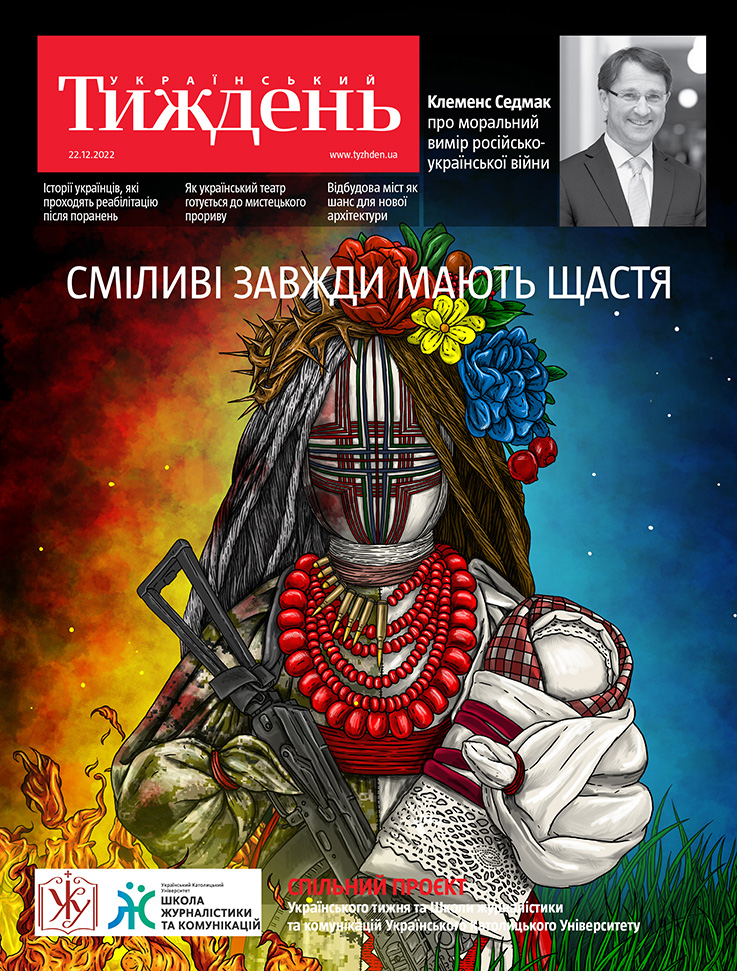
Yvan Baker, a Liberal Party member of the Canadian Parliament, has chaired the Parliamentary Group for Ukraine since 2020. Of Ukrainian descent himself, he spoke with The Ukrainian Week about Canada’s ongoing support for Ukraine, shifting public opinion on the war, the upcoming elections, and the influence of Donald Trump’s politics on Canada.
***
— Let’s talk about the big news: Mark Carney has just been elected Canada’s new Prime Minister, and it looks like Parliament will be going through some changes soon. How does this affect Canada’s support for Ukraine?
— Canada’s commitment to Ukraine remains firm. First and foremost, when it comes to peace talks, especially those proposed by Donald Trump, no decisions about Ukraine should be made without Ukraine at the table. That’s non-negotiable. Secondly, Canada has been clear, even before 2022: we don’t just support Ukraine’s independence, we stand firmly behind its territorial integrity. And that stance hasn’t changed. The peace we’re striving for must be lasting—Ukrainians need to know they won’t be facing another Russian invasion in the near future, whether it’s in a month, a year, or even ten years from now.
My position is simple: Canada, the United States, and Europe must continue supporting Ukraine until it wins. And not just because Ukrainians deserve our help, but because it’s in the best interest of Canada and the West.
If Russia succeeds in Ukraine, it won’t stop there. The fight will spread beyond Ukraine and we’ll find ourselves facing it, too—Canadians, Europeans, all of us—because we share a long border with Russia in the Arctic.
— Since 2020, you’ve been leading the Parliamentary Group for Ukraine. What have been some of the key decisions made during that time?
— Yes, this group is made up of Canadian MPs and senators from all political parties who support Ukraine. Our job is to push the Canadian government and party leaders to provide as much support as possible to Ukrainians. Back in 2021, when Putin was amassing troops at Ukraine’s borders, we were really pressing the government to step up with military, humanitarian, and financial aid. At that point, there was still a lot of uncertainty about how the West would respond to Russia’s full-scale invasion.
Since 2022, we’ve managed to secure a number of important decisions in Parliament — from increasing military aid to imposing sanctions on Russia, and even recognising Russia’s actions as genocide. The incredible bravery of the Ukrainian people convinced many Canadians, including politicians. But of course, we know this isn’t enough until we reach the ultimate goal: Ukraine’s victory.
As the head of the group, I also arrange numerous meetings with Ukrainian representatives and MPs visiting Canada. One of the most memorable took place in March 2022 when the first delegation of five Ukrainian female MPs arrived. We invited Canadian parliamentarians to meet them in the evening, and I’ve never seen so many Canadian MPs gathered in one place outside of Parliament — it was truly remarkable.
Our role is crucial: we’re here to help people understand what’s happening and teach them to spot fake news and misinformation about Ukraine. We also make sure to celebrate Vyshyvanka Day, Ukraine’s Independence Day, and honour the anniversary of the full-scale invasion and the victims of the Holodomors.
My grandmother survived the Holodomor, and three of her brothers died young because of the NKVD and the Soviet regime. Every year, I share this family story in Parliament: my grandmother always hoped that such atrocities would never happen again. I think it’s helped many people realise just how important it is to support Ukraine.
What happened in the 1930s is happening again today — just in a different form. And if we don’t help the Ukrainians now, this genocide will continue in the future. If the world truly understood this, it would have long ago given Ukraine the support it needs to win.
— What decisions regarding Ukraine are you working on right now?
— I’m really concerned about President Donald Trump’s stance on Ukraine. I’m in constant talks with our ministers, pushing them to continue providing as much military and financial support as possible. I’m also pushing for us to do more to convince the United States to step up in the same way, as Canada, along with Europe, does have some influence on American decisions.
I’m also advocating for Canada to be involved in negotiations aimed at ending the war in Ukraine. And when peace finally comes, I hope Canadian armed forces, along with European forces, can set up security guarantees that will ensure long-term peace and safety for Ukrainians.
— What are the general sentiments among Canadians regarding the war in Ukraine, and how have they shifted since the full-scale invasion began?
— Even though Canada is geographically far from Ukraine, Canadians feel a strong connection to it. The Ukrainian community has been here for over 130 years, and that long-standing bond has shaped a deep understanding of the situation. Canadians recognise that it’s in our best interest for Ukraine to win. Ukrainians aren’t just fighting for their own survival; they’re fighting for democracy itself. Canadians see the threat Russia poses to Europe in the east, but for us, it’s in the north. Many people here are incredibly grateful to Ukrainians for their courage and for defending not just themselves but all of us as well.
A significant number of Canadians were also deeply upset by the meeting between Donald Trump and Volodymyr Zelensky in Washington. They saw it as a huge insult—not just to the president, but to the entire Ukrainian people. This moment heightened the sense in Canada that we need to offer even more support to Ukraine, particularly in light of Trump’s policies.
When it comes to the shift in support over the past three years, there’s a small group of Canadians who’ve become somewhat weary of the war. However, this doesn’t reflect the views of the majority, who remain committed to supporting Ukrainians. A big part of my work is to remind Canadians why this support is so crucial. After all, the Canadian government represents the Canadian people—so for Parliament to continue supporting Ukraine, it’s essential that the people of Canada remain firmly behind that effort.
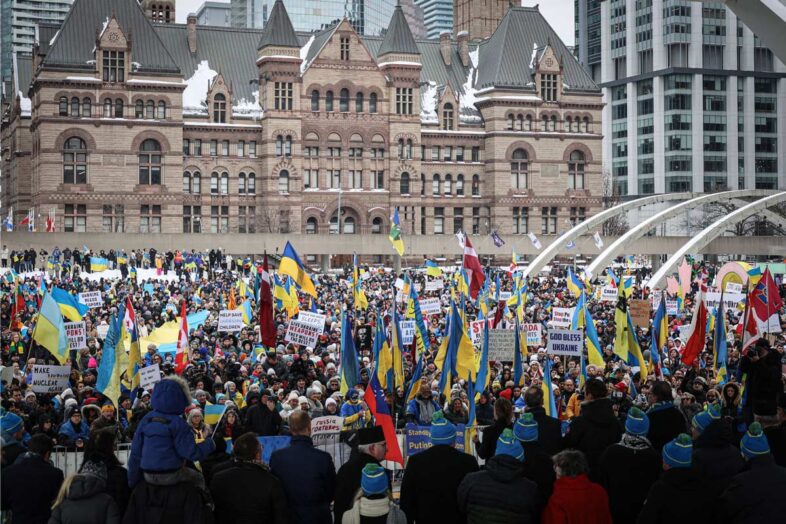
10,000 Canadians gathered in Toronto on the third anniversary of Russia’s full-scale invasion of Ukraine, urging Canada and its allies to stand with the Ukrainian people until victory is achieved
— At the start of the year, Canada announced it would provide $305 million in military aid to Ukraine, and the country is also training Ukrainian soldiers. How else can Canada assist Ukraine, particularly in light of recent statements from the United States?
— We are in constant communication with Ukrainian representatives at various levels, working to assist them in whatever ways they need. I’ve heard directly from the Ukrainian side that both military and financial aid remain crucial. Canada has already provided more support to Ukraine than any other country, relative to the size of our economy. On top of that, we’re leading an initiative to help support and repatriate Ukrainian children who’ve been deported by Russia.
This year, Canada is also chairing the G7, which gives us an opportunity to set priorities on the global stage. Our country can play a key role by influencing Ukraine’s major allies to ensure continued and robust support for Ukraine, particularly as we look to strengthen international resolve in the face of ongoing challenges.
— What about sanctions against Russia? Do you think they could be more effective, particularly from Canada’s side?
— Canada doesn’t trade with Russia, but I believe we can work more closely with other countries to make it harder for Russia to evade the sanctions that are currently in place. In my view, this is a significant issue. Just recently, as chair of the G7, Canada proposed new sanctions targeting the oil trade. Unfortunately, the US voted against it. So, yes, there’s definitely room for greater effectiveness, but much of that depends on how we collaborate with the US and Europe to ensure those sanctions are enforced more effectively.
It’s also worth noting that Canadians today feel a growing sense of threat from Donald Trump’s rhetoric — particularly when he suggests that Canada should become part of the United States and when he initiated an economic war. It’s deeply troubling to me that the American president is making decisions that seem to favour Russia, a country that has long been an adversary of the US, while simultaneously taking actions that harm Canada, a nation that has historically been its closest ally.
Trump’s statements about Canada not being independent, claiming the border between us and the US is wrong, and suggesting that Canadians would be better off as part of the States — along with his remarks about wanting to annex Canada — all follow Putin’s script. The steps are strikingly similar. This is exactly what he’s been doing, and continues to do, with Ukraine. So, Canadians are incredibly proud of their identity. We have many friends in the US, but we will stand firm in defending our independence.
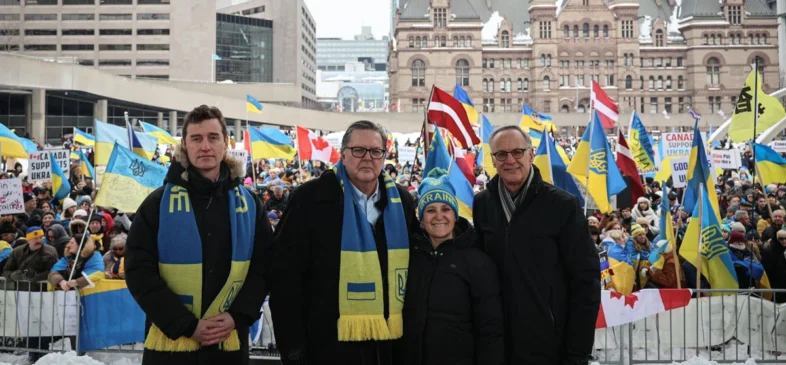
Together with Members of Parliament Chrystia Freeland, James Maloney, and Rob Oliphant
— Opposition parties have declared they may not recognise the current parliament, which means Canada is heading towards elections soon. Does Donald Trump already play a significant role in this race?
— Yes, absolutely. The key question for nearly all Canadians right now is how the country will respond to the threat posed by America. I think there’s a big risk during this election — and Ukrainians are well aware of this — that foreign countries will try to influence the outcome. This is especially true for Russia and the US.
The Conservative Party has traditionally been a strong supporter of Ukraine, but under Pierre Poilievre’s leadership, that’s changed. Now, they vote unanimously against free trade with Ukraine and military aid. In other words, the Conservative Party’s stance under Poilievre aligns closely with Trump’s policies. One of my main goals is to make sure Canadians are aware of this, and that those who back Ukraine — or those who want Canada to stand firm — vote for the parties that will take that stance. Unfortunately, Pierre Poilievre isn’t following that path.
— What are your predictions for the upcoming elections?
— I’m hopeful that the Liberal Party will come out on top. Of course, it’s ultimately up to the Canadian people, and a lot can change during the campaign. But I believe the stakes are high for the future of our country, especially with the threat posed by Trump. It’s also crucial for Canada’s support of Ukraine, as we are one of the world’s leading nations on this front. So, the outcome of these elections will have significant implications for Ukrainians as well.