
Naval power is becoming increasingly crucial in modern warfare as emerging threats push for more sophisticated, long-range strike capabilities. To safeguard national interests at sea, naval forces must stay ready for combat.
Success on the water is key to broader strategic goals. Ukraine’s Defence Forces achieved a major victory between 2022 and 2024 by driving Russia’s fleet from the Black Sea, lifting the naval blockade, and reopening vital export routes. In March 2024, Ukrainian maritime drones also disrupted Russian shipping between Novorossiysk and the Syrian port of Tartus.
Similarly, US and NATO naval vessels equipped with advanced air and missile defence systems have successfully intercepted missile and drone attacks by Iran and its proxies, including the Yemeni Houthis, against Israel and civilian ships in the Red Sea since October 2023. However, the threat persists, and the US and its allies continue to maintain a strong naval presence in the region, led by nuclear-powered aircraft carriers.
Evolution of remote sea warfare
War is no longer confined to the Black and Azov Seas; it is now taking shape across multiple theatres, from the Baltic and Mediterranean to the Red Sea. The Far East, South China Sea, Persian Gulf, and Taiwan are all emerging as potential flashpoints for naval conflict. Beijing’s ambitions to seize Taiwan, possibly as soon as 2027—or even earlier, depending on the trajectory of the war in Ukraine—are well known despite Taiwan’s long-standing independence from China. Large-scale Chinese provocations around the island have become an unfortunate part of today’s geopolitical reality.
In response, a coalition of nations, including the United States, Japan, South Korea, Australia, New Zealand, the United Kingdom, the Philippines, and India, is preparing to contain or confront China’s growing maritime assertiveness. During international military exercises, their navies are trained for scenarios ranging from defending Taiwan against invasion to potentially blockading China’s maritime supply routes.
It is no coincidence that industrially advanced maritime nations are pouring significant resources into expanding their navies, building new ships, and developing cutting-edge naval weaponry. The stakes have never been higher, and failing to invest in naval capabilities can leave a country vulnerable to adversaries—an oversight that could ultimately lead to defeat. This overview examines the largest and most recent platforms under construction—aircraft carriers, destroyers, and frigates—vessels built for operations in both maritime and oceanic zones.
Aircraft carriers, the cornerstone of naval power
Aircraft carriers remain the largest and most technically advanced warships in the world, with only a handful of nations— the United States, China, Italy, France, and Turkey—capable of building them. In addition to traditional carriers, aircraft are now deployed on amphibious assault ships operated by the U.S. Marine Corps, as well as the navies of Japan, South Korea, China, and Italy. Iran has also expressed its ambition to join this exclusive group of carrier-operating nations.
For the U.S., aircraft carriers are a crucial tool for maintaining strategic dominance at sea and countering China, its primary maritime challenge. A steady modernisation programme is underway, gradually replacing parts of the 11-strong fleet with advanced Gerald R. Ford-class ships. In 2025, Newport News Shipbuilding will deliver the second ship of the class, USS John F. Kennedy (CVN 79), launch the third, USS Enterprise (CVN-80), in November, and lay the keel for the fourth, USS Doris Miller (CVN 81), in January 2026.
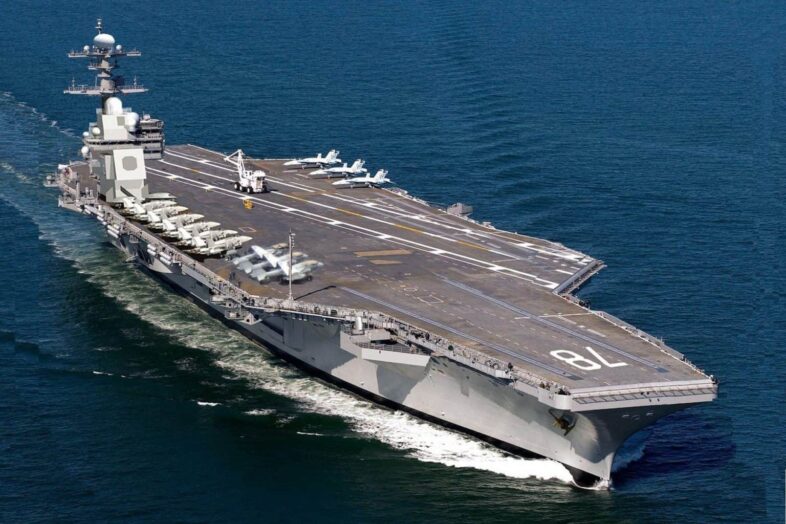
American supercarrier USS Gerald R. Ford (CVN 78)
American supercarriers – the largest in their class. The USS Gerald R. Ford, like other American supercarriers, stands as the largest warship of its kind. At 337 metres long, 78 metres wide, and 76 metres tall, it displaces a staggering 112,000 tonnes. Powered by nuclear propulsion, it can reach speeds of over 30 knots. Its crew, which includes air wing personnel, totals 4,660 sailors, petty officers, and officers.
The carrier’s main weapon is its air wing, which consists of 80–90 aircraft, including F/A-18E/F Super Hornets, EA-18G Growlers, C-2 Greyhounds, E-2 Hawkeyes, F-35 Lightning IIs, along with Sikorsky SH-60 Seahawk helicopters and combat drones.
Meanwhile, China is swiftly advancing its own aircraft carrier programme. In November 2024, trials began for the new Fujian, which weighs in at 80,000 tonnes, is 313 metres long, and 75 metres wide. This carrier is a step forward from the unfinished Project 11436 Varyag, which China acquired from Ukraine in 2000. Fujian is fitted with three electromagnetic catapults, unlike its predecessor, which featured a ski-jump ramp.
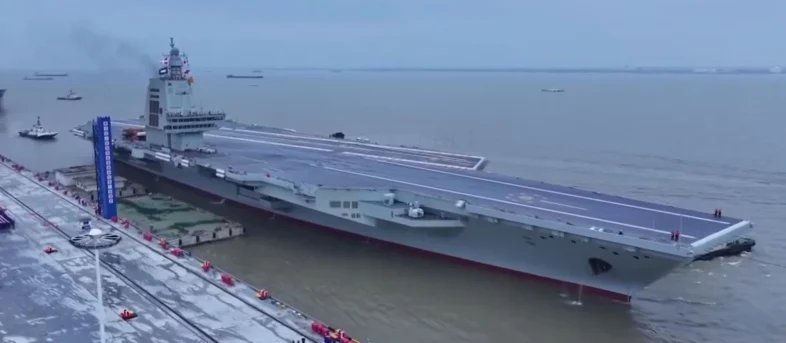
The new Chinese aircraft carrier Fujian (Type 003)
In late November 2024, China began testing a newly designed aircraft carrier, built by Guangzhou Shipyard International. Measuring 200 metres long and displacing up to 15,000 tonnes, the vessel stands out for its fully horizontal flight deck, three superstructures along the starboard side, and a docking chamber at the stern. Recent reports suggest that China classifies this ship as a carrier for advanced integrated multi-domain unmanned systems, with no direct equivalent anywhere in the world.
Meanwhile, France has announced plans to fund the construction of a next-generation nuclear-powered aircraft carrier starting in 2025 under the Porte-avions de nouvelle génération (PA-NG) programme. The design phase is expected to wrap up by the end of 2025. Displacing between 75,000 and 80,000 tonnes, and measuring 310 metres in length and 80 metres in width, it could become the largest warship ever built in Europe.
The carrier will feature an 80 MW propulsion system powered by two K22 nuclear reactors developed by TechnicAtome. It will have a top speed of 27 knots and accommodate a crew of 2,000 sailors, petty officers, and officers.
On 7 December 2024, the Italian Navy commissioned the amphibious assault ship (LHD) L 9080 Trieste, which replaces the light aircraft carrier Giuseppe Garibaldi. The new LHD features a full-length flight deck with a ski-jump at the bow and a superstructure on the starboard side.
Turkey is also making strides in expanding its aircraft carrier fleet. On 2 January 2025, construction began on the MÜGEM (Milli Uçak Gemisi – Turkish National Aircraft Carrier) at a shipyard in Istanbul. At 285 metres long and with a displacement of up to 60,000 tonnes, the ship will be powered by a gas turbine propulsion system, capable of reaching a top speed of 25 knots and a cruising range of 10,000 miles. Its air wing will comprise 50 aircraft, including fixed-wing planes, helicopters, and various types of drones.
Turkey’s push to add aircraft carriers is no accident. It reflects Ankara’s ambitions in the Mediterranean (notably Syria and Libya) and the Persian Gulf, where it operates its only overseas military base in Qatar. It also ties into efforts to ramp up domestic extraction of hydrocarbon resources from offshore fields. Should Qatar proceed with its plan to build a gas pipeline to Europe via Syria, Turkey could emerge as a pivotal player in the region.
Fleets’ missile defence umbrella
Aircraft carriers typically operate with a group of escort ships, such as destroyers and frigates, which are multi-role platforms offering anti-submarine (ASW), air defence (AD), and missile defence (BMD). Today, destroyers are increasingly replacing missile cruisers and have become the largest ships built by the United States, China, Japan, South Korea, and Turkey.
As of November 2024, the US was constructing 11 Arleigh Burke-class destroyers of the Flight 3 version, with an additional eight already ordered. On 22 November 2024, Ingalls Shipbuilding launched the 83rd ship in the series—the USS Sam Nunn, an Arleigh Burke-class destroyer with a displacement of 9,648 tonnes. The ship measures 155.29 metres in length, 20.4 metres in width, and has a draft of 6.57 metres. Powered by gas turbines, it can reach speeds of up to 32 knots and has a range of 6,000 miles. The crew consists of up to 330 sailors, petty officers, and officers.
A standout feature of the USS Sam Nunn is its AEGIS multi-functional missile defence system, which allows it to intercept ballistic missiles targeting the ship. The system also facilitates real-time data exchange with other US Navy ships, allied nations, and airborne early warning aircraft. This capability has made the system a standard choice for US allies, including Japan, Australia, Spain, and South Korea.
Australia, for example, built three Hobart-class AEGIS destroyers for its Navy between 2017 and 2020, each equipped with a Mk-41 VLS with 48 cells. Japan has also made strides, commissioning two Maya-class destroyers, with plans to add two more by 2027–2028.
South Korea recently joined the ranks of AEGIS missile destroyer builders. On 27 November 2024, Hyundai Heavy Industries delivered the first of six planned ships, the ROKS Jeongjo the Great, a KDX-III Batch-II destroyer. The second ship in the series, Dasan Jeong Yak-yong, is expected to launch in 2025.
The standard displacement of the South Korean destroyer is 8,100 tonnes, with a length of 170 metres, a cruising speed of 30 knots, and a crew of 300 sailors, petty officers, and officers. Its primary mission is to intercept North Korean ballistic missiles, for which it will be armed with SM-2 and SM-3 surface-to-air missiles in the Mk-41 VLS.
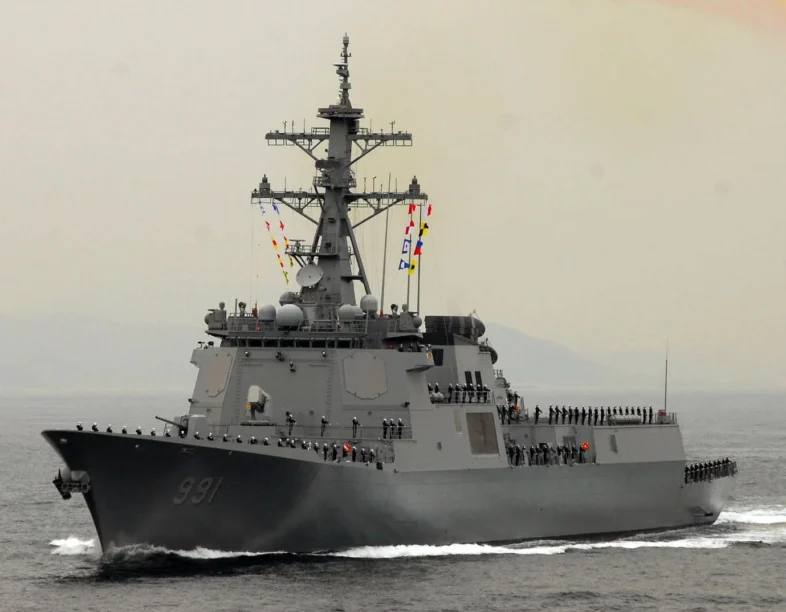
South Korea’s lead AEGIS destroyer, ROKS Jeongjo the Great
Meanwhile, China continues its ambitious plans with a series of 16 large Type 055 missile destroyers (Nanchang). The ninth ship in the series was launched in May 2024. At 183 metres long, 20 metres wide, and with a draft of 6.6 metres, the ship has a full displacement of 13,000 tonnes. Its gas-turbine-based power plant consists of four QC-280 gas turbines, generating 28 MW. It can reach a maximum speed of 30 knots, a range of 5,000 nautical miles, and carries a crew of over 300 sailors, petty officers, and officers.
In China, the Type 055 destroyers are classified as fourth-generation ships, though Americans more accurately label them as missile cruisers. For the People’s Liberation Army Navy (PLAN), these vessels serve dual purposes: as escorts and protectors for aircraft carriers, as well as independent tools of power projection in far-flung regions. In fact, they often act as flagship command vessels for naval forces. It is no accident that PLAN destroyers, as key instruments of China’s foreign policy, are increasingly appearing in the Pacific and Indian Oceans, the Persian Gulf, the Red Sea, the Mediterranean, and even the Baltic Sea.
Turkey is the next nation ramping up its destroyer construction. On 2 January 2025, the keel of the first ship in a series of eight, the TF-2000 air defence destroyer, was laid at Istanbul Naval Shipyard. The primary mission of these ships will be to provide air and missile defence for Turkey’s aircraft carriers.
The TF-2000 will have a displacement of 8,600 tonnes, a length of 149 metres, a width of 21.3 metres, and a draft of 5.75 metres. Its main propulsion system will combine diesel and gas turbines, enabling a speed of over 26 knots.
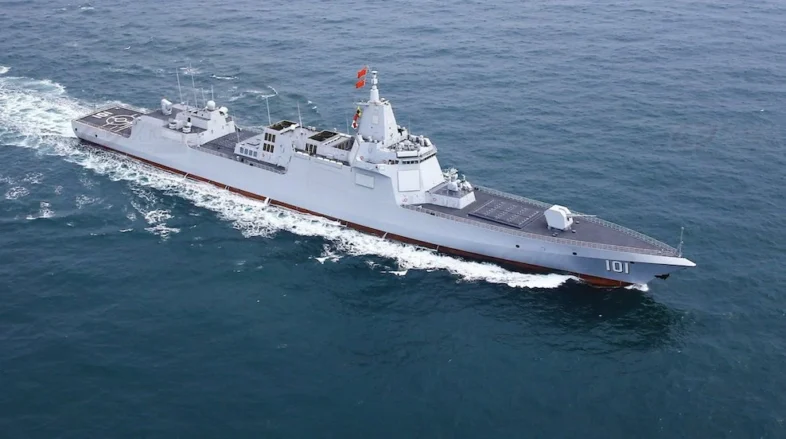
Chinese Type 055 large missile destroyer
Frigates – the backbone of the navy
Frigates (FF) are among the most versatile and widely used platforms in global navies, prized for their size and flexibility. Smaller and less powerful than destroyers, they remain integral to modern fleets. Countries like China, the UK, France, Germany, Italy, Spain, the US, Japan, Turkey, South Korea, Poland, and Russia continue to build new frigates.
A notable entry in this category is France’s ambitious Frégates de Défense et d’Intervention (FDI) program. The lead ship of the class, Amiral Ronarc’h (D 660), began sea trials on 7 October 2024.
One of the standout features of these frigates is the distinctive “water-cutting” shape of their bow, designed to enhance seaworthiness and reduce radar visibility. Yet, despite its modern design, the ship’s architecture harks back to the battleships of the early 20th century.
The Amiral Ronarc’h is equipped with cutting-edge radio-electronic systems, including the Thales Sea Fire 500 multifunctional radar with AESA capabilities in an integrated mast, the SETIS Combat Management System, hull-mounted and towed sonar arrays, the Aquilon communication system, advanced navigation systems, and the SENTINEL electronic warfare system. Cybersecurity is also a top priority, making these frigates the first to offer full protection against digital threats.
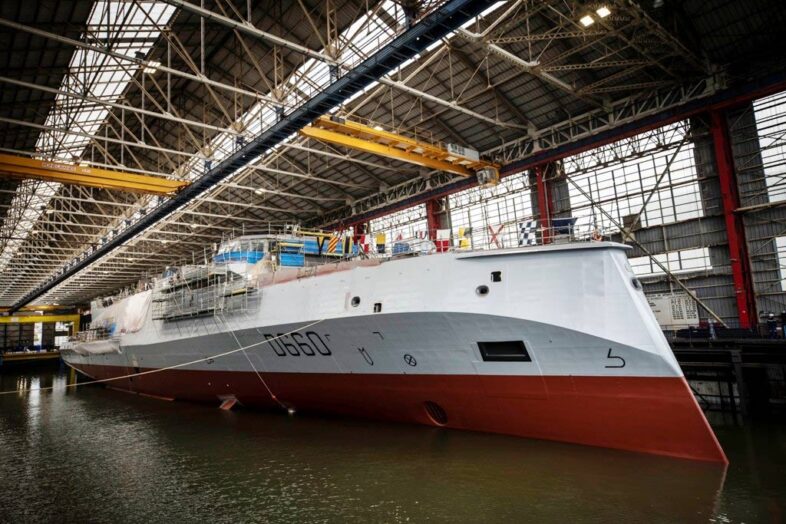
The lead French FDI-class frigate, Amiral Ronarc’h (D 660)
A notable new entry in the frigate category is South Korea’s ROKS Chungnam III (FFG-828), part of the FFX Batch-III program. Set to be delivered by the end of 2025, the class will consist of six ships in total. One of the key innovations of the Chungnam III is its new “integrated mast,” which houses several advanced technologies, including a radar with an active phased array antenna, an infrared search and tracking system, and an electro-optical surveillance system.
Experts see these frigates as a significant leap forward, serving as a testing ground for cutting-edge combat systems that will likely equip future surface ships, notably the “integrated mast” and the CIWS-II anti-aircraft gun system.
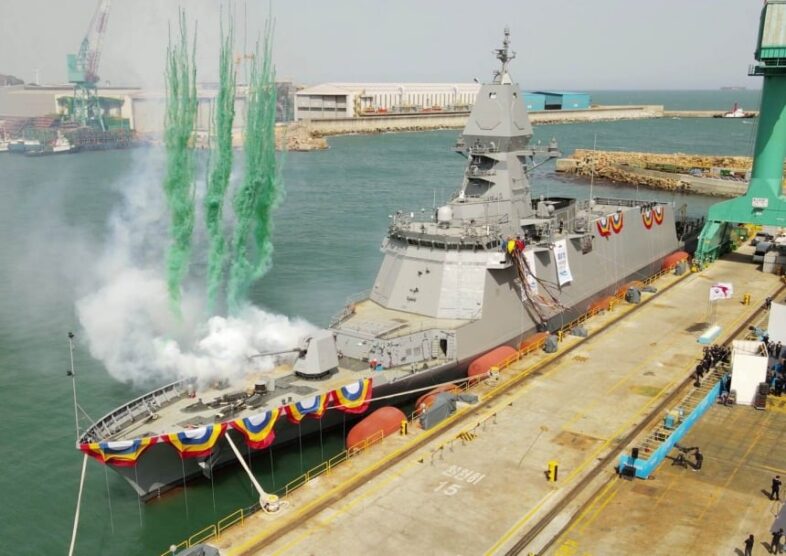
The lead South Korean FFX Batch-III frigate, Chungnam (FFG-828)
China is also making strides in frigate construction. On 22 January 2025, the lead frigate Luohe of the new Project 054B class was commissioned into the Chinese Navy.
In Turkey, the MİLGEM project continues to progress with the launch of two new frigates. On 10 and 11 January 2025, the TCG İzmir (F516) and TCG İzmit (F517) were launched at the Istanbul Naval Shipyard.
In Italy, the FREMM (Fregata Multi-Missione) project continues with the construction of multi-role frigates, including the Bergamini class. The following two ships in the series, the 11th and 12th, are set to begin construction in 2025 and 2026, and will feature an updated GP-EVO configuration. These new vessels will be capable of both air defence and anti-submarine warfare, powered by a new powerplant.
The EVO version will differ from the original design in several key areas. It will include dual-band AESA radars (C-band and X-band), a 76mm STRALES gun with DART anti-aircraft ammunition, and an increase in Sylver VLS missile cells to 32.
After a long hiatus, the United States has resumed frigate construction with a series of 20 FFG(X)-type ships based on a modified version of the FREMM design. On 12 April 2024, Marinette Marine Corporation (owned by Italy’s Fincantieri) laid down the lead ship, USS Constellation (FFG 62), at the shipyard.
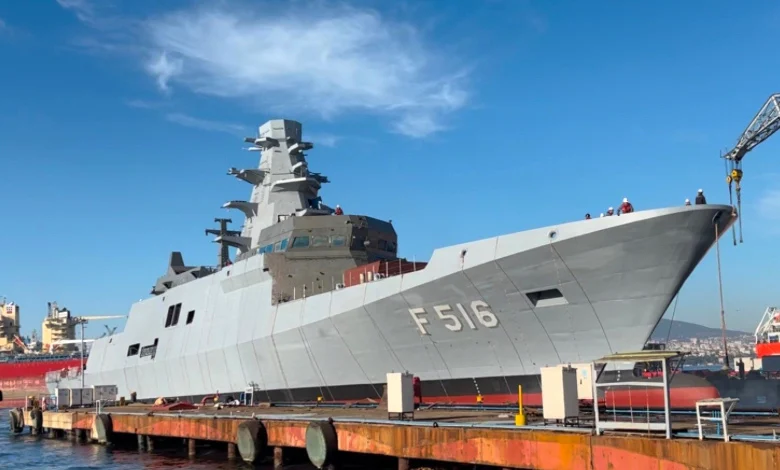
Turkish frigate TCG İzmir (F516)
In Japan, the Ministry of Defence and Mitsubishi Heavy Industries have signed a $1.16 billion contract to build two new multi-role Shingata FFM frigates. Over the next five years, 12 ships will be constructed in total. A key feature of the Japanese frigates is their inclusion of remotely operated underwater systems for detecting and neutralizing sea mines. This will enable them to take part in mine countermeasure operations, setting them apart from other global counterparts.
The United Kingdom is simultaneously advancing two frigate construction programs. BAE Systems is building eight Type 26 frigates for the Royal Navy, with the first, HMS Glasgow, set to join the fleet by the end of 2028, followed by the rest in the early-to-mid 2030s. These ships will be versatile and designed for anti-submarine warfare, air defence, and general operations.
Norway has signalled its intent to purchase at least five Type 26 frigates from the UK, raising the possibility that Glasgow might be sold to them once completed.
In Spain, Navantia has begun work on the F110 class of frigates, with the lead ship, F111 Bonifaz, expected to launch in 2025.
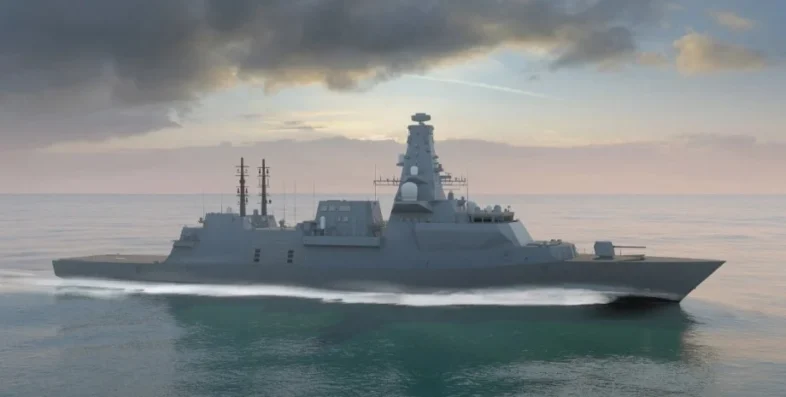
Visualisation of the future British Type 26 frigate
Meanwhile, Germany is building a series of four multi-role F126 frigates. These ships are designed to operate in both traditional naval warfare and asymmetric conflicts. The F126’s capabilities will be adaptable, with “mission modules” that can be introduced as needed, with dedicated space and power already incorporated into the design.
Poland is moving forward with a program to build three multi-role Miecznik-class frigates as part of its Armed Forces’ Technical Modernization Plan for 2021–2035. The trials for the lead frigate are expected between 2028 and 2030, after which ORP Wicher will join the Polish Navy. These new frigates are not intended for the shallow waters of the Baltic but for NATO operations in the Atlantic, Mediterranean, and other far-reaching regions.
A similar parallel can be drawn with the new Ada-class corvettes for Ukraine’s Navy, being built in Turkey. Like other ships provided by naval coalition partners, these corvettes are likely to serve not only in the Black Sea but also in future international missions under the UN, EU, and NATO.
Ukraine’s growing naval fleet is certainly a positive step forward. The country’s new Maritime Security Strategy, approved on 22 November 2024, also includes plans to add two more corvettes by 2026 and 2030. Further strengthening this push for a balanced navy is the 100-year partnership agreement signed with the United Kingdom on 16 January 2025. This deal lays the groundwork for joint efforts with the Royal Navy to safeguard shipping routes and protect trade in the Black and Azov Seas, as well as other key strategic waters.