As the November presidential elections loom, the United States is grappling with growing unease while the political landscape within the European Union fluctuates between left- and right-wing factions. Meanwhile, in the UK, the Conservative Party has faced what could be one of the most significant defeats in its history during recent parliamentary elections, leaving the newly elected Labour government to tackle a daunting array of economic and social challenges. These developments, coupled with various other pressures, have prompted Ukraine’s key allies to redirect their focus inward, thereby delaying crucial foreign policy decisions—especially regarding sustained support for Kyiv in its resistance to Russian aggression. In this shifting landscape, Canada stands apart, its own elections scheduled for next year, allowing it a moment of relative detachment.
Historically, relations between Kyiv and Ottawa have been notably strong: a significant Ukrainian diaspora has helped nurture cultural ties, economic cooperation has expanded steadily with the signing of a free trade agreement, which was later broadened to cover new goods and services, and diplomatic engagement has been frequent and largely effective.
The onset of Russian aggression and the accompanying political developments in Ukraine have provided a renewed impetus for cooperation, extending into critical areas such as security and defence. Since that pivotal moment, Canada has emerged as a steadfast supporter of Ukraine, vigorously championing its interests across various international platforms. While this support may be viewed by casual observers as a given, often fading into the background of global affairs, Canada plays a crucial role on the international stage, equipped with its own agenda and the capacity to shape the trajectory of key processes.
At the forefront of solidarity with Ukraine
When discussing the international response to Russian aggression against Ukraine, we can’t overlook the issue of economic sanctions. While it’s fair to criticise Ukraine’s international partners for the limitations and effectiveness of these measures, sanctions have nonetheless played a crucial role in containing the Russian Federation. They have also served as a clear indicator of support for Ukraine’s sovereignty within the framework of international law.
The Canadian government was among the first to implement sanctions against Russian companies and officials in the wake of Crimea’s occupation and the onset of hostilities in eastern Ukraine in 2014. Since then, the sanctions lists have been progressively expanded to encompass a broader range of entities and sectors, with the most significant increase—nearly fourfold—occurring following the initiation of Russia’s full-scale aggression in 2022.
Ottawa has actively coordinated its sanctions policy with international partners, synchronising the implementation of restrictions and bans on cooperation with Russian individuals and entities contributing to the ongoing aggression.
A particularly compelling issue in this context is the confiscation of frozen Russian assets, a topic that has long sparked debate. Less prominently featured in the Ukrainian information landscape is the fact that Canada was among the first countries to enact legislative amendments facilitating the confiscation of Russian assets in support of Ukraine. Canadian lawmakers approved these amendments to the Special Economic Measures Act in June 2022. Since then, two significant instances have demonstrated the practical application of these provisions. The first involved the seizure of $26 million from Granite Capital Holdings Ltd., a company owned by Russian oligarch Roman Abramovich. The second case concerned the confiscation of an Antonov An-124 cargo plane belonging to the Russian state airline Volga-Dnepr, which was included on Canada’s sanctions list. In both instances, the seized assets and property were allocated as aid to Ukraine, underscoring Canada’s commitment to supporting its ally in the face of aggression.
While the direct confiscation of assets belonging to Russia’s Central Bank has yet to be realised, Ottawa has actively championed this issue on international platforms, such as the G-7, advocating for enhanced coordination with its allies. Simultaneously, Canada has been refining its own bureaucratic processes to facilitate these efforts. This year has seen significant strides in this direction, as the United States and the European Union have adopted similar measures regarding the confiscation of Russian assets, with strategies for practical implementation now under development.
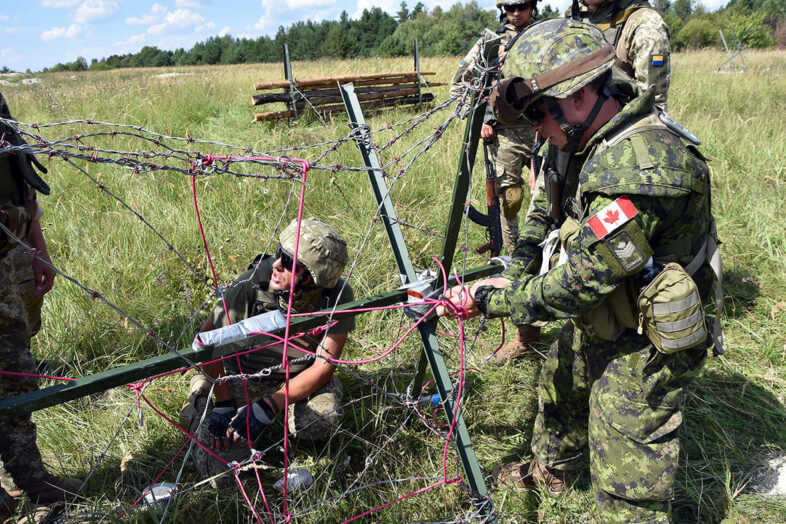
Canadian and Ukrainian sappers during training at the International Peacekeeping and Security Centre in Starychi, 2017. Source: www.canada.ca
Canada has shown a solid commitment to supporting Ukraine through military-technical cooperation. Since 2014, the Canadian government has launched several programmes aimed at providing extensive support and training to the Ukrainian Armed Forces. One of the standout initiatives is Operation UNIFIER, which was one of the first and largest training missions for Ukrainian troops. This mission not only provided training within Ukraine but also coordinated efforts with other nations. Following Russia’s full-scale invasion, the mission was moved outside Ukraine and integrated into wider initiatives focused on preparing military personnel at various levels.
When it comes to direct military support, it’s important to note that Canada’s own military resources are relatively modest compared to those of its allies. However, as a NATO member, Canada has access to a broad range of weapons and military equipment used by the Alliance, and it has actively sought to provide meaningful assistance to Ukraine on both bilateral and multilateral levels.
Indeed, within days of Russia’s invasion on 24 February 2022, the Canadian government announced a series of military supplies to Ukraine, including anti-tank weapons, small arms, sniper systems, and personal protective equipment. By April 2022, Canada, in collaboration with the United States and Australia, delivered the first 155-mm M777 towed howitzers to Ukraine. Around the same time, it began regular shipments of ammunition sourced from Canadian stockpiles and procured from other countries, notably the United States. Ottawa was also among the first nations to pledge support in supplying German Leopard tanks to Ukraine. Subsequently, Canada provided eight Leopard 2A4 tanks from its fleet of 82 Leopard 2 tanks of various modifications and contributed to the establishment of a tank repair centre in Poland.
Canada’s involvement in the “F-16 coalition” is especially important in terms of supporting Ukraine. It’s worth noting that the Canadian Air Force has a relatively limited fighter fleet that doesn’t include F-16s. However, this hasn’t stopped Canada from actively participating in international efforts to supply these jets to Ukraine.
Canadians have funded aircraft and equipment purchases, sent personnel to training centres, and offered organisational support for these initiatives. This strategy extends to other areas of Canada’s aid to Ukraine as well. The government provides weapons and equipment whenever it can and aligns its political and financial contributions with those of its allies, particularly when its own resources are constrained.
The political dimension of Canada-Ukraine relations is equally significant and cannot be overlooked. A considerable majority of Canadians hold a positive view of Ukraine, transcending political affiliations. Interactions between military and political leaders during reciprocal visits have become routine, and the legal framework for bilateral cooperation continues to evolve. Canada actively champions Ukraine’s interests across various international platforms, including NATO, the G-7, the G-20, and the United Nations. Prime Minister Justin Trudeau and other representatives of the Canadian government have consistently expressed public support for Ukraine’s European and Euro-Atlantic aspirations, as reflected in numerous declarations and the bilateral Agreement on Security Cooperation.
Additionally, Canada has been instrumental in advancing Ukraine’s peace formula. Ottawa has consistently called for the restoration of justice and accountability for war crimes while also initiating and coordinating efforts to repatriate illegally deported Ukrainian children. As a leading agricultural nation, Canada has made significant strides to stabilise global food markets amid restrictions on Ukraine’s grain exports from its ports.
The way forward
Can we identify certain shortcomings in the approaches adopted by Canadian leaders in collaboration with their American and European counterparts? Indeed, some of their economic and political decisions have failed to deliver the outcomes Ukraine desired. Some decisions came with challenges and demanded persistent efforts from Ukrainian diplomats. Nevertheless, it is crucial to recognise that, given the circumstances, Ottawa has established itself as a truly reliable partner for Ukraine. Its support and assistance, while not always decisive, have been and continue to be highly significant.
Given the strong support for Ukraine across different parties in Canadian politics, we can expect this backing to stay steady. However, we shouldn’t get too comfortable. Some initial frameworks for future cooperation were established in the bilateral security agreement signed last year, but others still need to be fleshed out in upcoming talks. Ultimately, how things unfold will depend a lot on the efforts of all parties—especially Ukraine—to make sure these frameworks are filled with real, actionable plans.