While reading a historical study, I came across a simple note: “Yuriy Kostenko, former Minister of Ecology of Ukraine.” Technically accurate, but somewhat amusing, as it hardly captures Yuriy’s true significance in Ukrainian history. He wasn’t just a member of several convocations of Ukraine’s parliament; he was one of the founding figures of the country’s independence. Our focus on Yuriy Kostenko is mainly due to his key role in Ukraine’s nuclear disarmament process, which is forever tied to the infamous “Budapest Memorandum,” marking its 30th anniversary today. In his book Ukraine’s Nuclear Disarmament: A History, published in two editions and translated into English, Yuriy Kostenko shares invaluable insights and, without exaggeration, unique documents. Some of his views in this interview might seem extreme or even provoke disagreement. But who, if not him, has the right to share his perspective on these crucial events?
***
— Let’s start with a more “philosophical” question. It’s clear that throughout its history, the USSR was a classic empire of evil, with ambitions of conquering, at the very least, an entire continent and, at most, the world. At certain points in time, can we see Ukraine as being a part of that empire of evil?
— If we look at the entire history of the Russian Empire, it’s clear that Ukraine played a major role in its strength, particularly through its resources—especially intellectual ones—and by serving as the empire’s breadbasket, not just for Russia, but for all of Europe. In other words, Ukraine contributed its resources despite being, in many ways, part of an empire that resisted Russia, dating back to the Cossack era. Unfortunately, Ukraine ended up supplying some of the empire’s most powerful elements. Our foundation as a state, our history, and our Church—along with our intellectual achievements, artists, writers, and more—became both formally and effectively part of the empire’s legacy and even that of modern Russia. After all, Putin’s war against Ukraine is rooted in the claim that we are one people.
When it comes to the Soviet Union, Ukraine was a key pillar of its economic and military strength. It all started with the vast deposits of iron ore and coal in the region, which were crucial for building the empire’s industrial base. Ukraine supplied not just the natural resources but also the workforce and intellectual capacity. In this sense, Ukraine was not only the engine of the Russian Empire’s development but also the industrial powerhouse driving its progress.
Take the Pivdenmash Factory, for example—it was Ukraine’s contribution that enabled the Soviet Union to possess strategic weaponry that still outmatches the United States today. I’m talking about intercontinental ballistic missiles capable of carrying 10 nuclear warheads, each powerful enough to wipe out a city the size of New York, along with a range of decoy targets designed to overwhelm missile defence systems. Even now, Russia can’t match this level of capability.
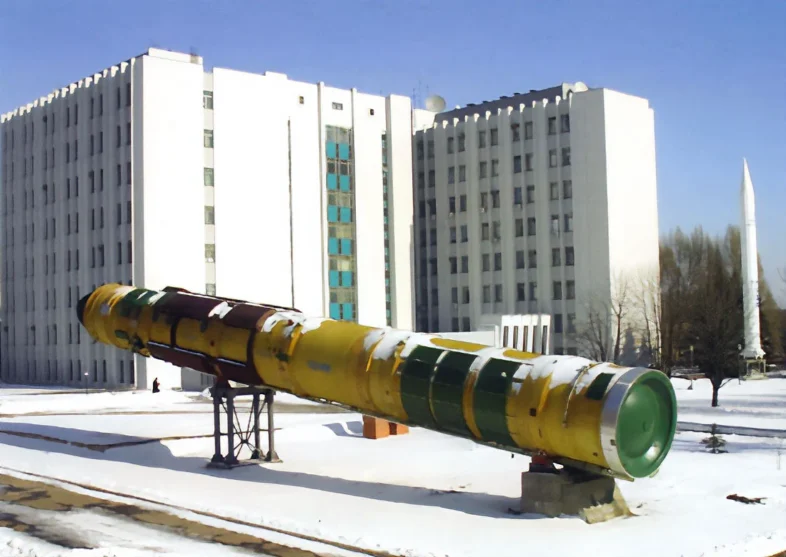
“15A18M” (R-36M2) TEL (Transporter Erector Launcher) at the Pivdenmash Factory in Dnipro, Ukraine.
— If we simply look at the numbers—weaponry and personnel—Ukraine was clearly the third-largest military power in the world in 1991. There’s no denying that. But the question is, was it a true power or just an abstraction? Could it have been considered a genuine military-political reality?
— No, it was real power, especially in nuclear terms—Ukraine was the third-largest nuclear power in the world, with around 2,000 strategic warheads. To put that in perspective, countries like Britain, France, and China each had about 200–300 warheads. Ukraine’s stockpile was far greater, though the exact numbers were only known to the USSR’s General Staff. I chaired a special working commission in the Verkhovna Rada focused on this issue, and even we couldn’t get all the information. In fact, at times, we had to rely on Western sources, as they sometimes had more accurate data than our own Ministry of Defence—it’s a surreal reminder of that time.
When you compare Ukraine’s 2,000 warheads to the 200–300 of other nations, the difference is staggering. Ukraine also had between 3,500 and 4,200 tactical warheads—everything from tactical missiles and nuclear torpedoes to mines and aviation weapons. It was a truly phenomenal arsenal. Additionally, we had heavy long-range cruise missiles, both nuclear and non-nuclear. Ironically, Russia now uses the non-nuclear versions of those same missiles to attack us today.
In that sense, Ukraine was indeed the third-largest nuclear power in the world—something that the entire globe, including the United States, feared.
— Let’s talk about how the West perceives Ukraine compared to Russia. It’s clear that the so-called Sovietology, which was built around a Russia-centric model, shaped the West’s understanding of the region. But beyond the objective factors, there’s also this curious fascination the West has with Russia—not just as a territory or a power, but with what it imagines to be a “great Russian culture.” Can you offer any rational explanation for how Russia managed to captivate Europeans and Americans in this way?
— The fact is, after the collapse of the Soviet Union, the West saw Russia as its successor in every way. Even during World War II, the term used wasn’t “Soviet soldier” but “Russian soldier.” This was the result of Soviet propaganda, which relentlessly promoted the idea of the “great Russian people” without ever truly explaining what that term meant.
As a result, the West remained unaware of other nations within the former Soviet Union, including Ukrainians, and the fact that Ukraine had, in many ways, contributed its historical foundation to the building of the Russian Empire. They simply didn’t know the history.
But you know what still amazes me to this day? Did our own leaders even understand our history? Over the years, I’ve tried to discuss this with many of them—except for one, Yanukovych. I always focused on our roots and our traditions, stretching back to the Trypillian culture. Why are Ukrainians so unique, and why do we still astonish the world today?
The Ukrainian authorities have never clearly defined a national interest, unlike countries such as Poland or Israel, which have done so admirably. They never outlined national priorities, clarified Ukraine’s role in the modern world, and, most tragically, did nothing to safeguard the nation’s statehood. Instead, they actively undermined our ability to defend ourselves. This applies to nearly every government and president we’ve had. A stark example of this is the story of Ukraine’s nuclear disarmament.
But here’s the real issue: it’s not just that the West didn’t know. It’s that we ourselves didn’t know our history, our origins, or why we are so unique. Why have all the Maidans been driven entirely by self-organisation, with no formal leadership, without exception? Why did the defence of Ukraine in 2022 also begin with self-organisation when the Russian forces were stationed near Kyiv and couldn’t make progress? It was self-organisation.
However, as soon as the process was placed under formal management once again, the same traditional failures of Ukrainian state policy reemerged—even on the frontlines.
— In the 1990s, we saw the United States and Europe struggling with their foreign policy, unsure of how to handle issues like Yugoslavia, the Middle Eastern conflicts, or the collapse of the USSR. How can we explain that countries with such long-standing traditions in foreign policy and powerful intelligence and analytical capabilities ended up in such a state of confusion?
– A political meme emerged from U.S. President George Bush’s speech to Ukraine’s Verkhovna Rada, just weeks before Ukraine declared its independence—the infamous “Chicken Kyiv” speech. At the time, I was part of the opposition minority in the Rada as a member of the Rukh movement. Honestly, we couldn’t help but laugh when President Bush spoke about supporting Gorbachev, warning of the dangers of “deadly nationalism,” and so on.
For someone in his position—leading a nation with vast intelligence services and analytical centres, spending hundreds of millions of dollars to prepare for emerging challenges—not to sense where the world was headed, especially in a world the U.S. intended to lead, shows a complete failure of the structures upon which America based its geopolitical strategies.
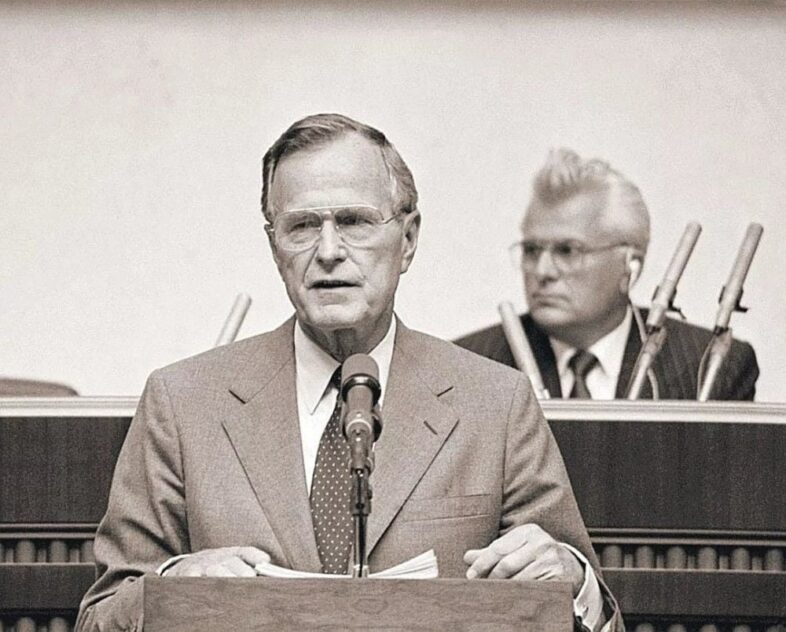
On August 1, 1991, George H. W. Bush addressed Ukraine’s Verkhovna Rada.
— Isn’t that exactly what’s happening today? Many high-ranking American officials, generals, and politicians are saying we need to prepare for the potential collapse of Russia, regardless of how the war in Ukraine ends—a “second act,” so to speak. For example, Ben Hodges, the former commander of NATO forces, has repeatedly stated that the U.S. must plan for the possibility of Russia’s dissolution.
– In 2018, at a conference in Siena, Italy, organised under the U.S. National Archives programme at Washington University, key figures from the era of Ukraine’s nuclear disarmament gathered from the U.S., Ukraine, and Russia. During the event, I had a conversation with Strobe Talbott, a special envoy and legal advisor to President Clinton, who had overseen the U.S. efforts on nuclear disarmament. He asked me how I saw Russia’s future. I replied, “Exactly the same as the Soviet Union’s.”
He was curious: “Why are you so certain?” I explained, “I came into politics from science. I spent nearly 20 years at the Paton Institute, visiting almost all the major Soviet military-industrial facilities as a researcher. I worked on plasma technologies, and when we proposed cutting-edge solutions, only for military factory directors to reject them because they found them too complicated, it became clear to me, as a scientist, why the USSR was losing the arms race.”
Talbott then asked, “And today?”
“What has changed in the Russian Federation?” I replied. “Has it become a high-tech, intellectual powerhouse? It’s still a raw material exporter. Yes, it’s dangerous because it has nuclear weapons. President Bush also told us that the Soviet Union needed support because of its nuclear capabilities and other factors. But why did the collapse of the USSR not alarm you as much as the potential collapse of Russia does now? This,” I added, “shows the limitations of American intelligence and how it operates.”
Has Russia ever renounced its imperial ambitions, even for a moment, as a supposed democracy? Politics is a deeply cynical game, but when white is called black and vice versa, it becomes impossible to ignore. President Yeltsin was never a democrat. How could he be, having ordered tanks to fire on the Russian parliament?
Yet, the West found it more convenient to see him as one, especially in a new and unfamiliar situation they weren’t prepared for. They needed a foothold, and Russia, with its vast resources, was the most appealing option—let’s be honest. As for us, as an already independent state, the West was only interested in Ukraine because of its nuclear weapons. They didn’t know how we would act; we were completely unknown to them.
What was Ukraine? To them, we were always terra incognita. And let’s be honest—Ukraine didn’t do enough to promote itself properly, either.
As for Russian democracy—it’s a farce. Why? Because the moment Russia tries to democratise, it will begin to unravel. Democracy means the right of nations to self-determination, and Russia is home to countless peoples yearning for independence. For the Russian empire, democracy is nothing short of suicidal.
— In your book, you go into detail about the process of adopting the Declaration of State Sovereignty in July 1990, where Ukraine first announced its willingness to renounce nuclear weapons and pursue a non-aligned status. But I’m still curious—where did this idea originally come from?
— I spent a long time studying this issue because I found it particularly interesting. Why? Well, it really came to the forefront during the discussion of the Declaration, right there in the session hall, without any prior preparation. Unfortunately, the idea was introduced by Ivan Drach, the first leader of the People’s Movement of Ukraine for Perestroika. At the time, I was involved in the Movement’s leadership, serving on its Central Directorate, and we never discussed this issue beforehand. The only context in which it came up was the aftermath of the Chornobyl tragedy, which led to widespread negative sentiment toward anything nuclear in Ukraine—something that needs to be acknowledged.
Formally, though, the initiator of this provision was the well-known diplomat Volodymyr Andriyovych Vasilenko, who, by the way, was also a member of the People’s Movement. Later, we had further discussions on this, and his explanation was that international law experts saw it as a mechanism for the potential withdrawal of the Ukrainian SSR from the Soviet Union. But then I thought, what about the republics without such weapons, like Kyrgyzstan, Uzbekistan, and the Baltic states? It became clear to me even back then that this idea, to put it mildly, was brought into the Supreme Soviet of the Ukrainian SSR with little real consideration.
I got the final answer to this question at a conference in Siena. Among the participants was a cheerful gentleman who led the U.S. and Canada Institute’s department. Formally, it was a scientific institution of the USSR Academy of Sciences, but in reality, it was an arm of the International Department of the CPSU Central Committee and the KGB. This department was one of the largest intelligence centres in the USSR. In 1987, it played a key role in the Vienna negotiations between the USSR and the USA on eliminating intermediate and shorter-range missiles. This gentleman had been part of the working group where military and intelligence representatives coordinated all the details.
He told me that once everything was agreed upon, informal celebrations took place in classic Russian fashion. The celebrations got so out of hand that suddenly, one of the American generals (I’m repeating how he told it) asked, “What will you do if the Soviet Union suddenly collapses?” This question caused a scandal, and things almost turned violent. But when he returned to Moscow, he was tasked with working on this issue. By the end of 1989, an algorithm was developed for how, in the event of the collapse, all of the Soviet Union’s nuclear potential would fall into Russia’s hands.
They came up with a clever scenario: the nuclear potential could be divided between the republics, but only if they agreed to take on the Soviet Union’s obligations—particularly those related to reducing conventional arms and dealing with the USSR’s debts. Back then, the Soviet Union had a $60 billion external debt, an enormous, unsustainable sum. So, we became a party to the USSR’s obligations regarding the destruction of conventional weapons—thousands of attack helicopters, planes, rocket systems, tanks, and armoured personnel carriers. And, of course, Russia met its obligations for reducing conventional weapons, but it was Ukraine that paid the price.
— What was the name of that cheerful gentleman?
— Sergey Rogov, who led the Nuclear Disarmament Control Department, shared an interesting piece of information about why the U.S. was caught off guard in terms of strategy. When the collapse of the Soviet Union began, Senators Sam Nunn and Richard Lugar quickly made their way to Moscow. They were deeply concerned about where the briefcase containing the so-called “red button” would end up—was it going to Yeltsin or Gorbachev? Rogov, who had worked in the U.S. at an American scientific centre, was familiar with both Nunn and Lugar. After the August Coup had failed, he drove them to meet Yeltsin in his “Zhiguli” car. He witnessed their discussion about Russia’s proposals for nuclear disarmament, which centred on the idea that all nuclear weapons should be consolidated on Russian territory. This approach influenced U.S. policy, steering it towards Russia’s nuclear disarmament plan until 1993.
Interestingly, Russia’s demand included the U.S. not recognising Ukraine’s independence, but the 1991 referendum, where over 90% of Ukrainians voted for independence, ultimately changed the game.
The U.S. wasn’t the first to recognise Ukrainian independence—Canada was the first, followed by Poland—but the U.S. eventually came on board within the first ten recognitions. By that point, they had no choice but to acknowledge it, even though the original agreement was for them not to recognise Ukraine until it had signed all the accords on its non-nuclear status and weapons transfer to Russia. In essence, this narrative, which shaped U.S. policy, was carefully crafted by the Kremlin.
The biggest mistake came on June 3, 1993, when the Verkhovna Rada of Ukraine, in a closed session, rejected President Kravchuk’s proposal to ratify the START-1 treaty on offensive arms reduction and the Non-Proliferation Treaty as a non-nuclear country. At the time, Prime Minister Leonid Kuchma supported the position of our special working commission, which argued for a phased reduction approach. In other words, only the reductions specified in the treaty between the USSR and the U.S.—36% of carriers and 42% of warheads—would happen immediately, while separate agreements would cover the rest. These negotiations would have to align with national interests, factoring in other conditions and requirements.
A few days later, U.S. Secretary of Defense Les Aspin arrived in Ukraine. Despite the closed session of the Verkhovna Rada, they already had almost all the details in real time. He said, “We understand everything, and we’re ready to cooperate with you now, not with Russia.” The U.S. had already been thinking about Ukraine’s NATO membership and had sent Kravchuk a proposal back in December 1992, focused on international security guarantees. They also planned to set up a fund for nuclear disarmament, recognising that it’s an incredibly costly process. American experts calculated that reducing Ukraine’s nuclear arsenals would cost 6 billion dollars—nearly the entire state budget at the time, which was only 10 billion.
So, how do you explain to an ordinary person why, under the Kremlin’s influence, we chose the most destructive and damaging path for Ukraine’s national security when the U.S. was ready to support us and move forward with our scenario?
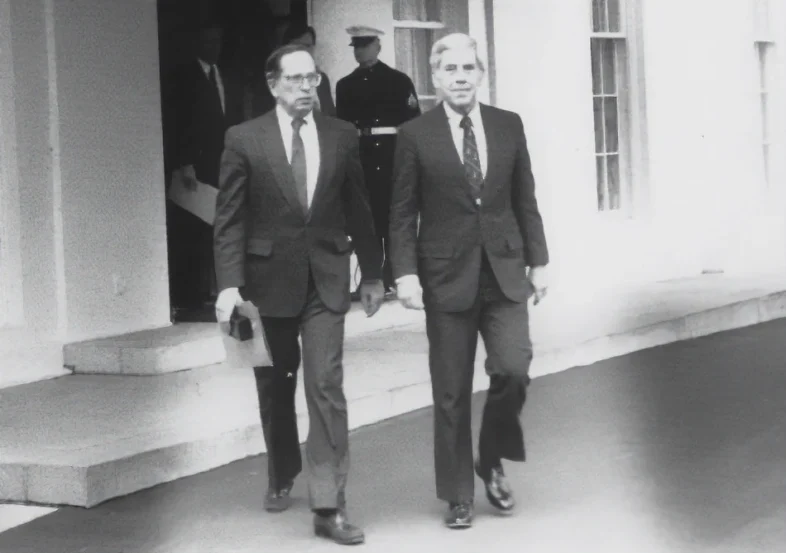
Senators Nunn and Lugar exit the White House after a meeting with President George H. W. Bush, 1991.
— We’ve already acknowledged how challenging it was to avoid this process. But if we hypothetically consider it: could Ukraine have maintained its nuclear weapons and used them independently?
– The move to a non-nuclear status had to come with several crucial conditions, especially guarantees for our national security. And I’m not talking about just some pieces of paper—I mean real, concrete guarantees, like NATO membership. Could we have used tactical weapons? Absolutely. Because their launch wasn’t controlled from Moscow; the commands could’ve come from Kyiv. But by May 15, 1992, Russia had already removed this element of our defence, fully aware of the autonomy of tactical weapons compared to strategic ones. And they did this without our consent.
What’s more, in April 1992, the parliament decided to stop the removal of tactical weapons because there was no agreement on the conditions for their removal and no clarity on the fate of the nuclear materials. Most importantly, the parliament’s decision wasn’t implemented. The key point was that if Ukrainian weapons were to be destroyed outside the country, there had to be international oversight to ensure the destruction process was properly managed.
In November 1992, I became the only Ukrainian official allowed by Russia to visit its facility, where Ukrainian tactical nuclear weapons were supposedly being destroyed. Why me? Because I was leading the special commission that was preparing the START treaty for ratification. Russia’s motivation was clear—it was my position on the treaty that would influence whether Ukraine’s parliament would vote for it.
At that facility, I uncovered several key facts. First, I learned the weight characteristics of the tactical warheads, which was crucial for determining how much Russia should compensate Ukraine. I also discovered that storing the warheads in Ukrainian depots posed no danger. The mechanics of the warhead meant it couldn’t detonate without a specific command—though the TNT might explode, scattering uranium or plutonium, it wouldn’t cause a nuclear explosion.
Then, I found out something even more surprising: more than 60% of the staff at this ultra-secret facility, located somewhere near the polar circle in the Urals (a place we had travelled to from Sverdlovsk, now Yekaterinburg, through the taiga for nearly a whole day), were Ukrainians. They were asking to be transferred to Ukraine to oversee the safe handling of nuclear warheads.
Most importantly, I learned that the destruction process wasn’t really happening as we’d been told. Only the casing of the tactical warheads was being destroyed, not the actual uranium-plutonium components.
When I asked what happened to those components, they said they were sent to a plant that makes fuel rods. I pressed further, asking what happened next. The FSB officers accompanying me replied, “Yuriy Ivanovich, that’s a state secret. We don’t even know ourselves.” Later, though, I learned those components were being repurposed for new Russian nuclear programs.
In other words, no destruction actually took place, despite what the Verkhovna Rada of Ukraine had decided. What really happened was that Russia strengthened its nuclear forces at Ukraine’s expense. As for international security, it only heightened the threat from what is now seen as a barbarian wielding a nuclear mace.
We didn’t want to use that weapon for military purposes. Why? As I’ve already mentioned, it was partly the “Chornobyl syndrome” we had back then, but it was more than that. Ukraine has always been a peaceful nation. Ukrainians have never thrived by attacking or plundering others, let alone destroying them. So, it might have been a bit of naive, romantic idealism that took hold in the Verkhovna Rada at that time, especially among the opposition, which was made up of writers, historians, and dissidents. Of course, this romanticism ended up hurting the process in many ways.
When it comes to the rational use of Ukraine’s immense starting capital, this was probably our number one asset. If we even consider its monetary value, we found through research that, by the most conservative estimates, it was worth over 100 billion dollars, while the annual budget in the early 1990s was only around 10 billion. And yet, the issue of military use never came up.
The truth is that thermonuclear war is practically impossible because it would result in mutual destruction. As soon as one side launches a strategic missile, the response would be the complete destruction of the entire country. This is the core of the so-called nuclear deterrence doctrine. Under Yeltsin, Russia could not have launched a missile from our territory, not least because the country was so weakened after the collapse of the Soviet Union that it was barely surviving. In fact, Russia asked the Americans for help in reducing its arsenals because it didn’t even have the means to store all these nuclear warheads, let alone dispose of them. That’s why they requested financial assistance from the U.S. for the disposal process outlined in START-1.
So, we needed to use our nuclear weapons, not as a direct threat of thermonuclear war, but strategically—to demonstrate a) our goodwill in addressing the global issue of nuclear confrontation and b) to protect Ukraine’s economic, financial, political, and security interests.
In other words, it was a way to show how Ukraine’s mindset differed from Russia’s. This approach could have positioned Ukraine as a leader in the European political system, much like we are today, but in a different way. However, the Ukrainian government at the time couldn’t seize this opportunity because it was still mentally rooted in Soviet thinking. Instead of pursuing its own national strategic interests, it followed orders, as it had been taught to do.
– In your book, you mention that after 1996, when all the weapons were finally removed, Ukraine lost its significance on the world stage.
– For taking a principled stand against signing an agreement with Russia over the transfer of its strategic warheads, I was removed from my position as head of the government delegation at Kravchuk’s insistence. They appointed Deputy Prime Minister Valeriy Shmarov in my place, and within two weeks, Shmarov had initialed all agreements to transfer every last strategic weapon to Russia. This agreement was later signed at the heads-of-state summit in Massandra in September 1993. As a protest against this surrender of Ukrainian interests, then-Defense Minister Konstantin Morozov resigned. That was the moment when the shift in the U.S. position began.
The process culminated in the signing of the Trilateral Agreement in Moscow on January 14, 1994, between the U.S., Russia, and Ukraine. It was clear to the U.S. that Ukraine was moving closer to Russian interests. Kravchuk later told me that President Clinton had said, “We cannot support you because you have effectively surrendered to Russia. You’re dependent on nuclear fuel, oil, and gas from them, so we see no reason to support you.” And honestly, that makes sense. If Ukraine isn’t willing to pursue its own policy or take real steps to protect its interests, why should the U.S. consider its concerns more sacred than any other? In the end, everything depended on the choices made by the Ukrainian authorities.
***
Yuriy Kostenko gave this interview for the documentary project “Budapest. A Bomb Under Independence,” produced by the Public Broadcasting Company and aired on the “Suspilne” channel. A repeat broadcast is scheduled for December, coinciding with the anniversary of the signing of the Budapest Memorandum.