NATO foreign ministers gathered in Brussels as Russia’s war on Ukraine shows no sign of winding down, prompting European leaders across NATO and the EU to step up efforts to reinforce military support for Ukraine. The ministerial meeting — which U.S. Secretary of State Marco Rubio is skipping — comes just a day after Russian President Vladimir Putin hosted Donald Trump’s special envoy, Steve Witkoff, and his son-in-law Jared Kushner for talks on ending the Russian war against Ukraine.
“We haven’t seen any concessions from the aggressor”
“The peace talks are ongoing, which is a positive development. But at the same time, we need to ensure that while they continue—and we don’t know when they will end—Ukraine remains in the strongest possible position to continue defending itself against Russia, and is also fully prepared when the talks reach the stage where they [Ukrainian and Russian officials –ed.] sit at the table”, NATO’s Secretary General Mark Rutte told reporters upon arriving at a meeting of NATO foreign ministers in Brussels.
Lithuanian Foreign Minister Kęstutis Budrys said that while Europe has mobilised over the past six months, Russia’s stance has not shifted at all, as it remains uninterested in a ceasefire or any peace deal and continues its aggression unchanged. “What has changed over the past six months is that we’ve seen Europe mobilise and pull itself together, providing the additional support Ukraine needs. With the PURL Mechanism, we also see the United States engaged in the process, putting real diplomatic effort into achieving a long-lasting peace. What hasn’t changed over this half-year is Russia’s position. They remain absolutely uninterested in either a ceasefire or a peace agreement, and they simply continue doing what they are doing.”
Elina Valtonen, Finland’s foreign minister, echoed that sentiment, telling reporters, “So far, we haven’t seen any concessions from the aggressor — which is Russia.”
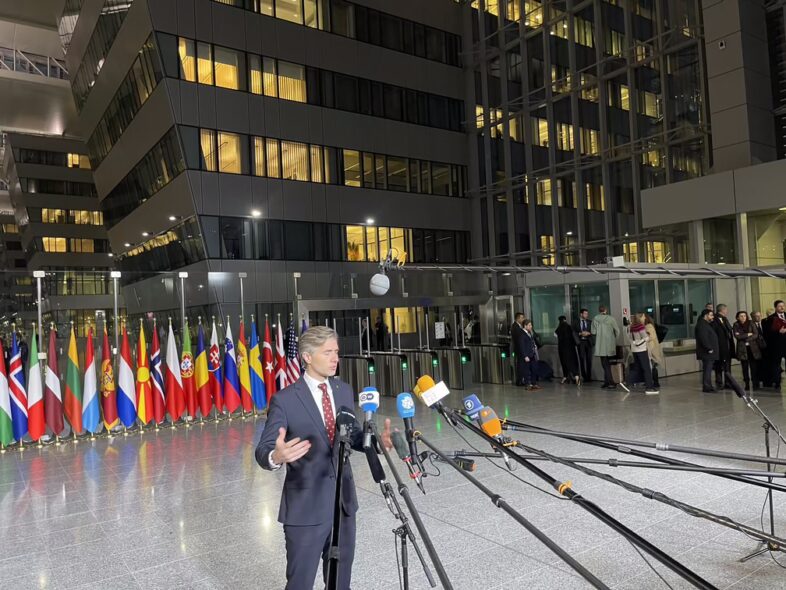
Lithuanian Foreign Minister Kęstutis Budrys
Polish Foreign Minister Radosław Sikorski said a series of recent attacks tied to Russia in Poland highlight the threat facing Europe. He added that Poland’s move to join Norway and Germany in a new support package for Ukraine is meant to show solidarity, prod other allies to do more, and send a clear signal to Putin.
“Vladimir Putin is threatening us, Europeans, from Moscow, and that simply will not work. A few weeks ago in Poland, there was an attack clearly aimed at killing Polish citizens. A group of saboteurs detonated a bomb intended to derail a train, and while it fortunately failed, the intent was clear. Partly in response to this, we are sending an additional show of solidarity to the people of Ukraine. Poland is proud to join Norway and Germany in contributing to the U.S. support program for Ukraine, with a substantial sum of $500 million. We hope the United States sees this, that Ukraine sees it, and, most importantly, that other allies take it as encouragement to participate as well—sending a clear message to Putin and helping Ukraine secure a fair outcome.”
He also told reporters, “I’ve shut down all their [Russian] consulates, which will make it much harder for their diplomats to operate as agents—not just in Poland, but elsewhere in Europe too. We also need to be realistic about Russia’s intentions, which are not good.”
Prospects for peace talks
Throughout the two-day summit in Brussels, a lot of emphasis was placed on potential peace talks and on the negotiations that American President Donald Trump has been trying to secure. Words like “peace” and “peace talks” were mentioned far more frequently than before. After the initial shock over the leaked 28-point plan—which would have effectively meant Ukraine’s surrender, capitulation, and likely the loss of its sovereignty and independence—Rutte stressed that the peace proposals have since “moved on” from that early plan. He explained that it was just the initial draft, and that all negotiations need a starting document—without one, the process cannot begin.
“I think it is very good that the US has put forward proposals. You need to start somewhere. You need to have proposals on the table. As you know, both in Geneva and two days ago in Miami, talks have been taking place with the Ukrainian side. Indeed, talks today with the Russian side.”
Rutte has repeatedly stressed his confidence in the seriousness of the current American push to organise peace talks or secure a ceasefire, insisting that the efforts have a real chance of success. He argued that Washington’s renewed engagement has been key in giving the talks fresh momentum.
“I know the Americans are doing everything they can to get us there. Just look at the numbers: we’re seeing around 20,000 Russian casualties a month, and enormous losses on the Ukrainian side as well. Ukrainians are mounting a fierce defence of their country, but many are dying in the process. It’s hard to predict whether we’ll succeed, but I can assure you that everyone—on the Ukrainian side, within NATO, and led by the Americans—is doing their utmost to make it happen, because we want this war to end. In the end, though, it takes two to tango. The Russians also have to participate, and that’s what’s being tested right now, so it’s difficult to say what the outcome will be.”
At a Q&A session with journalists, Rutte also rejected the idea that Ukraine is being forced into an unfair or humiliating peace, or pushed toward capitulation. “I have every confidence in what the Americans try to achieve. They are constantly aligning with the Europeans and within NATO to make sure we are all on the same page. I cannot criticise that process at all.”
NATO Secretary General added that he believes a deal is possible: “I think we can get there. I think the Ukrainians want to end this [war – ed.], and they are very appreciative of the American peace effort. Today, we will see whether the Russians are also willing to engage. That’s now being tested.”
Ukraine’s Foreign Minister, Andriy Sybiha, told journalists that the head of the Ukrainian delegation had spoken with Witkoff over the phone, and that, for security reasons, the details remain sensitive. Consultations are continuing today with counterparts from the UK, Germany, and France to coordinate efforts and assess progress.
“There has indeed been progress, from Geneva to Miami. This is a real step forward in the peace process. The talks are currently based on a 20-point document developed in Geneva. I can also confirm that the American delegation has heard the Ukrainian delegation, and the document continues to evolve. The most sensitive issues have been put in brackets and are left for leaders to decide. According to the American delegation, in their assessment, the talks in Moscow had a positive impact on the peace process.”
He also added that Ukraine’s allies “expressed support for our [Ukrainian – ed.] approaches and principles in defending our national interest—specifically, that there can be no compromises on Ukrainian sovereignty and no compromises on the UN Charter. All steps in the peace process must be based on these principles, and there can be no changes to borders by force.”
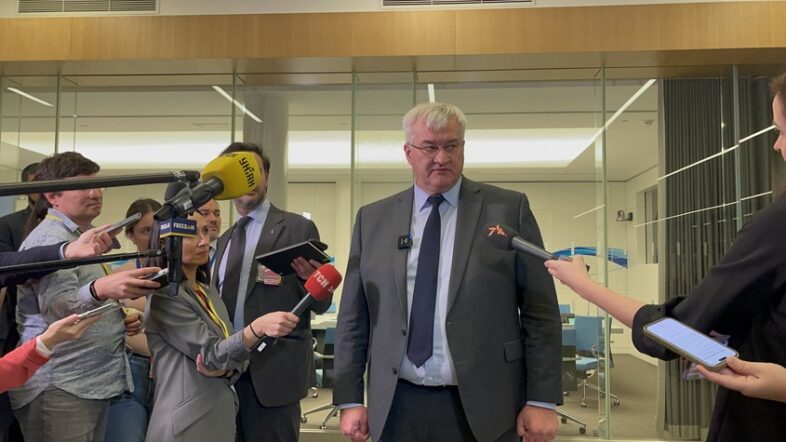
Foreign Minister of Ukraine, Andriy Sybiha
NATO studies Ukraine’s battlefield lessons for its own defence
While politicians remain hopeful about the prospect of a peace deal — or at least the launch of meaningful talks — NATO officials are simultaneously working at full speed to strengthen allies’ defensive capabilities. More than ever, the alliance is eager to absorb and adapt Ukraine’s wartime experience, especially when it comes to drone warfare, which has rapidly become a defining element of modern conflict.
According to a senior NATO military official, as the alliance designated Russia as a threat at the 2022 Madrid Summit it has been keen on integrating Ukrainian battlefield expertise into NATO’s own defence development. That means drawing on Ukraine’s experience in countering drones — from FPVs to larger unmanned systems — and applying those lessons across the air domain, where controlling the skies remains absolutely critical. Success, the official noted, increasingly hinges on precision munitions and battlefield mobility, while at sea NATO is moving to weave drones into maritime operations. The cyber side of Ukraine’s experience is just as urgent, with Russia’s attacks showing that NATO really needs to beef up its digital defences.
The alliance is studying how Ukraine evacuates casualties in a battlefield that’s fully exposed to enemy drones, meaning medics and soldiers operate under constant threat. The overarching lesson, the official said, is clear: the modern fight must be data-driven, highly integrated, low-altitude and relentlessly adaptable.
A Ukrainian military official attending the NATO summit said the alliance has shown strong interest in Ukraine’s battlefield experience and innovations.
He told journalists that when NATO recognised the need to develop its own drone capabilities, 32 member states agreed to produce them independently, without relying on third-country suppliers. The move is expected to increase the number of drones on the market and drive down prices. Until now, many of the cutting-edge systems used by Ukraine, designed and built domestically, could not be sourced elsewhere. As allies begin producing these systems, Kyiv will be able to access them more easily.
According to the military official, innovation is now absolutely vital for both Ukraine and NATO. On the ground, Ukrainians are fighting in a phase of war where technology and tactics shift every three to six months. It’s a stark reminder of the clear gap between countries actively at war and those that aren’t—there are several steps separating how ready and adaptable they really are.
“NATO has huge potential on the innovation front, but it still needs to identify the areas where that effort should go and the direction it wants to move in. Because the alliance’s militaries aren’t in an active phase of war, they often struggle to pinpoint which technologies need urgent development right now”, he added.
Are there any security guarantees for Ukraine?
At a pre-ministerial conference on 2 December, Rutte also said that although there is currently no agreement among NATO allies on Ukraine’s membership, the alliance’s 1949 founding treaty—which in principle maintains an open-door policy—still stands. “It’s important to separate the principle from the practical. The practical situation is, as you know, that consensus is required from all allies for Ukraine to join NATO. And right now, there is no consensus on Ukraine joining NATO. When it comes to the principle, that’s the Washington Treaty of 1949, and it still stands. And also, what we decided at the Washington Summit in 2024.”
While the prospects of NATO membership have been bleak and security guarantees remain unclear, a lot of attention has been given to maintaining strong, well-trained, and capable Ukrainian Armed Forces. According to Rutte, Europeans—working hand-in-hand with the United States—have already put in significant groundwork to ensure that once a potential peace deal is reached, Ukraine isn’t left exposed. The goal, he said, is to lock in security guarantees that provide Kyiv with the strongest possible protection long after the fighting stops: “And of course, the strongest foundation of that security will be the Ukrainian Armed Forces—the first layer of defence for Ukraine itself.”
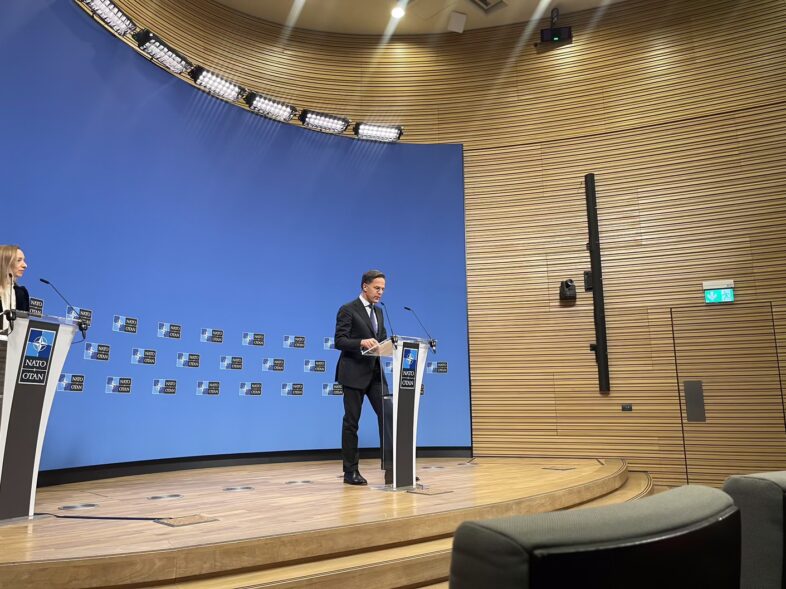
Mark Rutte at a Secretary General’s Press Conference in the Main Press Theatre, 3 December
On 3 December, at a Secretary General’s press conference in the Main Press Theatre, Rutte declined to comment on potential security guarantees for Ukraine, saying that while a lot of work is being done behind the scenes, he does not want to jeopardise it. “The last thing I want to do is make it more difficult to reach a deal by commenting on every in-between step. I can assure you that NATO here, the headquarters, myself, and my team are closely coordinating with the White House and the State Department.”
“We all agree that, in the end, what is needed is a sovereign Ukraine—a Ukraine that can be confident that the necessary security guarantees are in place, so that after a potential peace deal or long-term ceasefire, Russia will never again attempt to attack, knowing the response would be devastating.”
Another senior NATO official reiterated the same point: Ukraine’s own armed forces have to remain the backbone of the country’s defence. He also added that this is a standard NATO approach. Even when it comes to NATO member states, they are primarily responsible for their own defence, and it is the job of every member to be cautious and vigilant about their own security.
In a comment to The Ukrainian Week, he added, “I can confirm that Ukraine’s path to NATO has been considered irreversible. However, the question of when it will happen remains unclear because of NATO’s fundamental consensus principle. NATO is very strict about sticking to that rule, yet it is also very effective when it comes to building consensus. With Finland and Sweden, there were long discussions and some resistance, but in the end there was enough political will to ensure consensus was reached.”