A video of Indian Prime Minister Narendra Modi strolling hand in hand with Vladimir Putin toward China’s Xi Jinping — before the trio erupted in easy laughter — ricocheted across social media and news outlets within hours. What are we looking at here? A new “axis of evil”? And how did India, the world’s largest democracy, get pulled into the frame? Has Bharat really set aside its clashes with the Middle Kingdom? At first glance, the two-day Shanghai Cooperation Organisation summit in Tianjin seemed to raise more questions than answers — though the answers aren’t hard to find.
Why should SCO summits matter?
The Shanghai Cooperation Organisation (SCO) was established 25 years ago in Shanghai, originally bringing together six countries: China, Russia, Kazakhstan, Kyrgyzstan, Tajikistan, and Uzbekistan. India and Pakistan joined in 2017, Iran in 2023, and Belarus last year. The organisation also has two observers — Mongolia and Afghanistan — and 14 dialogue partners, including Azerbaijan, Armenia, Turkey, Egypt, the UAE, Qatar, and Kuwait.
The SCO was initially meant to resolve border disputes and tackle security challenges in the region. But in recent years, Beijing has leaned on the organisation to push its own agenda — often in lockstep with Moscow. With member and partner states accounting for more than 40 per cent of the world’s population, most of them in the so-called Global South, China and Russia have turned the SCO into a stage for amplifying their anti-Western narratives.
The two-day summit in Tianjin delivered several strategic wins for Beijing. For one, it was the largest gathering of SCO members and partners ever: 26 participants in total, including all members, two observers, and 14 dialogue partners. And for the first time in seven years, Indian Prime Minister Narendra Modi visited China, signalling a symbolic rapprochement between the two countries — a move seen as a response to the 50% tariffs Washington imposed on New Delhi over its Russian oil purchases.
Beyond the optics, the summit’s statements — particularly from China — carried a distinctly “reassuring” tone, aimed at the Global South rattled by Washington’s unpredictable foreign policy. Xi Jinping declared that the world had entered “a new stage of turbulence” and called for the defence of “an international system with the United Nations at its core, and a multilateral trading system with the World Trade Organisation at its core.” Beijing also promised SCO members 2 billion yuan ($280 million) in aid, along with an additional 10 billion yuan in loans for the SCO banking consortium.
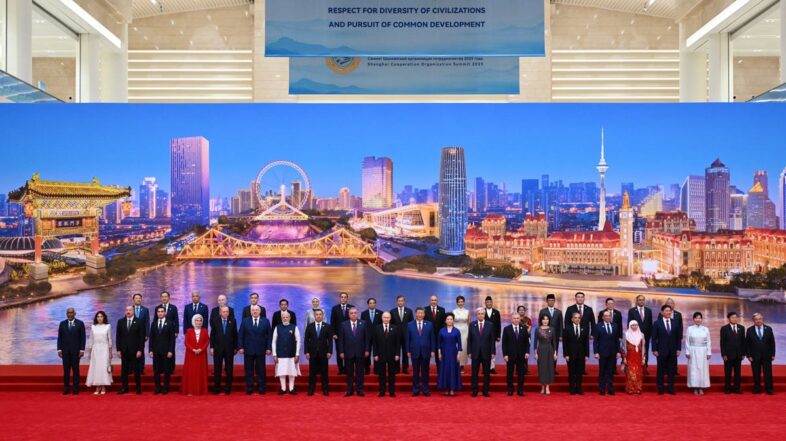
At the same time, the joint communiqué “strongly condemned” what it described as “the military aggression of Israel and the United States against Iran.” Notably, it made no mention of Russia’s war against Ukraine — a reminder of how China and Russia are using organisations like the SCO to shape the global agenda on their terms.
A new geopolitical “axis of evil”?
Much of the attention around the SCO summit has focused on India’s role. On the surface, it looks like worsening ties with Washington — to the point where, reportedly, Prime Minister Modi even declined a call from Donald Trump — pushed New Delhi to “reset” its relationship with Beijing and Moscow. In reality, however, despite political tensions and occasional border clashes (the last major one was in 2020 in the Aksai Chin region, with parts of the border still undemarcated — though in August, following new US tariffs, both sides agreed to form expert groups to start the demarcation process), China has remained one of India’s largest trading partners in recent years.
The trade volumes between India and China and between India and the US are actually quite close. In the 2024–2025 financial year, trade with China hit $128 billion, compared with $132 billion with the US. The big difference, however, comes in the balance: India ran a $99 billion trade deficit with China last year, while enjoying a $42 billion surplus in its trade with the United States.
Put simply, trade with the US is clearly beneficial for India. But it can’t do without imports from China — electronics, technical equipment, and components for its chemical and pharmaceutical sectors — which make up the bulk of its Chinese imports. That reality forces India to tread a careful line between the West and its partners on one side, and the China–Russia bloc on the other. In the run-up to the SCO summit, that balancing act was on full display.
Japan remains one of New Delhi’s most important regional partners. On his way to Tianjin, Narendra Modi stopped in Tokyo, where one of the biggest outcomes of the visit was Japan’s pledge to invest around $68 billion in semiconductor production in India. The move is part of India’s broader strategy to reduce dependence on Chinese semiconductor supplies. India and Japan also share a similar vision of Indo-Pacific security and, along with Australia and the US, are members of the Quadrilateral Security Dialogue — a grouping of democracies in the region created under US leadership as a counterweight to China. Today, however, the future of the QUAD is uncertain. Some Indian analysts suggest that the three other countries could continue developing the framework without the US, forming an alliance of three strong middle powers.
Military parade, dictators and the battle of narratives
Xi Jinping capped the symbolic success of the SCO summit with a military parade. On 3 September, Beijing rolled out its latest military and technological hardware in a parade commemorating the end of the Second World War. During the summit, Xi had already called on SCO countries to promote the “correct understanding of the history of the Second World War” — a message Beijing was clearly aiming to advance.
The problem is that in marking the 80th anniversary of the war’s end (which for China also marks victory in the Second Sino-Japanese War), communist Beijing is claiming credit for achievements it wasn’t part of. At the war’s conclusion, the internationally recognised government of China wasn’t the Chinese Communist Party (CCP), but the Kuomintang (Chinese Nationalist Party) led by Chiang Kai-shek, who fled to Taiwan in 1949 after losing the civil war to the communists.
Despite their ongoing civil war, the communists and nationalists agreed to a truce during Japan’s invasion. Historians, however, note that it was the nationalists who carried the brunt of the full-scale resistance to Japanese occupation from 1937 to 1945. Yet the communists have elevated only their own role, largely erasing the contributions of the nationalists from the historical narrative.
Taiwan — where the Kuomintang retreated after losing to the communists — long marked the end of the Second World War not on 3 August, but on 25 October, the day Japanese forces in Taiwan (a colony since 1895) surrendered to the Chinese nationalists. Over the past 25 years, however, following Taiwan’s democratisation, Taipei has abandoned grand celebrations, military parades, and other ceremonial honours. Last week, President Lai Ching-te mentioned that the Taiwanese “cherish peace” and “do not commemorate peace with the barrel of a gun.” For Taiwan’s current leadership, Beijing’s parade is also a stark reminder of the PRC’s regional aggressiveness.
While dictators in Beijing rattle their latest weapons and craft their own version of history, Taipei warns of the distorted narratives and the threats they pose to the freedoms of democratic nations.