The European Union summit on 18–19 December goes far beyond the usual talks about financial support for Ukraine. It is not just about lending mechanisms or the legal frameworks surrounding frozen Russian assets; it is a fundamental question of European security, political responsibility for its own future, and the EU’s strategic agency in Russia’s war, which will shape the continent’s future.
Just a day before, on 17 December, European Commission President Ursula von der Leyen set out her vision during the plenary debates of the European Parliament, in effect responding to Trump through her reaction to the new U.S. National Security Strategy. Her key message was clear: Europe must become independent, take responsibility for its own security, and continue backing Ukraine’s defence. She also used the speech to outline financing options for Ukraine ahead of the European Council meeting, offering two possibilities: tapping into Russian assets, which the United States had sought to control, or borrowing through the EU.
Ursula von der Leyen’s speech delivered a bold message to Europe: the time has come for the continent to redefine its place in a rapidly changing world. Europe’s capacity to stand as an independent geopolitical actor is inseparable from Ukraine’s success in the war that Russia has started.
Her address is conceptually distinctive, not only for its deeper understanding of emerging threats and narratives, but also for its direct call for Europe to draw on its own strength after Russia’s full-scale invasion of Ukraine in February 2022. For Ukrainians, of course, it is painful to hear the focus placed specifically on 2022, since Europe and Ukraine’s security guarantors — particularly the United States and the United Kingdom — failed to prevent Russian aggression in 2014 and, in effect, allowed a full-scale war and genocide to unfold.
In Ursula’s speech, Russia is no longer the sole threat to Europe, as it has been framed in hundreds of previous addresses. The danger is now a “world of predators,” a transactional, value-free world. The peace of yesterday no longer exists, and instead of dwelling on nostalgia, Europe must forge its own plan to ensure that no one else determines its future.
It is clear that the former ally — the United States, under whose security umbrella Europe has long lived for the past 80 years — has now become a rival, acting in ways that are unpredictable and, at times, destabilising. This shift is evident both in the speech delivered by U.S. Vice President Vance at the Munich Security Conference in February and in the release of the U.S. National Security Strategy at the end of the year, which codifies new approaches to U.S.-EU relations. In the document, the United States not only signals interference in European politics but also slips in humiliating suggestions about Europe’s low competitiveness and perceived inability to guarantee its own security.
Von der Leyen’s speech makes it clear that Europe isn’t the only one losing ground: the continent’s share of global GDP has dropped from 25% in 1990 to 14% today. The United States is on pretty much the same path, falling from 22% to 14% over the same period. She also notes China’s rapid rise — its share of global GDP jumping from 4% in 1990 to 20% now — and it’s this growth that worries the U.S., driving a shift in its strategic focus toward countering China.
I recall that a year ago, during a U.S. Congress hearing, one expert warned that Russia’s objective is to drive a wedge between the United States and Europe, aiming to push America out of the continent entirely — a scenario that would ultimately benefit China.
Sadly, without Ukraine’s victory and a solid alliance with Europe, the United States’ chances of successfully competing with China are extremely slim.
The President of the European Commission speaks candidly about the need for EU independence, even if many sceptics see this as unrealistic. Yet there is simply no alternative if European civilisation is to safeguard its future.
At the same time, her speech offers little in the way of concrete strategies to achieve that independence. The proposed measures, including steps toward energy independence, don’t hold up under close examination. “Thanks to REPowerEU, imports of Russian gas — both LNG and pipeline — have fallen from 45% at the start of the war to 13% today; coal imports — from 51% to zero; and crude oil — from 26% to 2%.” Yet such gradual reductions hardly constitute a solid path to true independence. Calculations also show that Europe continues to buy Russian energy in greater volumes than it provides aid to Ukraine.
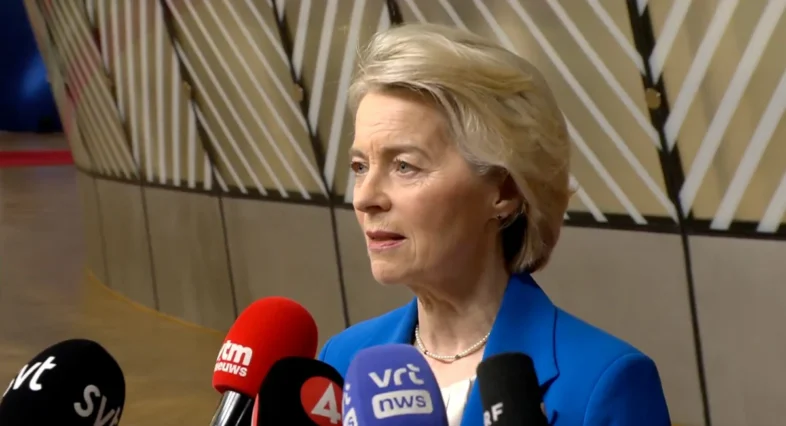
European Commission President Ursula von der Leyen said a solution will be reached to meet Ukraine’s financial needs for 2026–27
Even the 19th sanctions package, which bans the purchase of Russian liquefied gas, will not come into force until 1 January 2027. Four years into a full-scale war, Europe has still failed to achieve energy autonomy — and this is before considering that, after the 2014 invasion, Merkel pushed forward with Nord Stream 2, and Lithuania now fears that gas transit through its territory to Kaliningrad could be cut.
The surest path to European independence runs through a clear victory over Russia. Supporting Ukraine cannot be about giving “just enough for it to remain Europe’s shield”; Europe must stand with Ukraine, shoulder to shoulder. This isn’t just a war against Ukraine — it’s a war in Europe, a war against Europe itself. Only a shared victory can turn Europe into a genuine global player. That is the road to real independence.
The speech reflects realism and a keen understanding of today’s challenges. Yet there is little sign of the strategy or political will needed to implement these steps swiftly, leaving the declared aim of independence at risk of remaining just words on a parliamentary podium. Ursula von der Leyen talks of a “moment of Europe’s independence,” and indeed many of her measures are right — at least for peacetime. But the moment of true independence will come only when determination matches financial resources. Not merely the will to retaliate, but the courage to act decisively — to respond to 19 drones on Polish soil with 19 drones over Russian territory. Or better still, to act preemptively.
Plans alone are not enough; there must be determination. Budgets alone will not do; there must be a spirit of action, not a defensive stance paid for with Ukrainian lives. Europe cannot claim true independence without the ability to make decisive choices.
Independence cannot be bought with money. It is earned through the willingness to fight. And yet, European capitals still cling to the hope that somehow “it will all work out.” It won’t.
You can’t buy independence with money. It comes from a readiness to act, to fight. And yet, too many European capitals are still hoping it’ll somehow ‘just work out.’ It won’t.
Of course, the EU is complex. Decision-making here isn’t like in the U.S. under Trump, or in Putin’s Russia, or in China. Yet that very complexity — the one we saw, for example, in the slow approval of a reparations loan for Ukraine — shows that Europe needs a fresh approach.
It’s encouraging that Ursula von der Leyen is pressing the EU on reparations. Yet there’s a catch: she’s proposing two options — using frozen Russian assets or borrowing through the EU — and no decision has been made yet.
The bargaining goes on.
Bargaining during wartime is the definition of weakness. Picture this: you’re standing in front of a burning house, and the firefighters are arguing over whether to draw water from the river or the hydrant. By the time they decide, the house is gone, reduced to ashes.
That is Ukraine right now. Every day spent haggling costs dozens of lives. What we need is willpower. We need decisive leadership. We need to hear: here is the decision, here is the money, here are the weapons — and, by the way, Germany could finally deliver the Taurus.
Europeans like to say Ukraine is burning. But it would be more accurate to say we are all on the same plane — the European house. The difference is that Europeans think they’re flying business class, while Ukrainians are stuck in economy. If a fire breaks out in economy class and no one acts, the whole plane goes down — and the champagne in business class won’t save it.
It was Ursula herself who, in 2025, spoke of turning Ukraine into a steel porcupine. It’s heartening that the President of the European Commission grasps the concept — to arm Ukraine to the teeth so that no one dares attack again. Smart, necessary thinking. But here’s the crucial point: it’s not enough to simply arm Ukraine. Europe must stand shoulder to shoulder with us, fully committed, in action as much as in words.
Europeans need to face a simple truth: they will have to fight. The only question is whether it will be sooner, alongside us, or later, without us. If Europe believes it can merely “support” Ukraine with money while staying safely on the sidelines, it is gravely mistaken. Russia will not stop — they will push forward. And when, after drones and missiles, Russian tanks roll into Warsaw or Vilnius, neither an €800 billion defence budget nor SAFE with EDIP will save Europe.
Only soldiers can make the difference — those fighting with us now, or those who will die later if we are left to face the threat alone. And yet what frustrates us most is this: Ursula talks about “raising the cost of the war for Russia,” but not about Ukraine’s victory. Victory has quietly been replaced by “negotiations.” That, too, is a sign of fear — fear of clashing with Trump at a time when Europe is still not ready to confront the predators.
Not a word about de‑occupation. Not a word about Crimea or the Donetsk region. Why? Has all of this already been quietly written off?
And why has Ukraine’s territorial integrity disappeared from the conversation about Ukraine? There used to be a clear formula: “support for Ukraine’s sovereignty and territorial integrity.” Now only “sovereignty” remains. That shift is no accident. It is about preparing public opinion for so‑called “realistic compromises” — where “realistic” means leaving the occupied territories in Russian hands, and a “just peace” becomes, at best, a frozen war.
Ukraine does not need a “higher price for Russia.” Ukraine needs victory. And victory means the return of all occupied territories — every single one of them. No exceptions. No “buts.” No lectures about being “realistic.” When even close friends start playing these games, it rarely ends well for them.
History makes this painfully clear. European capitals — Berlin, Paris, Brussels, Rome — often begin with resolve: bold declarations, firm positions, principled speeches. Then come the compromises. “Taking reality into account.” “Balancing everyone’s interests.” “In the name of peace.” This time, the United States is simply doing the dirty work on Europe’s behalf.
Ukraine has already been down this road. In Budapest in 1994. In Minsk in 2014–2015. And it always ends the same way: Russia gets what it wants, Ukraine is left with empty promises — and the path leads straight back to war, this time on European soil.
Europe must transform if it wants to survive. It must change so that it does not simply fade away on the chessboard of those encroaching on our freedom, openly plotting a full-scale assault on the European homeland.