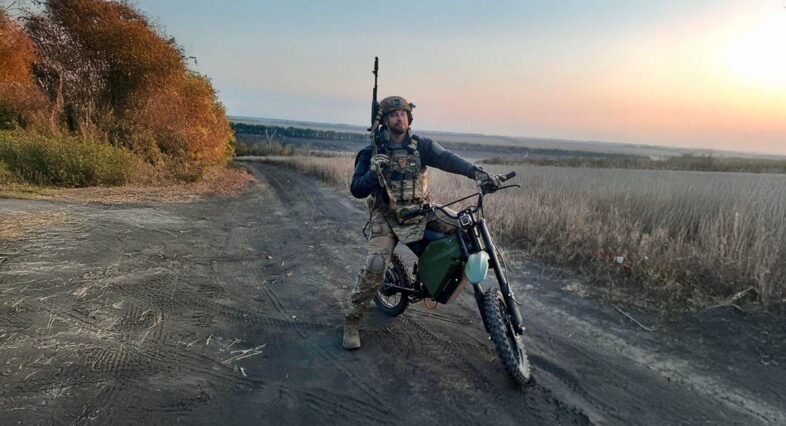
Being in the right place at the right time certainly defines Yanis Tereshchenko, an intelligence officer with the 3rd Separate Assault Brigade. His spring encounter in Italy quickly made headlines across Europe. On March 10, 2025, in Venice, Yanis saved a passerby’s life by applying a tourniquet to stop severe bleeding from a knife wound. The story of this Ukrainian soldier was widely covered by European media, and Venice’s mayor, Luigi Brugnaro, personally awarded him the prestigious Lion’s Commendation.
You can find the first part of the interview here.
— As a historian, do you believe this war was inevitable?
— Absolutely. This story never really ended; it just evolved. The struggle against Russia didn’t stop with the Ukrainian national liberation movement. Under Soviet occupation, partisan warfare erupted alongside a brutal crackdown on Ukrainian nationalism. There were deportations, forced relocations, repression, and the settlement of Muscovites in Ukrainian lands. Donbas, Crimea, southern Ukraine, even Kyiv — all underwent systematic Russification. The resistance never ceased though; it persisted.
During World War II, the armed struggle flared up again. The Ukrainian state was proclaimed once more, only to be met with open warfare—a raw, face-to-face conflict that dragged on well into the 1950s. Repressions continued, yet partisans fought on. So where did it all go? Nowhere. The fight shifted into the dissident movement.
Even after Soviet rule collapsed and Ukraine gained independence, did Russia ever truly let us go? No. The conflict over Tuzla Island and tensions with the Black Sea Fleet at Cape Sarych are fresh memories. Then there’s Russia’s stranglehold on Ukraine’s economy.
Who owned the country’s major industrial enterprises? Russians or pro-Russian collaborators. These assets were stripped bare, driven to bankruptcy and looted—everything valuable shipped off to Russia. Factories closed, workers laid off, businesses sold off cheap—not to us, but to Russia. For what purpose? Destruction. This went on for three decades of independence.
In other words, when the armed struggle ended, an unarmed one began—accompanied by a campaign of national oppression. Russia wages war against us on every possible front. They’re tearing down the monuments of Chersonesus in Crimea, determined to erase every archaeological and historical trace that might prove Crimea was ever anything but Russian. History is being rewritten to fit their narrative.
We all know Kyiv is far older than Moscow, and the evidence is overwhelming. Our historical roots run deep, and we had established statehood long before any foreign prince arrived to “teach us how to build a state.” People lived here, governed themselves, and shaped their own destiny because we are the indigenous population. But Russia wants to erase all of that. So whether the battle is fought with guns, economics, diplomacy, ideology, or history, it’s all part of the same war.
This empire has no reason to exist without Kyiv. That’s why Kyiv is at the heart of their campaign. They use it to claim a made-up historical right—one that serves as a pretext for continued aggression. Even though it’s false—and we know it—countering a lie is no easy task.
How do you prove the truth when the opposing side has destroyed all evidence and invented their own version of history, complete with a “great victory”? This struggle will never end as long as the Russian Federation remains. It must be decolonised and dismantled as a state before we can even begin to discuss historical legacies or any form of demilitarization. Right now, that’s simply not an option—the Russian Federation is our neighbour and an active threat.
There is some good news: we have the resources to keep fighting. They won’t outlast us.
— Why?
— First and foremost, logistics. Russia is an unimaginably vast landmass. But when we talk about Russia, we really mean its European part—everything beyond the Urals is largely uninhabited wilderness. No one truly controls that territory. There are a handful of settlements and some mining operations scattered about, but they’re more outposts than communities. In fact, about 85% of Russia’s land is empty. Some areas have likely never seen a human footprint throughout recorded history.
Moving anything across this expanse is a monumental task—you can’t simply hop in a car and drive from one point to another. On top of that, Russia faces deep-rooted systemic problems in governance, largely because its entire structure is built on corruption and a rigid, totalitarian hierarchy. That chain of command and subordination…
— Is it ineffective?
— It’s effective—depending on how you define effectiveness. Imagine sending 100,000 cockroaches charging at a machine-gun nest. Sure, it’s effective in a brutal, overwhelming sense. But we simply can’t afford to fight that way. Here, a kid can pick up his phone and tweet about living under a dictatorship. Yet no one is forcing him to work for the defence industry just to earn a meal. Over there? That’s a very real possibility. Why? Because they have a dictatorship—a totalitarian regime with a rigid chain of command.
That’s not how things work here. Because if that happened, by tomorrow people would be out on Maidan protesting. That’s who we are—that’s the Ukrainian mentality. Ukrainians refuse to be subordinate—unless it’s by their own choice. Leaders here rise through a democratic election, when everyone agrees, “Alright, this person will lead.” We don’t grovel, we don’t kneel before anyone. That’s who we are.
Every nation carries its own ethnic traits. These traits come from centuries of being rooted in their homelands. The Russians have their own distinct features, too. They are, no doubt, descendants of Mongol khans who plundered Asia, the Middle East and Europe —meaning they understand one thing: disobedience leads to destruction. And they accept that. It’s the foundation on which their totalitarian system is built. A slave doesn’t long for freedom—he wants to own a slave of his own. That’s exactly what shapes Russia today.
Russian citizens today live in squalor, unable to build reliable sewage systems. Despite sitting atop the world’s largest proven gas reserves, they still haven’t managed to bring gas service to half their own country. Yet they brag about having built the entire DniproHES for us—while they can’t even construct decent toilets for themselves. They’ve built everything—just not at home. This lets them send 100,000 people into the meat grinder and act as if those people never existed. We can’t—and won’t—operate that way.
— Are there any aspects of the Russian mindset that actually play to our advantage in this war?
— Absolutely. That’s precisely what’s helping us. Russia can’t wage this war forever. It’s a colossus with feet of clay—something Napoleon Bonaparte pointed out two centuries ago. Russia isn’t a force to be feared or relied upon. The Russian Federation is, in many ways, a myth, a fabrication. They boast about controlling one-sixth of the world’s landmass, but 85% of that is uninhabited. We could declare Antarctica Ukrainian tomorrow and end up with more territory. What’s the point? Should we start handing out passports to penguins?
The real point is that Russia is destroying itself. The Russians don’t even need outside help to do that. What we have to do—wherever possible—is cut into their manpower. After that, they’ll implode on their own. They are doing their best.
— Do Russians really understand the Ukrainian mindset? It often feels like they just can’t read us. Take their plan to take Kyiv in three days, overthrow the government without resistance — and just like that, claim Ukraine as theirs. That desperate bet on Medvedchuk and his cronies.
— They do understand us. They know our mindset well. But Russia simply can’t act any other way. What choice do they have? Throw some money at pro-Russian gamblers like Medvedchuk and hope he makes a mess.
Is Russia’s Federal Security Service (FSB) working to wage war against us? Absolutely, it’s operating at full tilt. Especially now, with all the data and metrics — even a savvy social media manager for an online underwear brand knows their audience inside and out. Russia knows its audience, knows itself and knows us. It acts purely out of self-interest.
When the Russians say they’re going to seize two more of our regions because we won’t agree to their terms, they’re not really speaking to us—they’re talking to themselves and their own audience. They don’t care about Ukraine. They know they won’t actually capture those regions, but they’ll send another two million people there—and claim that three million of them will die. Where does that extra million come from? No one knows—and don’t expect the Ukrainians to have the answer. That’s just how Russians operate.
If Russians didn’t know what we’re like, maybe they wouldn’t have come here at all. Maybe they’d have focused on the Baltics, finished colonising Belarus, or tried their luck in Kazakhstan. But with Turkey and China involved in Kazakhstan, Russia would simply get wiped out there. The Kazakhs share a mindset and situation very close to ours—they’re on their own land, too, having lived there for thousands of years as the indigenous people. But it’s Ukraine Russia wants.
— Because Kyiv is the “mother of all cities” to them?
— It’s more than that. Kyiv holds immense wealth—raw materials, people. Beyond that, access to Ukrainian developers, engineers, entrepreneurs, and managers is incredibly valuable.
The problem is, Ukrainians have also absorbed this colonial mindset through education and upbringing. We’ll be shaking that off for a long time. This war isn’t just about today—it’s literally a fight for the future of our children. I don’t want to speak Russian, because if I do, my child will speak it too.
That’s what this struggle is about. We need to put as much distance between ourselves and the Russians as possible. That way, there’s no question—we are unmistakably Ukrainian. It builds a barrier. Because that’s exactly what they want: a docile population, convinced we’re all one people. That’s where all the talk about millions of “Russian speakers” comes from.
— Will the war reshape the Ukrainian mindset?
— Absolutely. But it requires a systematic approach from the state. Take the language law passed in 2019—there was so much noise and outrage. People asked, “Why bother with this? Don’t you have bigger problems?” Yet today, when I walk into a shop and ask a question in any language, I get a reply in Ukrainian. Why? Because they’re simply following the law. It’s that straightforward. You go into schools—everyone speaks Ukrainian. The language law is working exactly as intended. We have similar laws for currency, too—we don’t just pay in whatever currency we want, we use the hryvnia. That’s the role of the state. The language law is a clear example of the government doing the right thing. In ten years, no one will even think twice about speaking anything other than Ukrainian in public.
As Oleksandr Avramenko, who taught Ukrainian to Zelenskyy, famously said: the road to good Ukrainian runs through bad Ukrainian. It’s the same with everything. If in the 1990s we hadn’t endured hundreds of now-forgotten greasy roasted pigs and mayonnaise-drenched chicken dishes, we wouldn’t have the brilliant Ukrainian artists and music we enjoy today. Without those early, awkward attempts—some downright cringeworthy—we wouldn’t have the remarkable painters or musicians now flourishing. They grew up on low-quality Ukrainian culture simply because there was no alternative. But they matured and created the good stuff. These creators are Ukrainians, writing for Ukrainians. The music we hear today, produced in top studios, rivals—and often surpasses—the quality of Western tracks. That’s the journey we’ve made.
If a hundred years ago, during the struggle for independence, we’d had the opportunities we have today, the whole problem with Russia might never have arisen. That’s why this moment is truly historic—a real chance to break the relentless cycle that’s bound us for 300 years, stretching back to the Zaporizhian Sich (Host). Speaking Ukrainian doesn’t cost us an extra effort. Our workday doesn’t get any longer because of it. Listening to Ukrainian music doesn’t make our life any harder either. We have to keep moving forward on this path and never look back.
But first and foremost, we’re at war. And second, if there were an easier way, we’d take it—there simply isn’t one. Some decisions need to be made swiftly; others can wait. The absolute priority now is modernizing the army and harnessing the cutting-edge knowledge born of today’s battlefields. This isn’t some mythical Hollywood fantasy—it’s happening right here in Ukraine. We have to scale it up and use it to its full potential.
— What are the most urgent issues in the military that need immediate improvement?
— The top priority is improving communication and coordination between units. We need to cut out unnecessary layers that get in the way of direct, horizontal contact. We’re already making headway—army corps are a promising step. But the command structure also needs an overhaul. It’s time to replace convenient but ineffective senior officers with leaders who can actually deliver results.
Above all, we face an existential threat—the very survival of our people and our nation. This is not some abstract concept; it’s real and immediate. No amount of school textbooks, no matter who writes them, will overcome this. It will only be settled on the battlefield. That’s why we need commanders who are truly effective.
Right now, we’re stuck with a mix of old Soviet-style officers resistant to innovation or learning from mistakes, alongside political appointees who took their posts yesterday simply because they’re friends of friends—mere extensions of their senior commanders. That’s the system we need to dismantle.
We need to put capable people where they’re most needed and learn from what’s working. Right now, it feels like we’re just scrambling—pulling resources from one fire to throw onto another. Fires break out everywhere, and it’s chaos. But what we really need is reflection: thorough debriefs after major events. This isn’t new—NATO has systems built precisely for that purpose. Experts have turned entire countries into testing grounds to refine these methods, all in the name of global security. We should be doing the same. The problem is that the necessary decisions haven’t been made yet.