General Filatov carefully chooses his words when answering questions—not out of fear of upsetting anyone, as he’s long since been free of superiors, but because he understands the weight of responsibility. For much of his life, he was in charge of an arsenal capable of destroying half of the United States. He served as the head of the 46th Missile Division in Pervomaisk, a city in Ukraine’s southern Mykolaiv region, part of the Strategic Rocket Forces, before becoming the first deputy commander of the 43rd Missile Army during Ukraine’s nuclear disarmament.
Ahead of the 30th anniversary of the Budapest Memorandum, Mykola Filatov reflects on his unique experience. He looks back on his personal trials, both as an individual and as a professional—one of the few who knows the intricate details of maintaining the USSR’s deadly arsenal in combat readiness, as well as the divorce process when Ukraine, almost voluntarily, gave up its entire nuclear arsenal to its ever-hungry neighbour.
***
– To really grasp why Ukraine’s disarmament matters, we first need to understand why the Soviets developed nuclear weapons. So, let’s start from the top: was the Soviet nuclear program a reaction to the American threat after Hiroshima, or was it just part of their broader imperial ambitions?
– To understand this, it’s useful to briefly revisit a particular period in history. It’s worth noting that the Second World War was, in effect, triggered by Nazi Germany and the Soviet Union—a fact that remained hidden from the Soviet people for decades. The 1939 Molotov-Ribbentrop Pact between Germany and the Soviet Union cleared the way for the war’s outbreak. For two years, Soviet leaders blamed Britain and France for instigating the conflict.
While the war officially began with Nazi Germany’s invasion of Poland, the Soviet Union’s actions that same year were also pivotal. In 1939, the USSR first attacked Finland and then annexed territory from several other neighbouring states. The Soviet-Finnish War alone resulted in Finland losing significant land—12% of its industrial base was destroyed, 11% of its agricultural land was seized, and around 12% of its population, more than 400,000 people, were forced to flee to other parts of Finland.
In 1940, during Commissar Molotov’s visit to Germany, he articulated the Soviet Union’s demands regarding the resolution of conflicts and territorial claims. The Soviet Union laid claim to the Danish Straits for access to the North Sea and mentioned territories in northern Iran, Iraq, parts of Turkey, and other states. Soviet strongholds were to be established in nearly all strategic directions: the Adriatic Sea, the Bosporus, the Dardanelles, and beyond.
When Nazi Germany attacked the Soviet Union, marking the start of what Russians would later call “the Great Patriotic War,” the fact that the USSR had been complicit with the aggressor during the first two years of the conflict was swiftly erased from the public record.
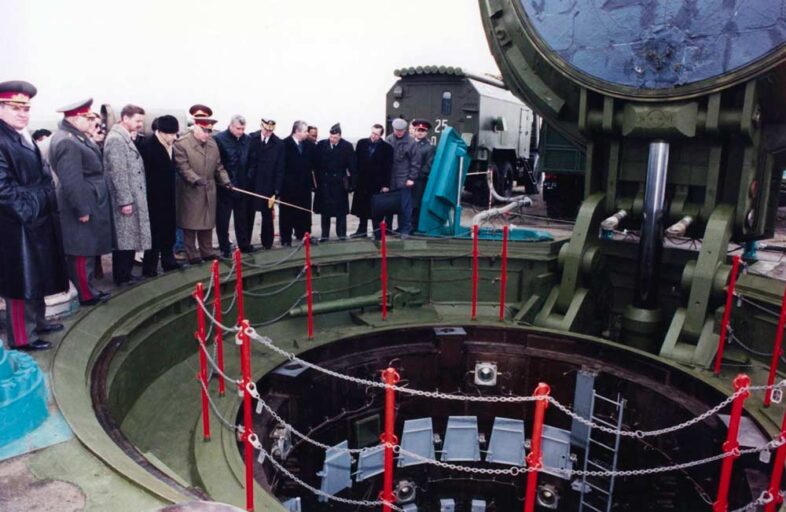
Photo: Near the missile silo launch facility during William Perry’s first visit to Pervomaisk, Mykolaiv region. March 1994.
After the war ended, in November 1945, Stalin signed a secret resolution to build a naval fleet over the next decade, from 1946 to 1955. The plan called for the construction of 3,500 combat ships and the establishment of over 100 aviation divisions—clearly not intended for defensive purposes. However, the primary focus of Soviet leadership during this period was on developing nuclear weapons and the delivery systems to deploy them.
Even a brief look at these events—let alone the subsequent waves of Russian expansion, including the two Chechen wars, the invasion of Georgia, the annexation of Crimea, the conflict in Donbas, and now outright war—helps to reconstruct the broader context. All of this is deeply rooted in the foundations of both the Soviet Union and modern-day Russia.
It is, therefore, entirely misguided to claim that Russia’s nuclear programme was simply a response to America’s. On the contrary, it was central to the expansionist ambitions of the Soviet Union and remains a core element of Russia’s strategy today. The aggressive tactics, terrorist practices, and underlying ideology have not faded.
— Could Ukraine, and more importantly, did its leaders at the time want to prevent the removal of tactical nuclear weapons to Russia?
– First, after Ukraine gained independence in August 1991, the transfer of any individual nuclear warhead—let alone entire trainloads of nuclear munitions—would have required the approval of the head of state. Second, the removal of tactical nuclear weapons was formalised by the Belovezh Accords, signed on 8 December 1991. Article 6 of the agreement clearly stipulated that Belarus, Kazakhstan, and Ukraine would transfer their tactical nuclear weapons by 1 July 1992.
Remarkably, all decisions, plans, and schedules were drawn up by the General Staff of the former Soviet Union—a body representing a state that had ceased to exist. The Soviet Union was gone, yet its General Staff continued to operate.
In addition to the previously mentioned documents, an agreement was signed in Almaty, followed by other accords. However, the Soviet General Staff primarily relied on the Verkhovna Rada’s statement of 24 October 1991, which outlined additional steps to implement Ukraine’s non-nuclear status. This statement was grounded in the Declaration of State Sovereignty and, later, the Act of Independence. By January 1992, Ukraine’s Ministry of Defence and its General Staff had already developed detailed plans for the removal of nuclear weapons. On 14 February 1992, the first train carrying tactical nuclear warheads left Ukrainian territory.
It is crucial to note that Article 6 of the Belovezh Accords explicitly stated that tactical nuclear warheads would be transported to “central pre-production bases” by 1 July 1992. Only specialists and the state leadership, including the president who signed the agreement, were aware that all these “central pre-production bases” were located in Russia—a fact that, to put it mildly, was concealed from the Ukrainian public.
Even the signing of some agreements was delayed in media reports by 2–3 weeks. The agreements themselves stipulated that the destruction of the weapons would take place under international supervision. However, when the first train departed, followed by others, there was no oversight whatsoever—no one was allowed into Russia. By February 1992, Ukraine’s Ministry of Defence was effectively forced to halt the removal of tactical nuclear warheads. This was because the Verkhovna Rada had not granted explicit permission for the removal, and the president of Ukraine did not have the authority to act unilaterally.
On 9 April 1992, the Rada adopted a statement outlining additional measures to ensure Ukraine’s non-nuclear status, explicitly prohibiting the removal of tactical nuclear weapons. Nevertheless, the process resumed on 21 April, moving at such a rapid pace that even nuclear specialists struggled to keep up, working around the clock. By the night of 5 to 6 May, the last train carrying tactical nuclear warheads crossed Ukraine’s borders.
As a specialist in strategic nuclear missile weaponry, I must stress that tactical nuclear weapons were the key assets that Ukraine’s leadership should have fought to retain. First, tactical nuclear munitions are far simpler to maintain and less demanding in terms of storage conditions. They could remain in warehouses for years without the need for complex technical measures, such as hydrogen absorbers, which are necessary for strategic warheads.
Moreover, Ukraine had little need for intercontinental strategic missiles aimed at the United States or China; tactical nuclear munitions would have sufficed. Had Ukraine kept them, it’s more than likely that there would be no Russian forces on Ukrainian soil today at all. This is my firm belief, grounded in both knowledge and experience.
– At the time, could Ukraine have actually maintained control over its nuclear weapons if the political decision had been made? In terms of preventative maintenance, care, and the regulatory work involved—did Ukraine have the capacity to handle this on its own?
– Could Ukraine have independently maintained strategic nuclear weapons? The answer is clear and unequivocal: yes, it could. Ukraine possessed vast scientific, industrial, and human resources to do so. There were numerous military specialists trained in handling nuclear warheads. Not only could they maintain and store the weapons, but they could also deploy them in combat if necessary. Additionally, Ukraine had a pool of scientists and engineers—largely civilian—capable of supporting this effort when required.
Consider the country’s potential: the world-renowned missile and space enterprises, such as the Pivdenne Construction Bureau and the Pivdenmash Machine-Building Plant in Dnipropetrovsk, alongside other facilities in Dnipro, Kharkiv, Kyiv, and beyond.
On 2 August 1994, just eight days after his inauguration, Ukraine’s second president, Leonid Kuchma, made his first official visit outside Kyiv—to the 46th Missile Division in Pervomaisk, which I had the honour of commanding at the time. He was accompanied by aides, ministers, and specialists. Our personnel knew well that Leonid Danylovych had been a professional missile engineer before entering politics, with an in-depth understanding of every aspect of nuclear weapon design, development, production, and deployment.
At the division, a closed-door meeting took place. Even my deputies were excluded; only specialists were allowed in. The president listened attentively to my report, as well as to that of Colonel General Mykhtyuk, commander of the 43rd Missile Army, before inspecting several key facilities. Afterwards, he addressed nearly the entire officer corps of the division, excluding those on active combat duty. Leonid Danylovych reassured them about their future, promising that the five missile regiments of the Pervomaisk 46th Missile Division—armed with the advanced SS-24 intercontinental ballistic missiles designed and produced by our Pivdenmash—would remain in Ukraine. These missiles, he noted, did not fall under any treaty on the reduction of strategic offensive nuclear arms. However, he emphasised that they would likely be reconfigured for non-nuclear purposes. I knew that certain enterprises were already working on these modifications.
It was both possible and necessary to retain at least five missile regiments, and no more, each equipped with the most modern, domestically produced missiles, which had been on combat duty since 1989. These strategic missiles were backed by a 10-year warranty, after which testing, including launches, extended the warranty for another 10 years—and then another.
For instance, in the Kolomyia Missile Division in the Ivano-Frankivsk region, second-generation missiles had been in service for nearly 30 years. Similarly, the SS-24 missile systems in our missile regiments could have remained on standby, with 46 silo launchers ready for deployment.
— I keep reading that instead of giving up the warheads, we should have dismantled them on-site, extracted the enriched uranium and plutonium, depleted them, and set up a facility to produce nuclear fuel assemblies (TVELs) for global trade. How much of this is realistic, and how much is pure fantasy?
– I want to emphasise once again that Ukraine possessed, and still possesses, a vast scientific and industrial potential—not only for developing and operating modern missile systems but also for maintaining the expertise to manage nuclear warheads. Each division had officers specially trained to service these weapons, supported by dedicated units—repair and technical bases—focused solely on nuclear warheads. The capability was there, but the key ingredient was time.
Despite our solid industrial and scientific foundation, we lacked a complete cycle for creating and dismantling both tactical and strategic nuclear warheads. Establishing such a cycle would have required vast funding and, crucially, at least 2-3 years. But above all, it was a political issue. The international community, including many EU countries and NATO, simply wouldn’t have allowed it. At that time, the notion of transferring warheads to the United States wasn’t even on the table.
Many politicians and military leaders, having come through the Soviet system, still believed in the possibility of peaceful coexistence with Russia. But those of us who objectively assessed the situation—who understood the history—knew that a war between Russia and Ukraine was inevitable. Personally, I always felt that way. The only question was when it would happen.
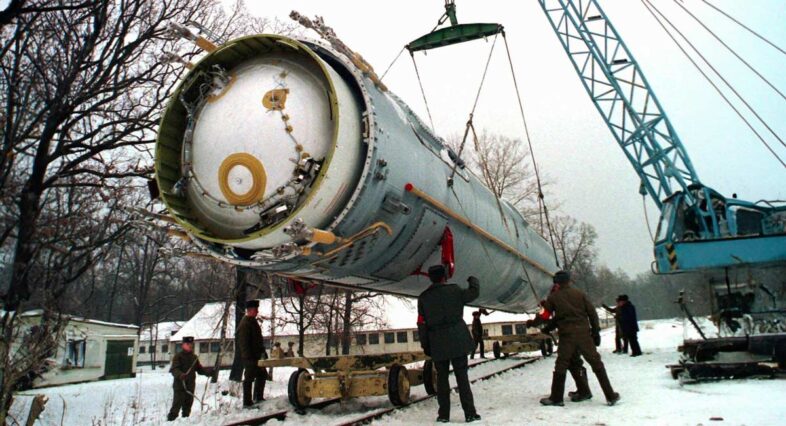
Photo: Ukrainian Armed Forces personnel prepare the SS-19 (UR-100N) ballistic missile for disposal at a base in the town of Vakulenchuk, Zhytomyr region, on December 24, 1997.
Unfortunately, there was only one option: to hand the warheads over to Russia, once the decision had been made. But the terms were deeply flawed. Russia received billions, while Ukraine was left with a pittance. The deadlines were unrealistic and unjustified, set at the highest levels of government without consulting experts. Furthermore, once the process began, we should have ensured it was carried out under strict, effective oversight—not just Ukrainian, but international as well.
At first, there was no control. When the removal of tactical nuclear warheads resumed on 21 April 1992, some semblance of control was introduced, but it was far from adequate. Yes, we sent officers to Russia, but what did that amount to? The warheads arrived at facilities near the Ural Mountains, in Arzamas. Our specialists stood at the entrance to the workshop as the warheads entered, and that was the extent of it. There was no further oversight. As both an expert and military officer, I have no doubt—nor did I at the time—that a significant number of the warheads, especially those from the last years of production, were never dismantled.
Thankfully, today, nuclear warheads are not aimed at us, and I hope they never will be. But we did hand over strategic aircraft and air-launched missiles to Russia. Today, those missiles are flying towards us, and the aircraft we gave away, supposedly as compensation for fuel, are now the ones launching them.
– You’ve said that you always knew Russia would eventually attack. Sooner or later—when did you first realise this? Did you see it coming right from 1991?
– Although I was born and raised in Russia, I left soon after graduating from the missile school and eventually settled in Ukraine. Despite being offered senior positions in Russia, I chose to stay. I was deeply committed to my beliefs, especially after the First Chechen War. I’m from Stavropol, just 140 kilometres from Chechnya, and had many Chechen friends. While I didn’t witness everything firsthand, I spoke to people and learned how the Chechen population was being decimated. Cities, including Grozny, were levelled—much like what we’re seeing now in places like Avdiivka. In reality, Russia lost the first war to Chechnya. A treaty was signed, but despite Russia’s commitment never to launch another attack, just three years later, the Second Chechen War began. Once again, everything that could be destroyed was destroyed.
I also knew President Dzhokhar Dudayev from when he was stationed in the Poltava Division of Heavy Bombers. He was a man of great stature. By then, I had already formed my views on the situation, informed by history and current events. So, when the events in Crimea and Donbas unfolded, they didn’t come as a surprise to me.
– The issue of selling off Ukraine’s military assets—its weapons, land, and everything of value—has long been a contentious one. Up until, say, 2014, this was done with little oversight, or worse, controlled by those who should never have had such power. While the true scale remains unclear, the consequences are evident. But how justified was this? Was it perhaps a necessary evil?
– The issue of downsizing Ukraine’s armed forces is a deeply painful one, especially for someone like me, with a military background. A great deal of damage was done, and while I’d rather not revisit it, it’s impossible to avoid. Many have forgotten the scale of what was lost. Beyond its missile-nuclear potential, which ranked third in the world…
…Ukraine was responsible for 13 of the 20 types of intercontinental ballistic missile systems deployed by the Soviet Union. Yet, that was only part of the picture. Our strategic bases and arsenals were stocked with weapons, equipment, property, ammunition, and supplies—enough to support 10 million people in the event of war with the Soviet Union. According to international experts, the total value of these assets was $89 billion—figures sourced from public records.
The sale of military property began in late 1991 and, unfortunately, stretched on for far longer than just a year or two—nor even ten. It was kick-started by Ukraine’s President, with Decree No. 28 issued on December 31, 1991. This decree established a commercial centre within the Ministry of Defence and outlined procedures for disposing surplus property. From 1992 onward, commanders of military districts, armies, and units were authorised to decide what equipment could be sold as surplus.
In effect, commanders had the discretion to determine what was deemed unnecessary. Previously, a commission would assess the residual value of the property—if it was new, an official price would be set, and the item would be redirected to the “national economy.” Later, the commercial centre handled domestic sales, although it lacked the authority to sell abroad. That said, much was sold—and often practically given away—for prices far below their actual worth, with many assets sold to other states at a fraction of their value.
In 1993, the commercial centre was disbanded after it had thoroughly discredited itself. Investigation materials were handed over to the prosecutor’s office, but, believe me, no one was held accountable, and the process continued unchecked. For instance, in 2000 or 2001, Ukraine transferred to Russia three Tu-95 strategic bombers, eight Tu-160 strategic bombers—some of the most advanced at the time, with almost no flight hours on them. Along with these, over 500 air-launched missiles were also handed over—missiles that, if I’m not mistaken, are now being used to attack Ukraine. This transfer was supposedly to settle a debt of $285 million for energy resources, primarily gas. That was the price of just one aircraft—well, one and a half aircraft, plus missiles. All of this was transferred to Russia. And this pattern continued into the 2000s: tanks, armoured personnel carriers, helicopters—sold not by the dozen, but by the hundreds, often at throwaway prices and without any strategic consideration.
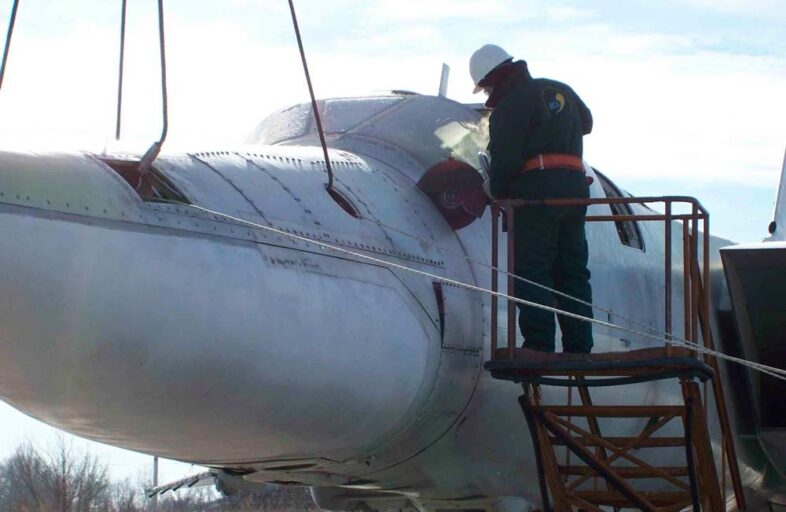
Photo: Decommissioning of the Tu-22M3 bomber.
Why was there no strategic assessment? Because there was never any clear identification of who our potential enemy might be. Who, exactly? No one. I’ve already mentioned how our respected, pro-Ukrainian president, Leonid Danilovych Kuchma—with all due respect—once said, “It’s laughable to think that Russia will attack us. Never!” He repeated this sentiment twice: Russia would never attack. Or consider the words of Ukraine’s Minister of Defence, Oleksandr Kuzmuk, during a ceremony marking the destruction of the last missile silo in the Kirovohrad region at the Pervomaisk missile division. He declared, “Finally, the Ukrainian people can sleep peacefully because we are no longer a target for attack.” While we still had silos, missiles, and nuclear warheads, we could have been a target. But once they were gone, according to him, we were no longer at risk.
This was the prevailing mindset on a matter of national security: no one seemed able to answer what exactly we were preparing for. In my view, this was influenced first by the Chornobyl tragedy and, second, by the sudden emergence of Ukraine’s independence after centuries of struggle. Sovereignty was declared, and a non-nuclear status was established. That was it—Ukraine was non-aligned, non-nuclear. Unfortunately, neither the political leadership nor the military establishment could adequately assess the long-term implications of this position. So, I’ll say it again: most politicians and military leaders simply couldn’t bring themselves to consider the possibility of an attack from Russia. Yet, I have always been clear and open about my perspective.
I discuss this in detail, with figures, facts, and documents, in my book The Lost Nuclear Missile Shield of Ukraine. This is now part of history, and the key is to draw lessons from it. Unfortunately, not from the mistakes of others, but from our own about how not to act. Today, we are at war, and Russia’s aggression against Ukraine continues. We must all stand in defence of our state and our people. Russia, with its aggressive and expansionist aims, must cease to exist.
***
Major General Mykola Filatov gave this interview for the documentary project Budapest. A Bomb Under Independence, produced by Suspilne. It was broadcast on the Suspilne channel, with a repeat scheduled for December, marking the anniversary of the signing of the Budapest Memorandum.