Airspace incursions
The Kremlin’s aggressive actions, aimed at ramping up tensions, remain a central factor in global security, particularly across the Baltic Sea region. After the high-profile September 10 incursion into Polish and Estonian airspace by Russian drones and manned fighter jets, a new episode unfolded on September 22: “unknown” drones suddenly appeared over airports in Denmark and Norway. By September 25, they were being spotted over Danish military facilities.
Analysts see these moves both as a clear projection of Kremlin threats and a deliberate effort to intimidate Europe, sow division within NATO and the EU, and erode support for Ukraine as it continues to resist Russian aggression. NATO’s response has been widely criticised as weak, appearing to embolden Moscow. Yet the reality is more nuanced.
Alliance members followed established protocols. In Poland, fighter jets were scrambled immediately, and orders were issued without hesitation to engage and destroy the intruding aircraft. The broader challenge, however, is that NATO forces — unlike Ukraine — still lack both the operational experience and the specialised tools needed to counter drones effectively.
In Estonia, the brief presence of Russian aircraft in national airspace left little time for a response. Any targets shot down would likely have fallen into neutral waters, giving Moscow a pretext to accuse NATO of aggression.
It appears the provocation was carefully calculated with this in mind. The operation involved three MiG-31s — high-altitude, high-speed interceptor fighters that, despite their age, still possess advanced technical capabilities, sophisticated electronic systems, and reconnaissance capacity. The pilots maintained full control, monitoring the approach of F-35s, but were confident they would not be engaged. By the time a response could be mounted, the MiGs would already have exited Estonian airspace.
Both Poland and Estonia also immediately invoked Article 4 of NATO’s Washington Treaty to consult with allies. The move had tangible consequences. By September, the Alliance had launched Operation “Eastern Sentinel,” aimed at strengthening its position on NATO’s eastern flank and, critically, deterring any attempt to seize the strategically important Swedish island of Gotland.
On 22 September, NATO’s regular exercises were joined by a new element: the bilateral Polish-Swedish SNEX (Short Notice Exercise) codenamed GOSE, or Gotland Sentry. The exercise was designed to rehearse the defence of Gotland against potential aggression. GOSE involved naval, air, and land forces and was conducted under the Polish-Swedish defence agreement signed earlier that month, which covers joint operations in the Baltic and the development of defence technologies. A key feature of the exercise was the ability of both sides to react quickly to changes on the ground, without being slowed by bureaucracy or delays. On 23 September, the US deployed several P-8 Poseidon multi-role patrol aircraft to Norway, which began patrolling and gathering intelligence over the Baltic Sea near Russia’s Kaliningrad exclave.
Poland also moved swiftly to reinforce its border, raising troop numbers to over 40,000 — roughly matching the size of the Russian forces involved in the Zapad-2025 exercises in Belarus. At the same time, Warsaw sent a military delegation to Ukraine, led by the deputy prime minister and defence minister, to coordinate joint efforts against Russian drones and to finalise an agreement on training Polish specialists in counter-drone operations.
On 23 September, a NATO Council meeting made it clear that allies are prepared to shoot down any Russian aircraft violating Alliance airspace. NATO Secretary General Mark Rutte underlined the point: “…if necessary, we will act as we should.” Polish Foreign Minister Radosław Sikorski later clarified, telling the UN Security Council that any Russian aircraft entering Polish airspace would from now on be shot down.
On 24 September, Italy extended the deployment of its air defence and radar control contingent at Estonia’s Ämari airbase until at least spring 2026. As part of NATO’s Baltic Air Policing mission, up to 500 Italian troops are stationed there on a rotational basis, equipped with F-35 fighter jets and SAMP/T air defence systems. Meanwhile, France and Germany, responding to Poland’s request, urgently sent additional fighter squadrons to reinforce NATO’s eastern flank.
For Denmark and Norway, the drone incidents took a different shape, with the temporary disruption of Copenhagen and Oslo airports clearly not the main aim. Both countries are among the largest contributors to Ukraine’s defence, particularly through funding and producing long-range Flamingo cruise missiles for Ukraine (and Denmark). These missiles are seen as superior and far cheaper than their American equivalents — and, importantly, they do not require US approval for use.
Experts say the reports involved “unknown” small drones — likely tiny quadcopters launched near the airports — whose flights went undetected by radar, suggesting a deliberate provocation. Who exactly was behind the incidents remains unclear, although Danish police have detained two Singaporean nationals as possible perpetrators. There were also reports that the drones may have been launched from a vessel belonging to Russia’s so-called “shadow fleet” off the Danish coast.
Austrian analyst Tom Cooper says Putin’s provocations are part of a broader Moscow strategy: to divert Europe’s attention, push it toward rearmament, and undermine support for Ukraine. Essentially, the Kremlin is trying to shift focus away from its own military and economic failures.
Finally, Ukrainian analyst Vitaliy Portnikov suggests that these latest air provocations are Moscow’s way of raising international tensions and testing the limits of what is possible — and he warns this could be just the start of a far larger hybrid war.
In recent days, “unknown” drones have once again been spotted over Denmark, as well as Germany, Lithuania, Finland and Sweden. This fits the pattern of Moscow’s textbook “escalation to de-escalate” tactic — provoking NATO into a response and then seeking negotiations on terms favourable to itself. The Alliance is working hard to avoid falling into that trap.
Ukraine, meanwhile, is actively involved. At the invitation of the Danish government, a team of Ukrainian military instructors and specialists has already arrived in Denmark to share their experience and counter-drone tactics with Danish forces. This is complemented by Ukraine’s proposals for air defence systems and combat equipment showcased at the MSPO-2025 defence exhibition in Kielce, Poland.
Among the highlights is a new command and staff vehicle (CSV) for an air defence tactical group, built on the Novator-2 armoured platform by Ukrainian Armoured Vehicles. Equipped with the integrated “Krechet” command system, it is designed to automate coordination between surveillance and detection assets, air defence units, and up to ten mobile fire groups.
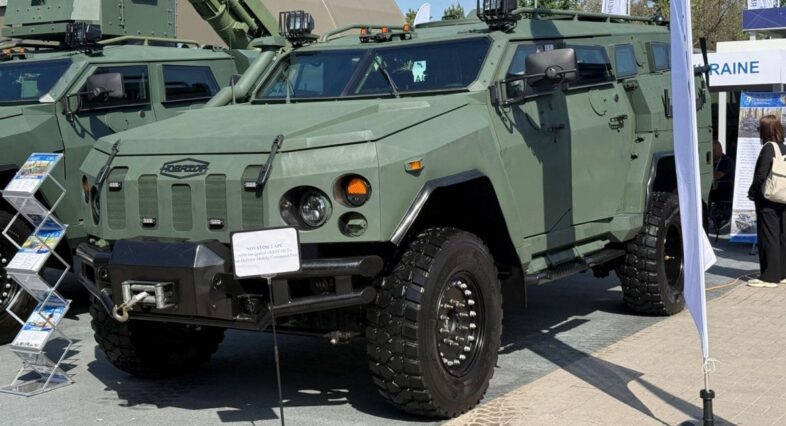
New Ukrainian command and staff vehicle (CSV) for the “Krechet” air defence tactical group
Military outlook
Any provocation only carries weight when backed by real military power — the means to turn an aggressor’s intentions into action. In the Baltic, that power rests largely with the Kremlin’s Baltic Fleet, an operational-strategic formation of the Russian navy.
The fleet’s role at sea is shaped by a few key factors. At the top of the list is the isolated position of the Kaliningrad exclave, trapped between Poland and Lithuania, and the need, in any conflict, to carry out offensive operations — hitting sea and coastal targets and, most importantly, landing assault forces.
To meet these tasks, Russia’s Baltic Fleet fields a submarine, a destroyer, two frigates, four corvettes, 13 small missile ships, 19 combat boats, six small anti-submarine vessels, 10 minesweepers, four large landing ships, two small air-cushion landing craft, nine landing boats, plus a range of reconnaissance, rescue, and support vessels. Also stationed in the Baltic are five ships from the Black Sea Fleet, which were outside the Black Sea when Turkey closed the straits in February 2022: a frigate, a corvette, a small missile ship, and two submarines.
By contrast, the navies of nine NATO Baltic countries — Poland, Germany, Denmark, Norway, Sweden, Finland, Latvia, Lithuania, and Estonia — collectively field a much stronger force: 25 frigates, 40 corvettes, 17 patrol vessels, 13 submarines, nine missile boats, nine landing ships, 12 landing craft, 14 minelayers, and 80 minesweepers. Meanwhile, new ships are under construction — nine frigates, seven corvettes, and 17 landing and unmanned vessels — alongside the deployment of new coastal missile batteries and the procurement of additional naval mines and missiles.
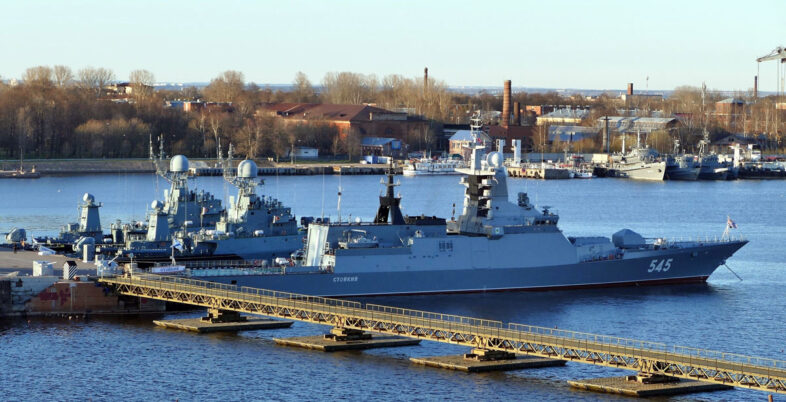
Baltic Fleet ships in Kronstadt
The large number of minelayers and minesweepers in NATO navies also signals a readiness to deploy naval mines extensively in a conflict—mines have long been a highly effective way to block enemy ports and sea lanes in the shallow Baltic waters.
This mission is made easier by the Baltic Fleet’s clear weakness in anti-submarine and mine-warfare capabilities, which are further divided between two locations. That includes the potential for allies to covertly lay mines using submarines or naval drones near Gotland and Åland, as well as around Russian ports and naval bases.
The naval picture is reinforced by the air component: NATO fields over 1,300 modern multi-role combat aircraft, including more than 300 fifth-generation F-35s. Here too, the Alliance holds both a numerical and qualitative advantage, while Russia has up to 600 multi-role aircraft, mostly fourth-generation, with the bulk of them tied down in the war in Ukraine.
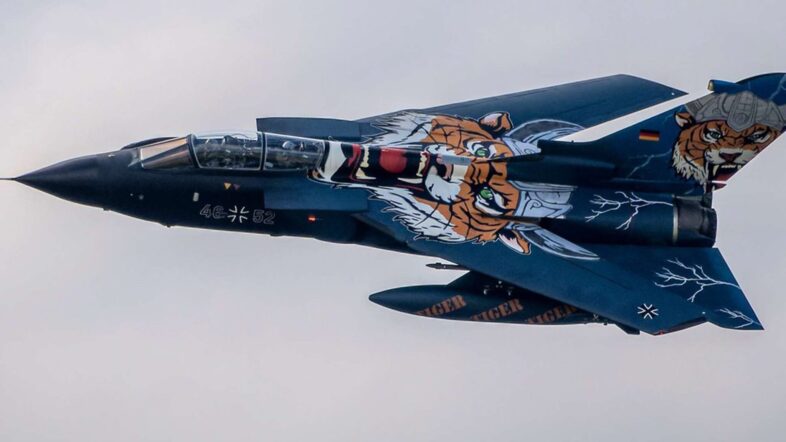
NATO holds a significant quantitative and qualitative advantage over Russia in the air
Security scenarios in the Baltics
From a military standpoint, control of the strategically vital Swedish island of Gotland would be central to any conflict in the Baltic. Situated 330 km from Kaliningrad and just 100 km from the Swedish mainland, Gotland’s significance is often compared to Crimea—whoever holds the island can exert dominance over the Baltic Sea.
The second key target for a potential Russian landing would be the demilitarised Åland Islands, part of Finland. They provide control over access to both the Bothnian Bay and the Gulf of Finland. Historically, these islands have also attracted Russian ambitions: Russia twice captured Gotland (in 1717 and 1808) and controlled Åland for over a century (1809 to the 1910s).
Western intelligence forecasts that in an open conflict, the Baltic Fleet would aim to seize sea and air superiority with aviation support, shifting the balance in its favour and securing operational freedom. Achieving this would require first capturing Gotland and Åland—and then holding them. The Baltic Fleet has been rehearsing a landing on Gotland since March 2015, following the annexation of Crimea, prompting Sweden to re-establish its military presence on the island.
Seizing these islands would let Russia break the strategic isolation created by the Baltic Fleet’s split deployment between the Kaliningrad exclave and Leningrad Oblast — more than 1,000 km apart. Once missiles were emplaced on Gotland or Åland, Moscow could aim to choke allied sea and air lines of communication, above all those linking the Baltic states, making any further advances against them — and potentially parts of Poland — far easier, and giving Russia leverage to press NATO for an end to hostilities on its terms.
To blunt NATO’s maritime edge, the Baltic Fleet is preparing to mass‑use drones and unmanned kamikaze boats against ships and critical infrastructure, alongside sabotage missions. Its ten launch platforms for Kalibr cruise missiles would also allow strikes deep into European territory.
Also deployed in Kaliningrad and Leningrad oblasts are potent missile systems: the OTRK Iskander‑M (range up to 500 km, with a nuclear‑capable option) and the Iskander‑K variant (claims of up to 2,000 km), which can reach targets across much of Sweden and from southern Poland to central Finland. The Kaliningrad exclave also hosts coastal batteries — the Bastion‑P with P‑800 Oniks cruise missiles (around 500 km) and the Bal system with Kh‑35 Uran missiles (up to about 260 km).
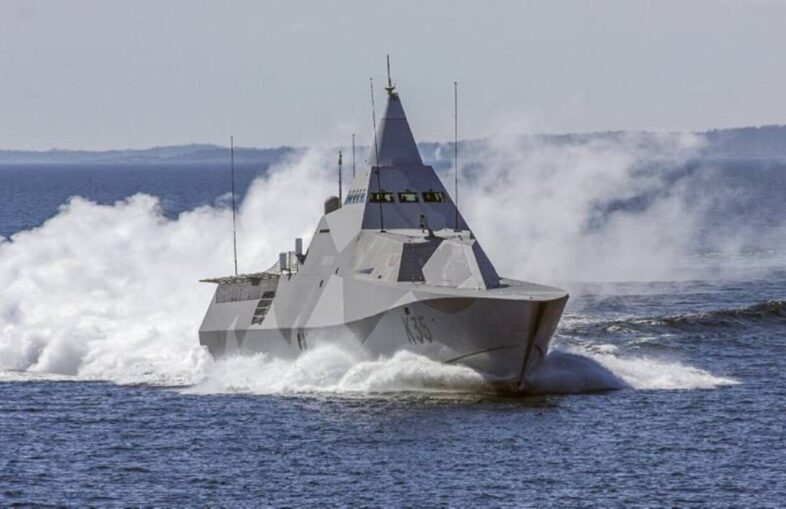
Swedish stealth corvette Visby
For NATO, preventing a Russian landing on Gotland and the Åland Islands is essential to holding the naval initiative, deterring Moscow, and pushing it toward a negotiated settlement. In the event of an open invasion, the Alliance’s ability to defend the Baltic states until reinforcements arrive would depend on it.
This scenario reflects a long‑studied approach for a potential Baltic theatre, with both sides practising elements in military exercises for more than a decade. The accession of Finland and Sweden to NATO has effectively turned the Baltic into “NATO’s sea,” making the operational picture far more challenging for Russia.
This raises a pressing question: can the Russian Baltic Fleet actually pull off a surprise amphibious landing on Gotland under these circumstances—especially with key forces and assets already tied up in Ukraine?
The Baltic Fleet cannot rely on reinforcements of large landing ships from the Northern Fleet either, where they are similarly scarce. This leaves Russia critically short of the means to launch any serious amphibious operation with heavy equipment. Without such a landing, the rest of the Kremlin’s plans for the Baltic theatre effectively lose their purpose. That abandonment could come without a hot phase, with provocations quietly halted, or it could be forced, with the fleet almost certainly destroyed in stages.
In the latter scenario, the conflict and blockade would inflict not only military losses but also severe economic damage. Russian oil and gas exports would be paralysed, maritime communications cut, container transit disrupted by up to 52%, and up to 40% of national shipbuilding capacity rendered inoperative.
Depending on the circumstances, Alliance forces could even block or occupy the Kaliningrad exclave, already under an energy blockade and in a precarious state. Expert assessments suggest there are almost no troops available to defend it. Such a scenario could have serious political repercussions, because it might even trigger the dismantling of post-Soviet Russia.