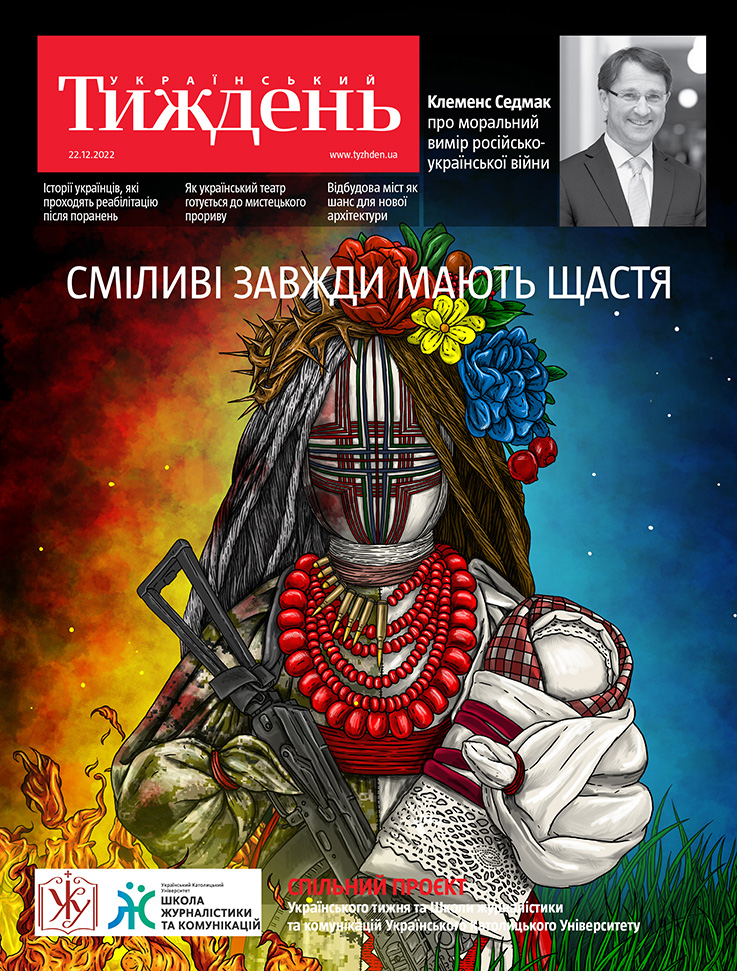
Debra Cagan, a former advisor to U.S. President George W. Bush and a veteran of the U.S. State Department, has extensive experience with issues concerning Eastern Europe, Georgia, and the relationship between former Soviet countries and the West.
In an interview with The Ukrainian Week, Debra shared her insights on expectations for Trump’s presidency, peace negotiations between Russia and Ukraine, the prospects of Ukraine joining NATO, and the potential risks of Russia using nuclear weapons.
***
– Ms. Cagan, in less than a month, the new President of the United States, Donald Trump, will take office. He will face a situation where Russia sees Ukraine’s very existence as a threat to its security, while Ukraine is determined not to remain a “buffer zone” and has set a clear pro-Western course. What advice would you give Donald Trump as President?
– I would advise the White House to recognise that it cannot negotiate about Ukraine without Ukraine at the table. The United States must avoid repeating the mistake the Allies made with Hitler when they handed over Czechoslovakia, hoping he would stop—and he clearly did not. Similarly, Putin will not be appeased by granting him part of Ukraine; he wants the entire country.
Furthermore, I would not characterise this as a security issue for Putin. Before 2014, Ukraine posed no threat to Moscow; Kyiv simply wanted to govern itself independently. Putin, however, believes Ukrainians should not have the right to decide what is best for their own country—he considers that to be his prerogative alone.
Lastly, I would caution the incoming Trump administration that no agreement with Putin can be trusted to hold. He and his forces will inevitably find a way to violate any such deal early on and shift the blame onto Ukraine.
– Historian Timothy Snyder recently coined the term “Trumpomuskovia” to describe the influence of Elon Musk and Russia on Trump. He even suggests that Trump could follow in Boris Yeltsin’s footsteps, with an oligarchy emerging in the United States that might replace Trump with a younger “successor.” What are your thoughts?
– I suspect that Elon Musk’s influence will have a short shelf life.
– Could Trump, early in his presidency, succeed in initiating a resolution to the war in Ukraine? What are your thoughts on the proposal to freeze the war by establishing a “grey zone” between Ukrainian and Russian forces, with NATO peacekeepers stationed there?
– Ceasefires are notoriously difficult to enforce. I think it’s absurd to call any force willing to take on this role “peacekeepers.” They would be peace enforcers. If this were to happen, all participants and negotiators must approach it with clear eyes, understanding that this operation would far surpass previous ones in scale and complexity. It would require not only ground forces but also air and naval components, along with strict rules of engagement that allow them to fire back if attacked—which, frankly, I believe is inevitable. Furthermore, it is pure fantasy to assume that such a complex undertaking could be accomplished without U.S. involvement. That is simply not going to happen.
– The ultimate goal, of course, is to fully restore Ukraine’s territorial integrity. Is there a realistic path to achieving this?
– The only way Putin will realistically stop trying to annex all of Ukraine is if he personally feels the same pain as the Russian and North Korean military are enduring. He clearly will not be dissuaded by the number of bodies he has already thrown into this war as sheer cannon fodder. He could not care less how many of his own people die as long as his vanity and world designs are being met.
So, if we’re being realistic, we must take a much tougher approach across every sector of the Russian economy and everywhere else we can to make Putin feel the pain. Unless this is part of the plan, he will never let go of his grand ambitions.
– At this point, is it realistic to consider a scenario where the war is frozen and Ukraine’s free territories are integrated into NATO?
– No, it’s not realistic at all. There are still too many countries in NATO that Russia, and China for that matter, have a strong influence over by buying their loyalty. Orban is a classic example of this. There are also other countries that are so afraid of Russia that they will not support Ukraine’s NATO membership. Putin thrives on these fears, which are also present in the United States across both political parties.
– Putin seems to believe he has a technological edge on the battlefield or at least a greater resolve to use advanced weapons. That might be why he proposed a “duel” between Western air-defence technologies and “Oreshnik” over Kyiv. Or is this just a bluff?
– I think what the Russians are discovering is that their battle tactics and strategy, which were much more effective in the last century and the first part of this one, are not as relevant in this technological age.
I like to say that today, in general, we’re seeing an industrial revolution every 3-4 months. But in the modern battlefield, these tectonic shifts are happening every few days. What worked yesterday won’t necessarily work tomorrow, and we’ve seen this repeatedly in Ukraine.
Putin brags a lot, and the Russians are competent, but they, like also many in the West, are discovering that not all of our supposedly great weapons have proven effective in this war. Innovation, dynamism, and the ability to embrace change are crucial, and the Russians are slow to adapt.
– On December 19, Putin declared his readiness to negotiate with Ukraine without preconditions, despite having expressed his intent just this summer to fully occupy four Ukrainian regions. However, he insists on negotiations based on the Istanbul agreements, which undermine Ukraine’s sovereignty. Is there a risk that “Istanbul” could become a new “Minsk” for Ukraine?
– Absolutely. Putin’s perspectives are that Minsk was just fine. He got everything he wanted, and Ukraine got nothing.
– Putin has claimed that Russia did not lose in Syria but simply achieved its goals and withdrew its forces. Could you explain the real geopolitical consequences for Russia after leaving Syria?
– The realistic consequences for Putin in Syria are significant. This was one of the biggest lies in his New Year’s press conference, among a long list of falsehoods.
Soviet and then Russian forces have been in Syria since the 1969 revolution, starting when Hafez Assad became defence minister, then prime minister, and finally president in 1971, when formal agreements were signed with the Soviets granting them long-term access to air and sea bases in Tartus and Latakia. This was Russia’s only permanent military presence outside of the former Soviet Union.
It also provided them with crucial access to the Eastern Mediterranean, where they supplied military training and weapons to Hamas, Hezbollah, the Houthis, and, most importantly, Iran.
Those arms routes are gone, thanks to Israel taking out the leadership of these deadly terrorist organisations. Without Hezbollah, the inept Syrian army was never going to be able to hold its own. And Russia was never going to commit forces on the ground beyond naval, air, and military advisers, and certainly can’t do so now, especially when it’s relying on North Korea to provide forces to be killed in Kursk.
It’s difficult to predict what will happen going forward, but Syrians trying to rebuild their nation would be wise to ensure that the Russians—who helped kill tens of thousands with chemical and other weapons—are not part of its future.
– By the way, it’s evident that the “special military operation” in Ukraine could end in a similar way—with claims of achieving objectives. The question is, how much Ukrainian territory would Putin be willing to give up during his retreat?
– Putin is probably thinking that a Trump administration will not force him to give up any territory, and therefore he does not think he will have to volunteer to relinquish any territory. The word “retreat” is simply not in Putin’s vocabulary.
– There is speculation that Trump might engage in negotiations with China to pressure the Kremlin, forcing Putin to end the war. How viable do you think this strategy is, and how long could this geopolitical game last?
– I think this is a fool’s errand, a joke at best and a strategic blunder at worst. The Biden administration tried multiple times to separate China from Russia and Russia from China, but it made absolutely zero progress.
What the Trump administration needs to understand and what the Biden administration still has problems with, is that both of these countries, along with Iran and North Korea consider the United States its mortal enemy so even if we chose to call them a strategic adversary, the enemy gets a vote, and to them we are the enemy.
– North Korea has described its alliance with Russia against the West as “highly effective.” According to journalists, hundreds of North Korean soldiers have been killed or injured in the war in Ukraine. During his presidency, Trump claimed to have good relations with Kim Jong-un. Is there currently any chance of pulling North Korea out of Russia’s sphere of influence, perhaps through China’s mediation, since Beijing also supports Pyongyang? What strategies could dismantle this new “axis of evil”?
– No, no and no. Russia’s relationship with the DPRK is purely transactional. North Koreans will die on Russian soil in exchange for Kim getting money and other assets, perhaps including advanced military technology, which will be a significant problem for the United States.
– During his New Year’s Eve press conference, Putin suggested that Russia might use nuclear weapons against Ukraine if Ukraine uses non-nuclear, American-made missiles to strike Russian territory. My question is: if Russia were to use nuclear weapons against Ukraine, would the United States respond, and if so, what form might that response take?
– First of all, this is just a lie by Putin to scare the incoming Trump administration. I believe that not only would the US react if Russia used tactical nuclear weapons, but others would as well. Moreover, the Chinese would be livid.