When you think of the Kingdom of Denmark, images of Copenhagen’s snow-red rooftops, the icy Baltic waves, the distant age of Vikings, and the fairy tales of Hans Christian Andersen spring to mind. It is a land steeped in stories and legends, of enduring faith and strength, of swords and shields—a country that has a remarkable way of keeping its past alive.
Among Denmark’s most enduring legends is that of a hero who sleeps, sword and shield in hand, ready to rise when his country calls. This is Holger Danske. According to folklore, he rests deep in the cellars of Kronborg Castle, lying in wait for the day he will awaken to defend the nation.
Denmark: history, economy, and military backing for Ukraine
But Denmark is not just a land of myths. It is a country with a rich military history and a robust economy. On one hand, it is an ancient kingdom the Vikings called the homeland of “shields” and “a wagon of swords.” On the other, it is a modern, economically strong state, investing in its own defence and building international partnerships.
Denmark’s military tradition runs deep. Since the Middle Ages, its armies have fought in wars across Scandinavia. Its soldiers were victorious in the Thirty Years’ War, and at the Battle of Kolding, they repelled Swedish forces. During the Napoleonic Wars, the Danish navy mounted serious resistance. Even in the twentieth century, after German occupation, Denmark preserved a resilient partisan spirit and later emerged as an active NATO member.
Since Russia’s full-scale invasion of Ukraine, Denmark has become one of Kyiv’s most reliable allies. The Danish government even launched the Danish Model programme—a scheme that doesn’t just send weapons, but also provides financial support directly to Ukrainian defence companies.
By September 2025, Denmark had offered Ukraine around €8.1 billion in military aid, along with significant civilian support. And the partnership goes beyond handing over equipment. Denmark is working with Ukraine on developing and adapting weapons to NATO standards, and even producing them together. In the Danish Model, Ukraine isn’t just receiving help—it’s a full partner, building its own defence capabilities side by side with Denmark.
Drones are getting special attention. Denmark is investing in the production of Ukrainian UAVs that have already proved their worth on the battlefield. This includes both reconnaissance and strike models, capable of carrying munitions and operating in complex electronic-warfare environments. Danish partners are helping set up drone production workshops in Ukraine and supporting the testing of new prototypes.
Artillery is another focus. Denmark has shown interest in backing the production of Ukraine’s self-propelled howitzer, the Bohdana, providing financing, components, and logistical support. Already deployed with the Ukrainian Armed Forces, the system has proven highly effective, and expanding its production is seen as key to strengthening Ukraine’s defence.
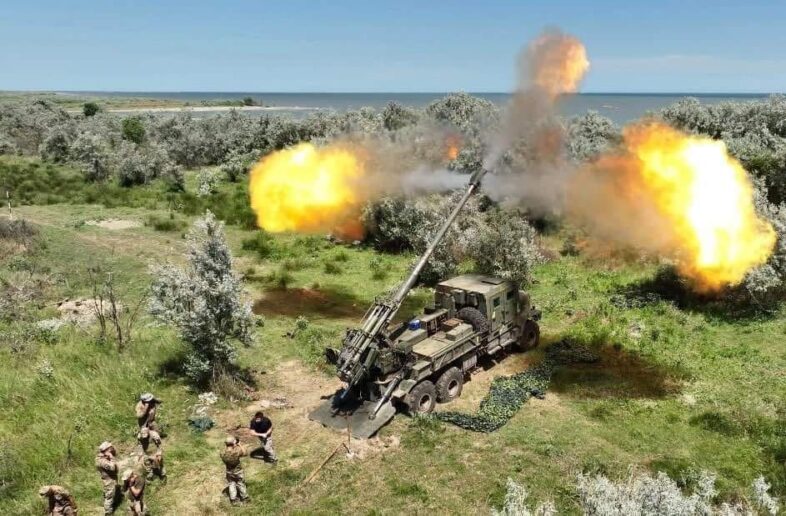
The 155mm self‑propelled howitzer Bohdana fires on Russian positions on Snake Island, June 2022. Photo: mil.gov.ua
Talks are also underway on missile technology, particularly on improving long-range strike systems to meet Western standards. Denmark sees Ukraine’s fight not just as a war effort, but as an opportunity for technological development, with joint production serving both immediate defence needs and future capabilities.
Under the Danish Model programme, Ukrainian companies are receiving direct funding to produce weaponry, including air-defence systems. This approach creates a stable model of cooperation, supporting domestic industry while simultaneously strengthening military capabilities.
For Denmark, building Europe’s security alongside Ukraine makes sense not just politically, but technologically. This support is no accident—it reflects a strategy that balances moral responsibility with pragmatic interests.
Drone warfare and cybersecurity talks
The local Danish military command invited me to a series of working meetings and briefings, and the agenda was unmistakably urgent. We talked about the new conditions of war already shaping the battlefield — drones, artificial intelligence, cyber-security, countering electronic warfare, and the integration of digital platforms into combat. Ukrainian case studies drew particular interest: tactics for FPV drones, the rise of mobile air‑defence groups, and software used for real‑time battle management.
A session focused on preparing soldiers and officers for this new kind of war. In my talk, I made a simple point: it’s not drones that fly on the front line, it’s the operators behind them. As head of the training centre “Kruk”, which has trained nearly 10,000 operators for the Defence Forces, I stressed the importance of organised training, modern tech, fresh approaches, and updated courses.
The discussion also explored how Ukraine sets up its so‑called kill zones — areas designed for almost guaranteed, instant strikes. These aren’t created by artillery alone, but by a combination of drones, ground reconnaissance, AI, and mobile teams, all working together to locate and hit targets quickly.
Scenarios were analysed in which Ukrainian forces can strike a target in just 30 seconds — much of the process now automated. The Danes listened closely, asking technical questions and requesting further detail. One officer admitted frankly: “We’ve seen this in videos from the front, but now we understand we’ll have to prepare for it ourselves. Right now, we’re not ready to operate under these scenarios or at this intensity.”
“We are behind, but taking action”
The military don’t shy away from the truth: they are not as prepared as they would like to be. Politicians in Denmark — and across Europe — are still coming to grips with the scale of the threats. For decades, Denmark existed in a kind of idealised world, built on stability, small armed forces, and the assumption that a large-scale war would never touch its shores. But that reality is shifting. Local media reported that Denmark now plans to significantly boost its defence spending.
Yet Denmark has a clear edge: unlike many European nations, it has already begun the hard work. Taking lessons from Ukraine, it is is rethinking its military doctrines and putting strategy into practice.
Denmark’s reserve system prioritises youth and women
Denmark’s reserve system is being reshaped with a clear focus on youth and women. These are the people being consulted, trained and folded into the reserve now — with an explicit emphasis on the 18–25 age group. After about 42, the Danes say, someone is no longer considered optimal for service in the active reserve, let alone in a modern fighting force.
Those numbers stand in stark contrast to Ukraine, where the average age of a servicemember is over 43. Yet debates in Ukrainian society still circulate about recruiting retired military personnel aged 45–50 rather than prioritising younger recruits.
Denmark may be small, but its calculation is simple: military service is an honour for young people of all genders. The reasoning is unflinching — if the young do not defend the country in a crisis, there may be nothing left to defend. An enemy occupation would spare neither youth nor women — nor the nation itself.
On the way to Copenhagen, I passed rows of new and varied military equipment: armoured vehicles, transport trucks, soldiers heading to training. The contrast between the “old, fairy-tale Denmark” and the stark reality of modern northern defence struck me sharply. In that moment, I thought of the ending of the legend of Holger Danske, who lies asleep underground with his shield and sword. One day, when his country calls, he will awaken to defend the homeland.
Denmark is waking up. Slowly, but with purpose. Rising from its slumber, donning its armour, taking up its shield. Like the heroes in Andersen’s fairy tales, who never gave in even in the darkest night, Denmark is searching for light in a new reality.
Ukrainians see a Denmark that is more than an ally. A country ready to stand with us on the same line of defence. In a world reshaped by war, it is these awakened heroes who can make a real difference. And this is no longer a fairy tale — it is a reality our countries are writing together today.