
On 7 July, NATO leaders will gather in Ankara for this year’s two-day summit. On the evening of 3 July, the draft final declaration — already approved by ambassadors from all member states — was obtained by the media. According to Reuters, the Alliance’s leaders — including Donald Trump — are expected to reaffirm their “ironclad commitment” to collective defence under Article 5 of the North Atlantic Treaty. “We […] have gathered in Ankara to reaffirm our ironclad commitment to collective defence in accordance with Article 5 of the Washington Treaty and to the transatlantic bond. An attack against one is an attack against all,” the draft says.
After two crises that have shaken the Alliance this year — one triggered by Trump’s suggestion that Greenland should become part of the United States, the other by Washington’s frustration over some allies’ reluctance to support the US-Israeli war against Iran — Trump’s endorsement of the text would be seen as a significant signal of unity.
Yet on the same day the draft was leaked, Trump wrote on Truth Social that it was “ridiculous” for the United States to continue supporting NATO at its current level “when the relationship is not reciprocal”. He has also previously complained that Washington “spends far more money on NATO than any other country” to defend allies “without getting anything in return”, and has dismissed the Alliance as a “paper tiger”.
The widening gap between Washington and the rest of the Alliance is expected to hang over the summit, even if Trump can be kept on board during the meeting. Still, simply getting him to show up is already being seen as a diplomatic win for the host country and President Recep Tayyip Erdoğan.
“Turkey is reluctant to talk about NATO without the United States because it does not want to create a self-fulfilling prophecy. Ankara fully understands that the US nuclear umbrella, its strategic capabilities, Patriot air defence systems, intelligence, surveillance and reconnaissance (ISR) assets, along with a range of other critical capabilities, would be either extremely difficult or impossible to replace in the short term,” Yevgeniya Gaber, a senior fellow at the Atlantic Council, told The Ukrainian Week.
According to her, Turkey is not preparing for a NATO without the United States, but instead trying to keep Washington as the key guarantor of European security, even as its direct engagement in Europe gradually declines. “That is why one of the biggest wins ahead of the Ankara summit is seen as President Trump’s decision to attend. Unofficially, but quite openly, people in Turkey say this is largely the result of the personal relationship between Donald Trump and Recep Tayyip Erdoğan — a textbook case of strongman diplomacy. Keeping the United States engaged in NATO remains a key priority for Ankara,” she explained.
At a meeting with NATO Secretary General Mark Rutte at the White House on 24 June, Trump said he would not have attended this year’s NATO summit if it were not being held in Turkey. The US president also described Erdoğan as a “strong man” and said he had great respect for him.
Among the other key commitments in the draft declaration seen by reporters is a pledge to provide $80 billion in military assistance to Ukraine in 2026, followed by “at least an equivalent amount” in 2027. The text also continues to describe Russia as a “long-term threat” to “Euro-Atlantic security and stability”, while reaffirming last year’s pledge at The Hague summit to ramp up defence spending. On 3 July, German Chancellor Friedrich Merz announced that Germany would double its defence budget over the next four years.
The draft also points to a greater European role in its own security — a long-standing US demand. Earlier this year, that shift in thinking about the Alliance was dubbed “NATO 3.0”, following remarks by US Under Secretary of Defense for Policy Elbridge Colby.
Fault lines on display ahead of summit
Perhaps the biggest challenge is the US president’s unpredictability alongside a broader line from both Trump and his administration pushing for a sharp reduction in America’s military presence in Europe. At the meeting of NATO defence ministers in Brussels on 18 June, US Defense Secretary Pete Hegseth announced a review of the deployment of American troops and the US military posture in Europe over the next six months. While European allies had expected such a move, the pace of the planned changes and Hegseth’s blunt rhetoric, according to European media reports, irritated many of his counterparts.
Higher defence spending also remains a major challenge for the Alliance. At last year’s summit in The Hague, NATO members agreed to raise defence spending to 5% of GDP. The Ankara summit is expected to assess how much progress each member has made towards that target. A fairer sharing of the Alliance’s defence burden remains one of Washington’s key demands — a point President Trump continues to hammer home.
Experts say NATO Secretary General Mark Rutte will once again try to keep the Alliance united by keeping Trump onside — a strategy that has so far worked well — while making the case for the benefits NATO membership brings to the United States.
That is also the view of Claudia Major, a defence expert at the German Marshall Fund, who told Deutsche Welle that Alliance leaders will aim to project unity while trying to “keep Trump satisfied and make the case for NATO”. In her assessment, the decision to make this year’s Defence Industry Forum one of the centrepieces of the summit is designed to serve exactly that purpose. As Major puts it, Rutte’s goal is “to demonstrate that there is a market for American industry and to make the economic case for NATO in ways that will, hopefully, appeal to Trump”.
The summit’s host, Turkish President Recep Tayyip Erdoğan, is also expected to push the argument that NATO works best as a united Alliance with Washington fully engaged. “For Turkey, NATO membership is one of the cornerstones of both its national security and its strategic identity,” Yevgeniya Gaber says.
Turkey also brings considerable weight to the table. It has NATO’s second-largest armed forces, has been among the Alliance’s biggest contributors to NATO operations, and has a powerful defence industry. Taken together, those factors could also resonate with a US president who has long shown an affinity for displays of strength.
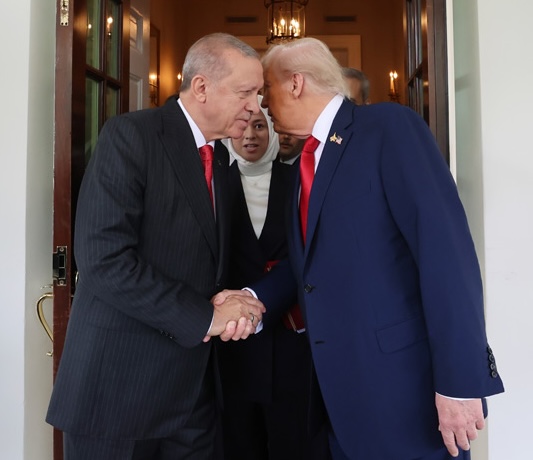
Turkish President Recep Tayyip Erdoğan and US President Donald Trump during a meeting at the White House on 25 September 2025. Source: https://www.tccb.gov.tr
At the same time, some argue that — unlike at the Hague summit — NATO members have now largely dropped any illusion that they can still “appease” the US president. “This time, it should become clear not only that Trump will remain resentful towards his NATO allies as long as he stays in office, but also that NATO is undergoing structural change driven by diverging transatlantic perceptions of interests and threats,” Stephen Wertheim of the Carnegie Endowment for International Peace noted.
Disagreement over what actually constitutes the main security threats is emerging as one of the summit’s key fault lines, at least from the White House’s perspective. For European allies, the focus remains on Russia and support for Ukraine. The United States, by contrast, is increasingly looking to the Indo-Pacific, where China is seen as its main long-term strategic rival — an argument reflected in Elbridge Colby’s pitch for a “NATO 3.0” framework. Washington’s other immediate priority is its confrontation with Iran, which several NATO members have declined to support.
Here, once again, Turkey – the host nation – could play a constructive role. “There is no doubt that Turkey will use the summit to promote a ‘360-degree’ approach, stressing that the southern flank is no less important than the eastern one. For Ankara, threats from the south include Iran, Israel, Palestine, Gaza, and the broader Middle East, as well as the Eastern Mediterranean, Greece and Cyprus. All of these issues remain highly significant for Turkey,” Yevgeniya Gaber told The Ukrainian Week.
That being said, Ukraine is not expected to slip off the agenda. “This does not mean that Ukraine disappears from the agenda or is pushed to the margins of NATO as an Alliance. The summit agenda is shaped not only by Turkey as a host, but also by Brussels and all the allies,” the expert notes. Gaber expects Ukraine to still take up a significant share of attention. “For Turkey itself, Ukraine remains an important, however, not central priority,” Gaber added.
More broadly, NATO’s southern flank — and the growing attention it’s getting from European allies — is high on Ankara’s list going into the summit. Gaber says the host country also has two other goals: to underline its growing role in NATO and European security, and to push for a bigger Turkish presence — including its companies and sizeable defence industry — in European security structures. That second goal, however, runs into clear limits. As a non-EU member, Turkey is largely shut out of instruments such as PESCO and SAFE — two of the EU’s main defence policy tools — largely due to objections from Greece, Cyprus and, to some extent, France. “This causes significant frustration in Ankara,” Yevgeniya Gaber notes.
“In Turkey, there is a broad conviction that European security cannot be ensured without its participation — especially at a time when the United States increasingly expects European allies to take greater responsibility for their own defence, while threats to NATO are simultaneously growing across all strategic directions. That is why Ankara is ready to play a more active role in strengthening European security, but under several conditions: full access to European funding, integration of its defence industry, and — most importantly — a say in shaping political decisions, not just implementing them,” the Atlantic Council researcher says.
Overall, experts do not expect the summit to deliver major new initiatives or sharp shifts in Alliance policy. The Ankara meeting is likely to focus on implementing decisions taken at the Hague summit. Turkey may succeed in nudging European allies to pay more attention to the southern flank. But even modest progress in easing tensions within the Alliance would already be seen as a meaningful outcome.