“Kuba” (real name Yuliia Sidorova) is a military medic and the protagonist of the documentary Cuba and Alaska (2025). A fashion designer in civilian life, she has been saving lives on the front lines since 2014. In an interview with The Ukrainian Week, Kuba discusses how the film came together, what she believes is stronger than friendship, and whether there’s any hope for a quick peace.
— Kuba, what was your life like before the war, before 2014? You were working in fashion, right?
— Before 2014, I was mostly involved in music festivals. I danced professionally for a time and designed costumes and stage looks — at first just for myself, and then for others too. When I came back from the front in 2019, I decided to pursue fashion design more seriously. But yes, my life was always tied to creativity. Nothing in my past suggested I would ever end up in the military.
— So before the war, you hadn’t studied medicine at all?
— Military medicine is very different from civilian medicine. Even with the same injuries, the care a civilian receives during evacuation — when they’re quickly taken to an operating table — is very different from what needs to be done on the battlefield. I studied TCCC protocols, which are international guidelines used by NATO armies. Later, I went deeper into them with Denys Surkov, a Doctor of Medical Sciences in Ukraine who developed the “Medevak” protocol. It’s more complex, covering things like tracheal intubation, pleural drainage, and ventilator use. The course is built on the NATO approach to pre-hospital care.
Not many people in Ukraine are familiar with military medicine, which creates problems in the armed forces. There’s often a requirement for formal medical education — for example, a dentist or psychiatrist. And sometimes a dentist ends up as chief medical officer of an assault battalion. But in reality, they don’t know what to do, because their training doesn’t cover tactical medicine or combat trauma.
At the same time, if someone wants to learn military medicine, it takes far less time than, say, becoming a dentist.
I learned on the job, starting in 2014. I joined the Hospitallers right at the start of the project and stayed until 2017. Then Da Vinci — the fallen Hero of Ukraine, Dmytro Kotsiubailo — suggested that Alina Mykhailova and I set up a medical service together. I worked there for two years before returning to civilian life, until the full-scale invasion. While I wasn’t at the front, I focused on fashion design and even had a show at Ukrainian Fashion Week. That show was on 6 February 2022 — just two weeks before the war escalated.
— You also had a fashion show in Paris, didn’t you?
— Yes, that was in April 2023, at the Ukrainian Cultural Centre. By my account, it went quite well. It ended up being our last show — right now, nothing is really happening on that front. I’ve been much more focused on the war.
— Is it hard to go from the front lines to a normal, peaceful routine on leave, and then back to combat?
— Hard? I don’t know. You see how people live, and it hits you that in Europe, for example, many simply don’t understand that the same kind of war could happen there too. That’s how it feels to me personally, and it aligns with my understanding of Russia’s direction. They’re focused solely on building military power, not moving toward peace.
— Did you meet Alaska on the front, or did you know each other before?
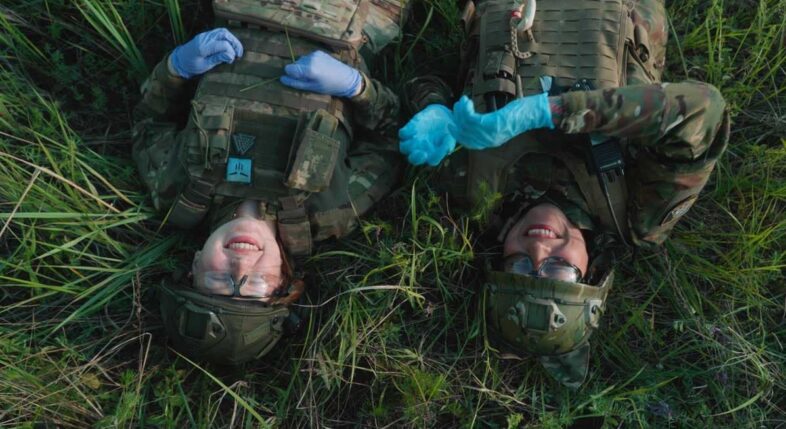
— We knew each other before. She actually came to visit me during a period when I wasn’t at the front. Volunteer Alla Martyniuk dropped by, and Alaska is her friend. We talked, but I wouldn’t say we were close — just acquaintances who had met a few times. When the war started, Alaska, who has a medical background, decided to join the military and was looking for a place to serve. She thought of me, called, and asked, “Do you need a doctor?” I told her, “Doctors are always needed. There’s never enough of them.” And she said, “Take me with you to the war.” That’s how she ended up at our office — we had just opened the VETERANKA movement office at the time.
The movement itself has been around for a long time, but its work supplying the army really took off with the start of the full-scale invasion. Kateryna Pryimak and I found a space, and people started coming — more and more each day. The office became multifunctional, constantly adapting to changing needs as our work evolved. Drones appeared, thermal imagers… the drones are even built right in our office. These days, we’re sewing women’s military uniforms. Our support focuses on women, but men also receive plenty of help, simply because there are more of them in the army.
That’s when Alaska joined us at the office. Once I saw the workflow was running smoothly and my presence wasn’t strictly needed, in May 2022 Alaska and I, along with Artist — who also appears in the film — headed to the Kharkiv region to carry out evacuations.
— Are you originally from Kharkiv?
— Yes.
— The film shows several scenes with your mother. Does she support you being on the front lines all the time?
— Of course she worries — what mother wouldn’t? But she tries to be supportive. Naturally, she didn’t want me to go back to the war. She had her arguments: I’d already done so much, so let someone else take over. And I had mine: I already have the experience and knowledge, I know what needs to be done in certain situations. Most people joining the army now — both then and now — still don’t seem to understand that preparation is key. Then they come and complain that their training isn’t enough, or something else. Eleven years have passed, and yet… But that’s not the main point. I always tell my mum, “I can teach, I can lead. I know things that can help people survive, and I can pass on those skills and knowledge.” She was against it at first, but knowing me, she accepts the situation and always tries to support me.
— Are you your mother’s only daughter?
— Yes, I’m her daughter. There’s also my brother, but honestly, we don’t really keep in touch.
— What about childhood friends, classmates, or university friends — did your relationships change after you joined the Armed Forces?
— By the time I went to war, even back in 2014, I didn’t really have any childhood friendships left. There’s one friend who lives in Germany — we’ve been friends for a long time, but it’s not from childhood. Did relationships change? Yes. Many of the people who once asked, “Why did you switch to Ukrainian?” — because I used to speak Russian — now tell me, “You were right!” They’ve also switched to Ukrainian since 2022. It’s like they’ve had an awakening.
But when someone hasn’t experienced combat, they’re still different. You can be friends with them, but everything you feel, everything you want to convey, the way you see the world — they’ll never truly understand it. They just don’t have that experience. So relationships inevitably change with anyone who hasn’t been in the war and doesn’t know what it’s like.
Even though I returned to civilian life in 2019 and then went back to the front in 2022, it still feels in my mind like I’ve spent more time fighting than living as a civilian. Three years off — it’s nothing compared to what stays in your memory. And in those memories, it’s war, war, war. I don’t really remember life without it. The veterans’ movement, too, is still about supporting those who are fighting. It was started by women who are veterans.
— After nearly 12 years of war, how has life in the army changed for women?
— Quite a lot, actually. At one point, the women’s veterans’ movement pushed for women to be allowed into combat roles, because back in 2014, officially, those positions were off-limits. How off-limits? Only on paper. Women were already serving as snipers or combat medics, but on paper, they were listed as cooks or logistics staff. That was obviously unfair. So the women’s veterans’ movement fought to make it official. And every woman in the military had to earn her own respect — that’s a story in itself.
The army is, as I say, a world built by men for men. So even now, some people don’t get why we need women’s military uniforms — like, “Can’t you just wear the men’s?” But it’s not just about the cut — women have different hips, a chest… It’s about being comfortable in combat. And comfort matters, yes, but it’s also about dignity. About equality.
But I don’t just defend women. I’ve always said there should be women’s mobilisation. If we’re talking about equality, women should be mobilised on the same terms as men.
With how much the war has changed and become more high-tech, women often excel at operating drones — their fine motor skills give them an edge. So all those old-fashioned questions like, “How will she drop a 120mm mine?” or “Can she carry something heavy?” or “Open a tank hatch?” — they’re just not relevant anymore. Today, the range of roles and tasks women can take on has expanded, and often they perform them as well as — or even better than — men.
Right now, Ukraine is basically acting as a shield for all of Europe. Unfortunately, not everyone there seems to understand that. I was recently in Paris with the Stabnet project, alongside two other women in the military — one a deputy brigade commander, the other a chief medical officer. We gave an interview to Paris Match, explaining the modern threats facing Europe, and then we checked the comments. “Propaganda, propaganda…” wrote the French readers. Sadly, Europe isn’t ready for what could happen, and it will never fully appreciate what we’re doing to protect them here.
— By that logic, does it mean Ukraine will eventually have to mobilise women?
— I think we’ll get there. Maybe not on the exact same terms as men, but it seems logical and perfectly normal to me. Even in my unit, there’s a woman serving while her husband stays at home with the children. I see nothing wrong with that.
What I also want to add is that war and service in the Armed Forces aren’t just about constant heroics — although sometimes those are unavoidable. Above all, it’s hard, daily work. What I love about the film Kuba and Alaska is that it shows that everyday life. Not just killing or saving lives around the clock. For everything to run smoothly, you need training, routines, and ordinary, everyday tasks. Often, it’s those very things that prevent the need for acts of heroism that could put your life at risk.
— Why do you think society is so unevenly involved in the military’s challenges, and have there been political shortcomings over the past 11 years of war?
— The roots of these problems go back to the collapse of the USSR and Ukraine’s independence. But when people say the full-scale war could have been avoided, or try to pin the blame on Zelensky or Poroshenko, that’s not really true. The war was already underway — it was just taking on a different form. Whoever had been president, it would have happened anyway. Maybe in the 1990s there was still a chance to avoid it, but by 2014 it was obvious the war was inevitable. Russia had been preparing for it for years. Before that, it could seem like they just wanted to keep Ukraine from developing.
We also have to remember that with the full-scale invasion, we couldn’t imagine exactly how it would unfold — a war like this had never happened before. We were living with our own assumptions, but no war is like ours.
Technology is changing incredibly fast, and even the level of preparedness of NATO armies, I think, wouldn’t be enough to fully protect Europe should the war spread beyond Ukraine. They would only be effective if they learned how to fight here. Working with NATO protocols is important and necessary, but theory always has to be tested and adjusted in practice.
— A real, stable, long-lasting peace. How do you imagine it?
— Right now, I don’t see the conditions for that. The longer the war drags on, the longer it will keep going. When we let the Russians dig in in the Donbas, we were basically saying the war would be prolonged. There’s a big difference between an offensive war and one where you’re defending prepared positions. The more territory they hold, the longer they can resist. And the closer they get to Europe, the higher the risk that war could spread there too.
That’s why it would make sense for European countries not just to watch and provide material support, but to get involved while they still can, on our territory, gaining combat experience — not theoretical, but practical — right now. That’s the best way to prevent a global escalation. Sadly, European societies don’t really grasp this. I’ve had meetings in France, and I know the military leadership understands that anything could happen. But ordinary people don’t believe war could reach their land. Russian propaganda has lulled them far too much.
— Are you and Alaska serving in different units now?
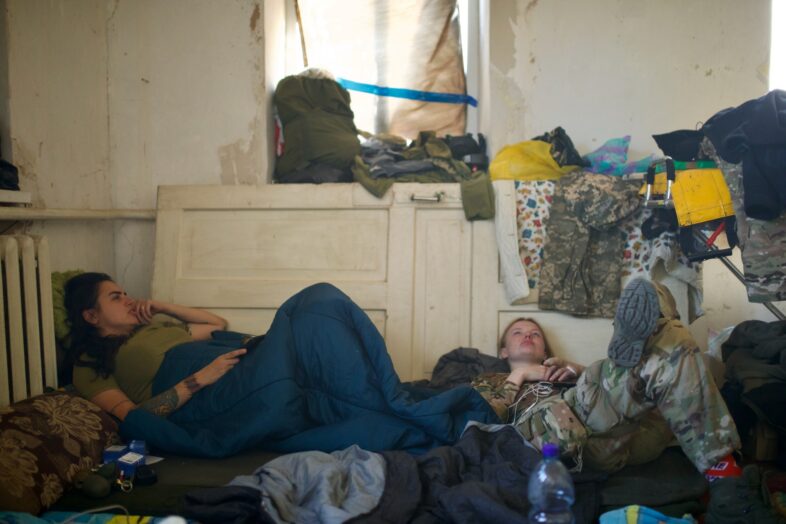
— Yes. She’s in the National Guard of Ukraine, and we’re in different locations. I’m in a new city too, with the 39th Separate Coastal Defence Brigade. I transferred here and brought my team from where they had stayed under my command. Karabin is here with me as well — he’s also in the film — and Artist too. We’re about to receive ground robotic systems for evacuating the wounded, and I’ll be training the crews. Evacuations are becoming more complex, which means they require more people. We try to stay close and support each other — Alaska and I are in constant touch, wherever we’re serving.
— That kind of bond forged in combat — a brotherhood, or in your case, a sisterhood…
— Yes. It’s probably more than friendship. Normally, to call someone a friend takes time — trust, shared interests, all that. But when someone becomes your brother- or sister-in-arms, you can be completely different people and, in civilian life without war, you might never have even met. And that bond forms much faster.
When you realise you can trust this person with your life, that they’re managing a critical process or a radio channel and won’t miss anything important — especially when you’re responsible for other people’s lives — it’s not a slow process like friendship. It happens fast. That’s exactly how it was with Alaska.
— What makes Kuba and Alaska unique is that some of the footage was shot by you and Alaska yourselves, using your own cameras and phones. Roughly how much was filmed by director Yehor Troyanovsky, and how much by you two?
— I didn’t count, but I’d say it was about 50/50.
— How did having a camera around all the time affect things? Didn’t it get in the way or make you censor yourselves?
— Well… did it not get in the way? You had to be constantly aware of it. The producer and director were always nudging Alaska and me to film more. Even though we actually shot very little, we still managed to make the movie.
— And the phone played a big role in the film, too?
— Yes, it was used periodically. In fact, Alaska kicked off the filming herself! Those opening shots, where we faced a Russian tank with our crew and then hid behind a bus stop — we genuinely thought we were going to be killed. I mean, there’s a tank, and there we are. Alaska started filming a farewell video, thinking that maybe someone would find the phone later and see it, hear our last words… That video went viral, and it became the spark for the whole film.
— Are there enough people at the front, or is there a shortage?
— In our unit specifically, there’s no problem with reinforcements right now — quite a few people are joining because this is, roughly speaking, an elite unit, the legendary “Bears.” We don’t even take everyone who wants to come. But overall, there are still not enough people, because we’re expanding. Across the army, there’s a real shortage of personnel — not just at the front, even for roles involving administrative work.
— Does the state mobilisation system itself need to change?
— Most of the people who were patriotic and motivated joined up almost straight away. Those who didn’t want to go will always find a reason to avoid it, and that, in turn, affects how society sees the military. So whatever the mobilisation system looks like, responsibility still comes down to each individual. And if you come voluntarily, it’s much easier to find a role that actually suits you. There are recruiting centres, you can contact brigades directly, talk things through — even join straight into a position you’ve agreed on. It’s absolutely possible.
— What’s your take on the ceasefire talks Trump is pushing? Are there any real conditions for a truce right now?
— Honestly, I don’t see any. There are no conditions at all. In fact, it’s an even bigger threat to us. We’ve seen what happened when Russian troops advanced at the start of the full-scale invasion in 2022 — the towns and villages that were later liberated, the mass graves, the looted homes, the civilians who were raped… All these talks about a peace deal make me think that if we let our guard down, it will end far worse — with even more loss of life, more deaths, more destruction than we have now. I don’t even want to imagine it.