Mstyslav Chernov is a Ukrainian photographer, photojournalist, war correspondent, director and prose writer. He has covered wars in Syria, Iraq and Ukraine, and was among the first to arrive at the crash site of Malaysia Airlines flight 777 in Donbas. A winner of numerous awards and a participant in photo exhibitions around the world, his video footage from Mariupol became the basis for the Oscar-winning film 20 Days in Mariupol. His new documentary, 2000 Meters to Andriivka, focuses on a Ukrainian counteroffensive to recapture the Russian-occupied village.
— The premiere of 2000 Meters to Andriivka, like 20 Days in Mariupol, was at the Sundance Film Festival. Can you tell me what the reactions were like for each film, and how you see the key differences between them?
— Sundance was a strange collision of worlds for me, both times. With 20 Days in Mariupol, I carried the weight of the city’s destruction into the beauty and quiet of Utah’s mountains. I didn’t know how people would react — whether they’d turn away from so much death, or stay with me through the full 95 minutes. But they stayed. They cried. They gasped when a baby was born in the middle of hell. For that brief time, I felt they were truly with me in Mariupol.
2000 Meters to Andriivka was different. It’s about soldiers, not civilians, and it all takes place within just one mile of forest, a stretch of land fiercely fought over for months during the counteroffensive. It has a different energy, a different tempo. We follow men who know exactly why they are fighting — this land is their home. The reception at Sundance was intense again. People came up to me saying they would never see “war footage” or Ukrainian soldiers in the same way. They weren’t sad this time. They were angry. Determined. That’s how I felt, too.
— Both this film and your previous one include numbers in their titles. Why did you feel it was important to name them this way, and is there a particular symbolism behind that choice?
— Numbers bring clarity, direction, a sense of purpose — they help the audience connect and stay focused. Even before the film begins, a number signals that it’s about something measurable — time, distance — but also about how those measures feel when you’re living through them. In peacetime, 20 days or two thousand metres is nothing. In war, it can feel like a lifetime.
— Could you talk about the role of music in a documentary? Why did you choose Sam Slater to compose the score for 2000 Meters to Andriivka?
— I don’t use music to decorate a scene. For me, it’s part of the battlefield’s texture. With 2000 Meters, I didn’t want strings or pianos — there are no pianos in a trench. Sam Slater, my favourite modern experimental composer and a close friend, has a way of creating music out of the place itself, out of the sounds of war. He turned radio static into an instrument, machine-gun bursts into percussion, and together with Jakob Vasak even built a new instrument specifically for the film. We kept it grounded — no foley, no artificial sound design. The music merges with the real sounds of drones and artillery. It doesn’t tell you what to feel, but it makes you feel as if you’re there.
— In the film, you ask the soldiers: “What if the war lasts for the rest of our lives…?” They stay silent. Do you have an answer to that question yourself? And what should we, as a society, do if the war really drags on for years, or even decades?
— I don’t have an answer — only fears. I’ve seen enough wars to know they can last for generations. But Fedya believes everything will be rebuilt; I’d call it “irrational optimism.” And yet, without that sense of hope and the determination of Ukrainian soldiers, my hometown of Kharkiv would already be occupied. I do believe there can be peace. Every Ukrainian wants it. But they also know that sometimes you have to fight for it.
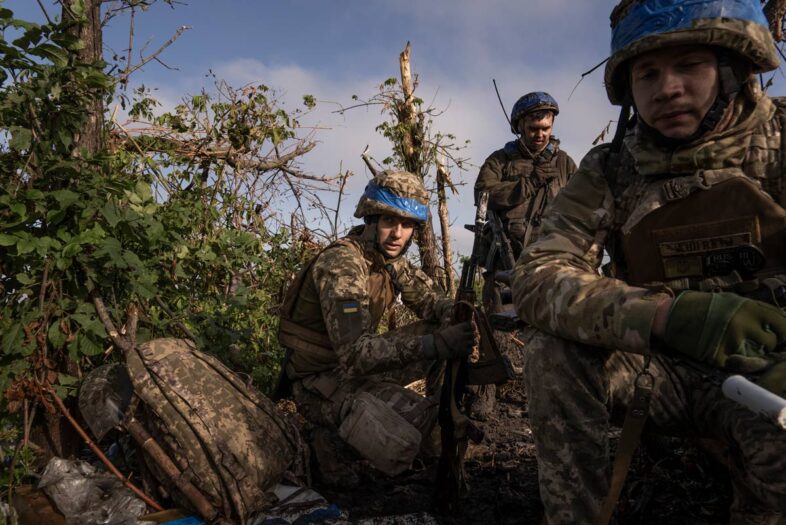
— One soldier said it felt wrong for you to film him because it made him look like a hero, even though he insists he hasn’t done anything heroic. Have there been times when soldiers flat-out refused to be filmed? After all, some believe that journalists on the front line bring bad luck.
— Yes, many times. Getting access to the front is always difficult, and it often comes down to whether a commander trusts you and thinks you’re mad enough to go. I’m not mad though — I’m very careful. Really. Some soldiers don’t want to be filmed because they don’t want their families to worry. Others think a camera will bring bad luck. And some, like the soldier you mention, simply don’t see themselves as heroes. That matters to me: to film people as they see themselves, not as the symbols I might want them to be.
— The closing caption reveals that Andriivka, despite being heroically liberated, was eventually reoccupied. To me, this seems to suggest, in a way, the futility of war and the seeming pointlessness of certain efforts. Was that the message you intended, or were you trying to convey something else?
— I wanted to leave space for both readings. My own instinct is often pessimistic — I’ve seen cities liberated, only to be destroyed again. But the men in the film are not pessimists. They know that even a temporary victory can give the country hope, and hope can be as strategic as any weapon. So yes, Andriivka fell again. But the moment they raised the flag, the country celebrated. For that day, it mattered. And this moment will remain in the history of the country forever.
— Do you have any plans to create a feature film about this war?
— I’m already working on the next one. 20 Days was about civilians under siege. 2000 Meters is about civilians who became soldiers. I want to build a body of work showing different faces of this war — so that in 10 or 20 years, there is an honest record. My dream is that the next film will be about the end of the war.