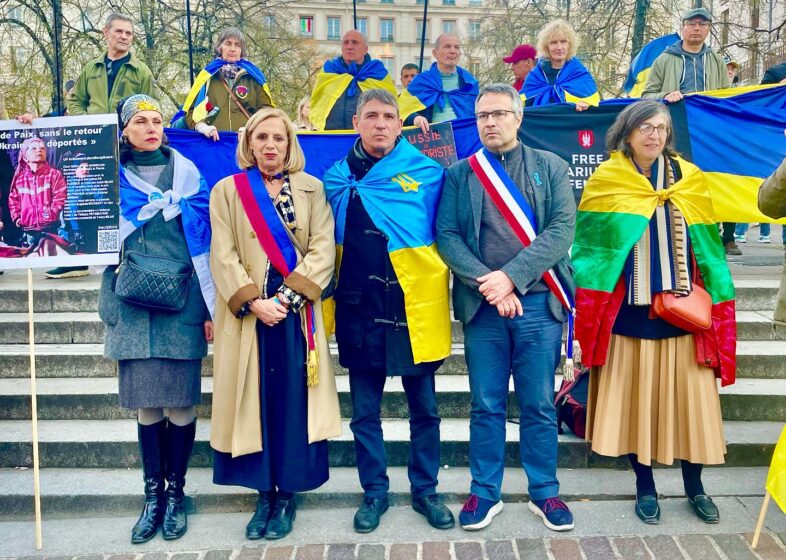
François Béchieau, adviser to the Paris City Hall and deputy mayor of the 19th arrondissement, spoke to The Ukrainian Week about how he sees the war in Ukraine, the country’s prospects of joining NATO and the EU, and commented on Donald Trump’s rhetoric. He also shared his personal involvement in solidarity marches and initiatives in support of Ukraine.
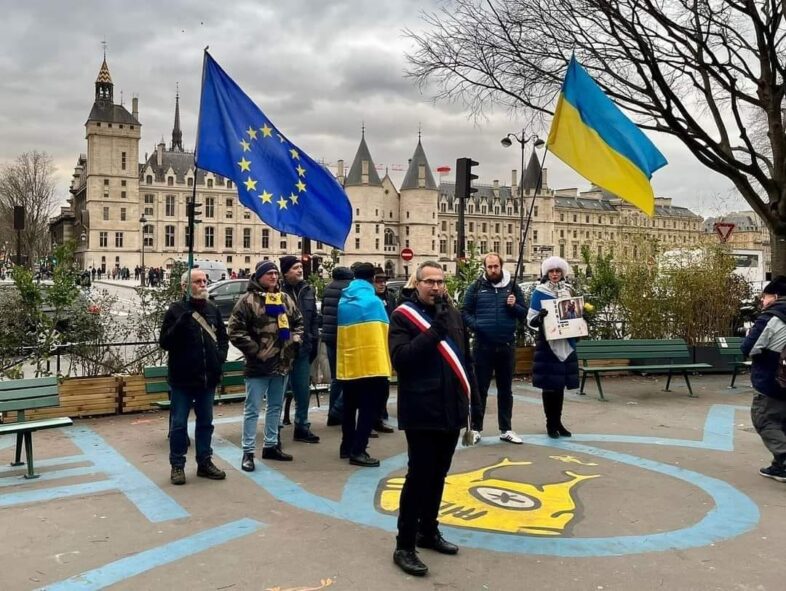
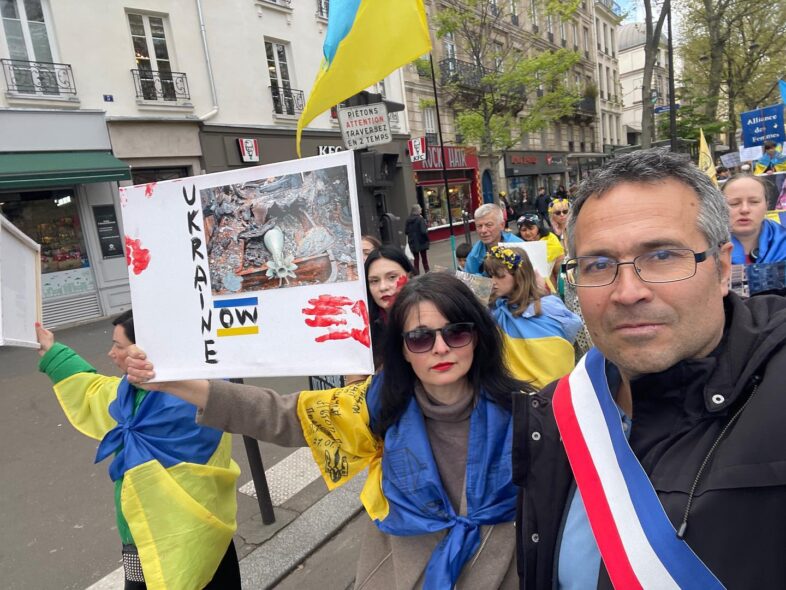
— Since the full-scale war began, you’ve been joining Ukrainians at protests twice a week — every Wednesday and Saturday. What drove you to take part so consistently?
— There’s really no way to explain or justify the invasion that started on 24 February 2022. Nothing in the international situation could possibly have warranted it. Putin claimed, absurdly, that someone was planning to invade Russia. It’s sheer madness — frankly, a glimpse into the true nature of the KGB mindset.
When people are being killed and injured, when children are being deported — and many Ukrainian kids have been taken to Russia — and if you value the core republican ideals of France — liberty, equality, fraternity — and democratic principles, then standing with Ukraine becomes a moral imperative. By defending Ukrainian children, we are standing up for French children and all children everywhere.
— What cultural initiatives has your city hall organised in support of Ukraine?
— We’ve put on concerts in cathedrals and stayed closely connected with the Ukrainian community here — for example, there’s a Ukrainian parish on Rue de Palestine. We also keep strong ties with “Plast,” the Ukrainian scouting organisation. These efforts go beyond just the war; they show the deep bond we share with the Ukrainian diaspora in France.
In 2023, we hosted the band Kalush at our community centre. They met with Plast scouts and their families, which was really special. Just last week, we screened Guillaume Sauzay’s film Diaries from Lviv. He went to Lviv — a city that’s relatively spared since it’s away from the front lines — but the film captured both the incredible resilience of Ukrainians and the brutal realities of war, including haunting images of Mariupol before and after the invasion.
One of our biggest moments was during the Paris Marathon. Together with the Union of Ukrainians in France, we set up at the 30-kilometre mark, where we gathered to sing the Ukrainian national anthem. Around 50,000 runners passed by, with Ukrainian flags waving and the anthem playing loudly. The response was incredible — both from the athletes and the crowd. It was a powerful show of solidarity.
We also organised a reception for an ambulance that had been hit by gunfire early in the war. This vehicle was attacked during the first year of the fighting in Ukraine. After being evacuated and repaired, it’s now touring cities across France. The idea is to give people a stark, tangible reminder of just how deeply implicated Putin’s Russia is in war crimes — even targeting ambulances. But this isn’t just symbolic: the initiative raises awareness and collects donations to help rebuild Ukraine’s healthcare system, focusing on what the war has destroyed.
We’re constantly urging French and European leaders to step up support for Ukraine. Just two months ago, three Mirage 2000 fighter jets were delivered — that’s three jets after three years of aggression.
Will we have to wait another three years for more jets? This can’t wait. European governments need to grasp that supplying weapons to Ukraine isn’t just about peace in Ukraine — it’s about peace across Europe. It’s dangerous to assume Putin will stop at Ukraine’s borders.
— Which Ukrainian organisations do you work with?
— Mainly with the Union of Ukrainians in France, led by my friend Jean-Pierre Pasternak. I also collaborate closely with the Ukrainian World Congress, where Volodymyr Kohutyak is vice president, and the Representative Committee of the Ukrainian Community in France, whose vice president is my friend Zoriana Haniak. Beyond these, I stay connected with several others like Aide et Support and Kalyna. One example is the group Ambulance Under Fire, which organised the exhibition featuring the ambulance I mentioned earlier.
— How has public opinion in France about Ukraine changed since the war started?
— At first, there was a powerful wave of solidarity — a moment when the Ukrainian cause truly united people. But that began to change with Donald Trump’s rise to power in the US. His presidency complicated things and, more importantly, sowed confusion. Today, we need to challenge the kind of rhetoric Trump embraced — rhetoric that’s often vague, sometimes even dangerously harmful to Ukraine. We have to be absolutely clear: we stand firmly behind President Zelensky and the Ukrainian people. And we must keep reminding everyone that Ukraine didn’t want this war — it was started by Russia, under Vladimir Putin.
— Do you think French interest in Ukraine has faded, or on the contrary, grown given the current tensions in the negotiations and the more conciliatory stance the US is taking towards Russia?
— It tends to come in waves — sometimes it rises, sometimes it falls. Take the Trump-Zelensky meeting, for example, where Trump basically asked, “Do you want World War Three?” as if Zelensky were the one pushing for it. Honestly, it was shocking. Even if that kind of rhetoric sounds like a bad joke, sadly a lot of people remember it. Those who aren’t deeply involved in politics, who don’t always have the time to dig deeper, end up absorbing a simplified, sometimes distorted, version of events.
Now, some people believe the war is basically over, that peace has already come. So when Ukraine says it won’t give up Crimea or the occupied parts of Donetsk and Luhansk, insisting it just wants to defend its borders, it’s met with scepticism. Some French folks start thinking, “Maybe Zelensky doesn’t want peace.” That’s exactly why we have to stay alert.
Of course, we want peace — but not just any peace. We want a just peace, one that fully acknowledges Ukraine has been the victim of aggression. Nothing, absolutely nothing, can justify Russia’s invasion.
— Should Ukraine join NATO?
— I firmly believe in the right of nations to self-determination. If the Ukrainian people want to join NATO, then they absolutely should. I don’t see why Vladimir Putin should get a veto over the decisions of countries that just happen to border Russia. Honestly, this needs to be said over and over again — it’s a myth that must be shattered: no one in Europe has ever seriously considered invading Russia. That’s Putin’s delusion, Russian propaganda, pure disinformation. Ukrainians, a free people, broke away from Russia long ago. So if they want to join NATO now, that’s their sovereign right.
That said, I’ll be honest: as a democrat and someone on the French left, I’m not exactly a NATO enthusiast. I’d much rather see Europe develop its own defence system. To build on that, what we’re really calling for is a genuinely political Europe — one with its own military capability, independent of NATO. Because, let’s be clear, NATO essentially means the United States. And with Trump in the picture, that’s a real security risk. It’s dangerous to base our safety on the whims of a third country with unstable leadership.
We want a political Europe, not just the economic union we’ve had for decades. If Ukraine wants to join NATO, we say: welcome. And if Viktor Orbán wants to leave the EU and make room for Zelensky, then so be it. Hungary has drifted toward a far-right regime, fully aligned with Putin. If Orbán wants to join the Russian Federation, let him. Honestly, we won’t miss him.
— You mentioned Russian disinformation. Is it widespread in France right now?
— Honestly, I think the situation is far more serious than most people realise. Right now, we really have to be careful not to let Ukraine slip from public attention. There’s a lot of focus on Palestine at the moment — and rightly so — along with pension reforms and social issues, all very important topics. Like many progressive Israelis, I stand with the Palestinian people in their fight against the crimes committed in Gaza by Netanyahu and his government. I support a two-state solution. But for that to happen, Hamas — which is a terrorist group — has to release all the hostages it holds.
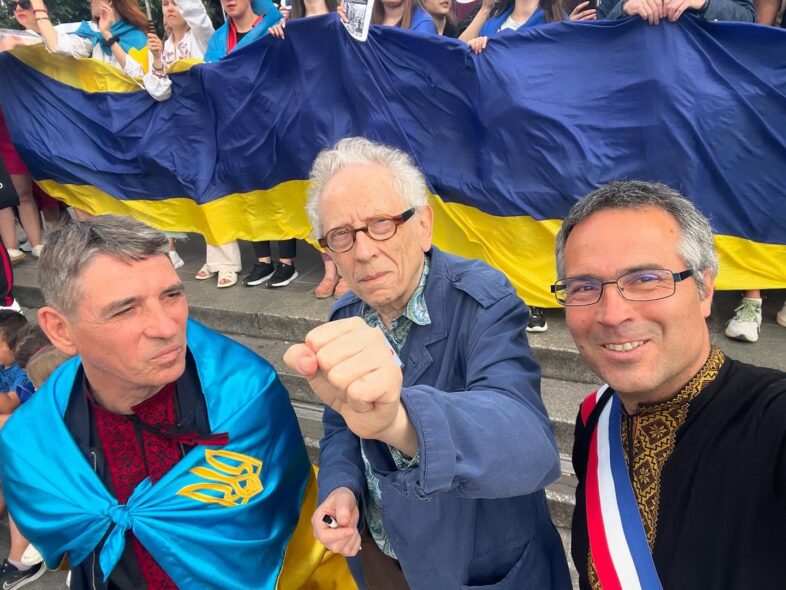
That said, during the May Day marches in Paris, I was quite shocked by how little Ukraine was mentioned. There were posters everywhere supporting Palestine, but not a single word about Ukraine. Only a handful of us — myself and about ten Ukrainians — stood holding flags, just to remind people the war is still raging. Every day, people are dying in Ukraine. Families are torn apart by Putin’s madness and Russia’s relentless bombings.
It’s crucial we don’t let our guard down, because public opinion can be incredibly reactive — it responds to events, then quickly moves on, forgetting what’s really happening. When that happens, usually one dominant narrative takes hold. And right now, on the international stage, that narrative is shaped by Trump and Putin. Putin is a clever man, a former KGB agent — blunt but a killer and a criminal, as everyone knows. As for Trump… well, frankly, we just hope he’ll act wisely and make the right decisions for peace.
— Do you support the volunteer coalition project initiated by France and the UK, aiming to form an international force to support Ukraine?
— Beyond the Franco-British contingent, we want all EU member states to join this show of solidarity — including military support. That means more than just sending instructors, as Ukraine has requested; it also means deploying peacekeeping forces to halt the bombings and slow the Russian advance. Obviously, we want this force to be much broader than just a Franco-British effort.
— Why is the West so afraid of a possible collapse of Russia?
— The real fear isn’t Russia breaking apart, but that Russia, with all its power, could start dominating not only Ukraine but other parts of Europe too. That’s the real danger. As for the current uncertainty in the US, many people are genuinely confused about where Trump is headed. One day he’s insulting Zelensky, the next he offers a handshake. One day he blames Ukraine for the war, the next he warns Putin. It’s a deeply ambiguous position. France, on the other hand, has taken the right stance, even if our support came a bit late. Now we have to stay the course. Personally, I’m not worried about Russia collapsing.
— Could the far-right actually win the next presidential election in France?
— Yes, unfortunately, we have to be frank: the far-right, specifically the National Rally, could well take the presidency in 2027. Just listen to people—from city centres to rural towns—and you’ll see why. It’s both sad and worrying. Over recent years, the racist and xenophobic rhetoric from the party’s leaders has sadly become normalised. They call themselves “of the people,” but in reality, they disdain the people and working-class communities.
I often say that if there’s one compelling reason to prevent a National Rally victory in 2027, it’s the survival of Ukraine. It would be a catastrophe—not just for Ukraine, but for Europe and the world—if Marine Le Pen or another far-right candidate were to win.
— And how do you see Ukraine’s future after victory?
— That’s not for me to decide; it’s for Ukrainians themselves. Naturally, I hope that Ukraine, having won the justice it deserves, will continue to develop as a strong democracy. From what I see, it’s already well on that path.