The Ukrainian Week spoke with Kateryna Shavanova, a PhD in Biology, R&D project manager at Kernel, and senior researcher at the Institute for Nuclear Power Plant Safety. Alongside her colleague Olena Pareniuk, Shavanova co-authored the book The Terrible, the Beautiful and the Ugly in Chornobyl.
In this conversation, Shavanova discussed the ongoing impact of the Chornobyl disaster, what could have prevented it, the current state of the Exclusion Zone, Russia’s nuclear threats, and the future of the Zaporizhzhia Nuclear Power Plant, now under Russian control.
***
— In April 1986, any mention of the Chornobyl disaster was quickly suppressed. Worst of all, people paid with their lives for the delayed response. If the Soviet leadership had reacted promptly to the first signs of the explosion at the Chornobyl Nuclear Power Plant, rather than covering everything up, could the catastrophic consequences have been avoided?
— I’d start by saying that radiation safety is one of the few fields where the lessons of the past are taken seriously. Chornobyl was a turning point. Its consequences were studied thoroughly, and those insights were directly applied decades later during the Fukushima response. In that sense, we did learn something.
One of the biggest mistakes made at Chornobyl was the sheer scale of the human response. No one really knew what to do, so the solution was to throw people at the problem — hundreds of thousands of liquidators were sent in. That approach was chaotic and costly. Compare that to Fukushima, where only 52 workers were directly involved in the clean-up — and they were dealing with three melted-down reactors, not just one. That stark difference shows how far nuclear safety protocols have come.
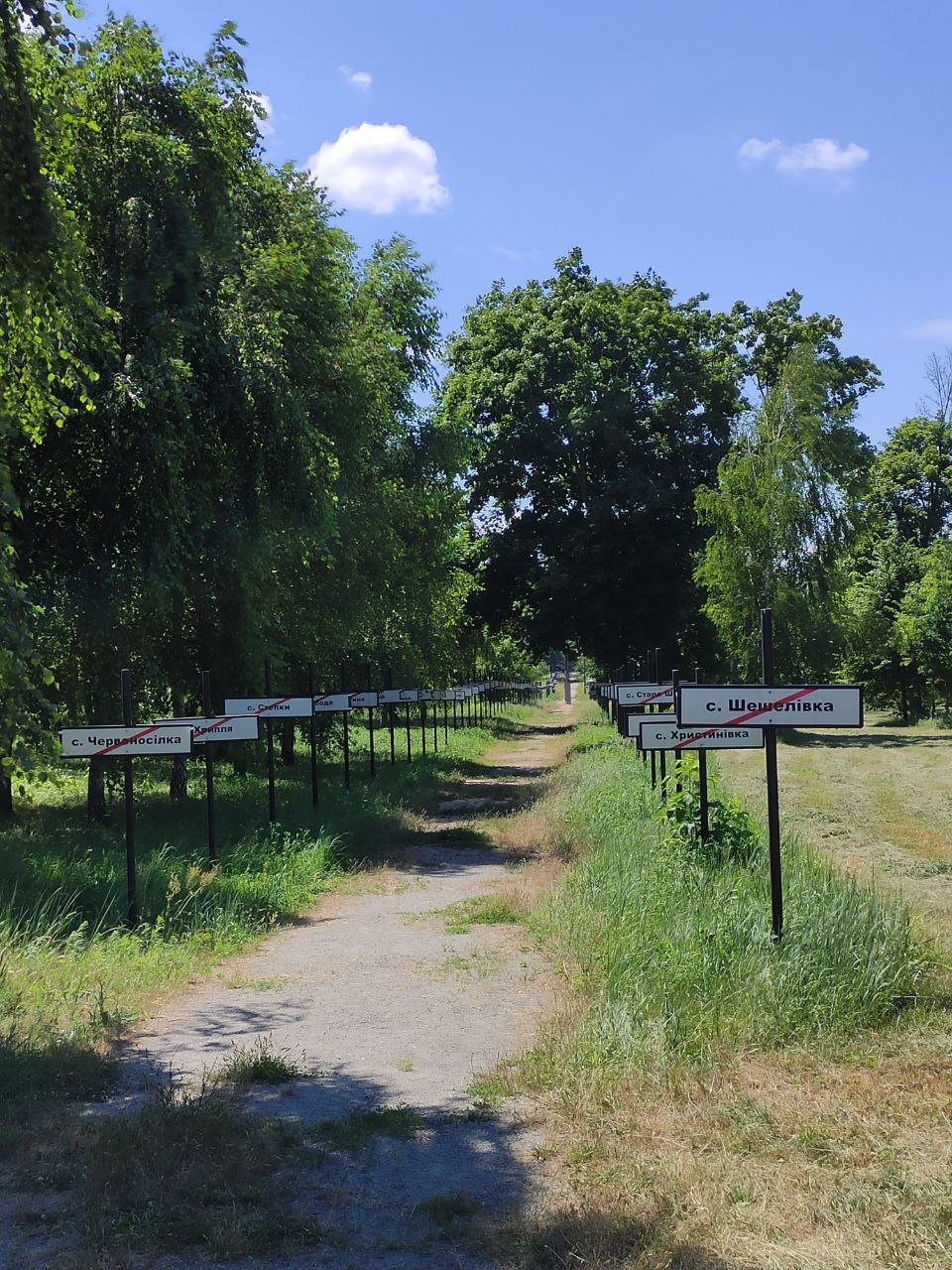
The alley of abandoned villages at the “Zirka Polyn” Memorial Complex
There’s little use now in pointing fingers over the Chornobyl disaster. What we’re really dealing with is something deeper and more systemic: in the Soviet Union, accidents weren’t confronted — they were buried. Instead of being openly investigated, understood, and used as case studies for preventing future tragedies, they were silenced.
Today, we make a crucial distinction between predictable and unpredictable accidents. The first category includes incidents that can, in theory, be anticipated — which means it’s possible to create a response plan ahead of time. But in the case of Chornobyl, there was no such plan. No one had thought that far ahead. And yet, we now know that even before 1986, there had been accidents involving the same type of reactor — including at the Leningrad plant, now in Saint Petersburg. There were also failures within the Soviet nuclear navy, which is particularly relevant, since the Chornobyl reactor itself was essentially an adapted version of one used on nuclear submarines.
Had these incidents been acknowledged and discussed out in the open, there might have been a chance to anticipate the risks. At the very least, we could have been better prepared. But the silence made the scale of the disaster all but inevitable.
It’s important to understand that the scale of damage in any nuclear accident is largely determined by how quickly we respond. That’s the central point I keep coming back to — speed matters more than almost anything else.
Take potassium iodide, for example. If it had been distributed promptly after the Chornobyl explosion, we could have dramatically reduced the incidence of thyroid cancer, especially among children and teenagers. But that didn’t happen. And because of that delay, we’re still grappling with the long-term consequences today.
— These days, we find ourselves in a moment where the question of whether or not to take potassium iodide is once again disturbingly relevant.
— And yet, the messaging around it couldn’t be more muddled. On one hand, we’re flooded with warnings telling everyone to take it; on the other, just as many voices are saying no one should. What’s missing is nuance — context. For instance, people over forty generally shouldn’t be taking potassium iodide at all, and that has to do with how the thyroid functions at that age. But almost no one is talking about that.
I remember a conversation I had in the autumn of 2022 with a representative from the World Health Organisation. “You know,” she said, “when your ministry sends us a request for forty million doses of potassium iodide, it raises some questions — because there aren’t even forty million people in Ukraine right now.” Millions had fled the country because of the war. Several million more were over forty and wouldn’t need it. Children only require half a tablet per dose. And by that point, the pharmaceutical company Darnytsia had already donated five million doses to the military. So, where exactly did that number — forty million — come from?
That said, we live in a country with nuclear reactors — and a reckless neighbour. So keeping a potassium iodide tablet tucked in your wallet isn’t paranoia anymore; it’s just common sense. It’s part of the new normal, no different than knowing how to apply a tourniquet or having a basic understanding of battlefield first aid.
Still, people need to understand why potassium iodide matters, and just as important, what its limits are. It protects one thing and one thing only: the thyroid. That’s it. So we also need to talk about the broader principles of protecting yourself from ionising radiation. The first is distance — the further you are from the source, the better. The second is barriers — ideally, two solid walls between you and the outside. If you can get to a proper bomb shelter or even a basement and stay put for at least 24 hours, you’re already significantly reducing your risk. That’s about how long it takes some of the most volatile isotopes to decay. Radiation levels drop hour by hour — so time is another form of protection.
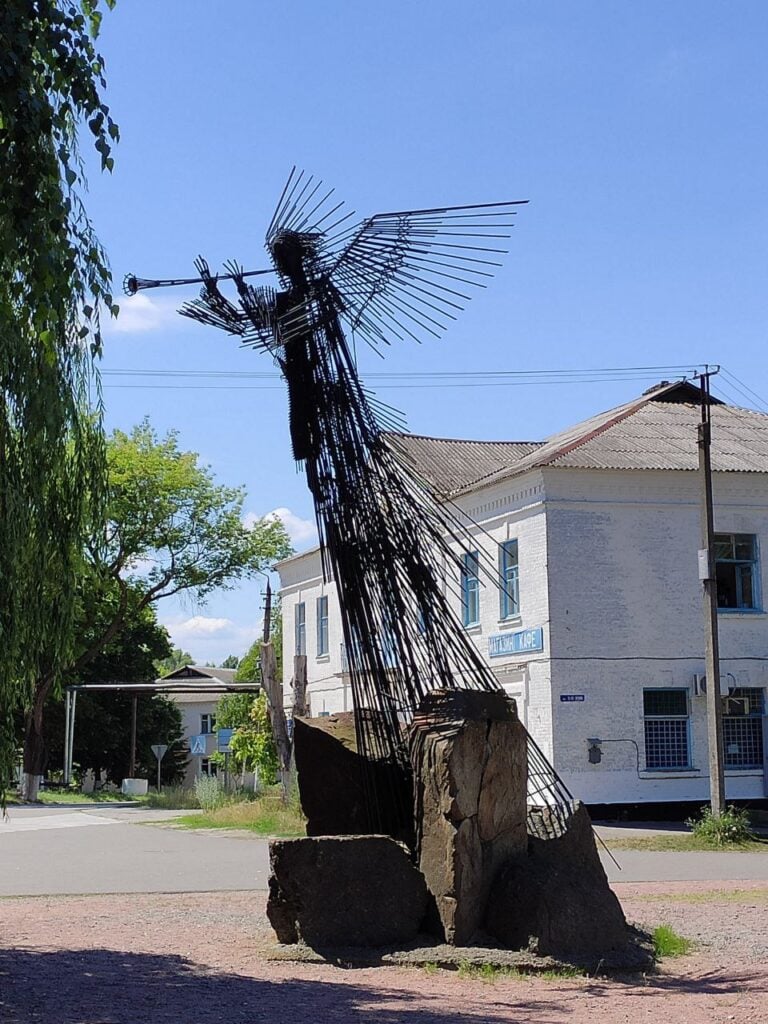
The Angel of Chornobyl Blowing the Horn monument at the “Zirka Polyn” memorial complex in Chornobyl
— What’s the current state of the Exclusion Zone? Is it still possible to conduct research there?
— It’s incredibly difficult now. The zone has become a militarised area. Our laboratories have been destroyed, and although international partners are trying to help, it’s far from enough.
Before the full-scale invasion, the process was relatively straightforward — you’d go in, take your samples, and leave. Now, you have to pass through multiple checkpoints just to get in, and once inside, everything has to be checked again for radiation. On top of that, huge swaths of the territory are mined. We used to joke that the most important person in Chornobyl was the dosimetrist — the specialist who measured radiation levels before we could safely move forward. Now, we’ve added a sapper to that list, because every step might mean encountering an explosive.
But the reality is, no one’s going to prioritise demining a nature reserve. Quite the opposite — mines are still being laid, especially since it’s a border zone. And then there’s the two-kilometre strip of borderland that was recently removed from the reserve altogether — we’ve lost access to it completely.
— What other problems are there?
— It’s no secret that Ukrainian science has been under strain for years. Why were there so few scientists in Chornobyl when the invasion began? The answer is painfully simple: there was no heating. It was too expensive to maintain, so most staff had already shifted to remote work. Only a small team stayed behind to continue monitoring on site. After the first explosions, the deputy director of the institute — a veteran of the war in the Donbas — evacuated those remaining researchers in just two cars. Then he joined the fighting himself.
So where are our scientists now? One of them — a senior lieutenant in the Territorial Defence and a PhD — has been serving on the front lines for over three years. Not in Chornobyl, where we badly need him, but in uniform. And we’re not alone in this shortage. Many of our scientists have left, and those who remain face dwindling resources. Before the war, international partners helped keep our work afloat. But today, most countries won’t allow their researchers to come here because of the risks. Our Japanese colleagues, for instance, are eager to return, but their government has issued a blanket ban on travel to Ukraine. We’re told, “There’s funding, but come do the work with us.” And we have to reply: we don’t need to be there. We need to be here.
At this point, the only research we’ve managed to keep going is monitoring. We’re still collecting samples at the station, tracking air and water quality, keeping tabs on the environment as best we can. But more complex experiments — like our work with bacteria — are on hold indefinitely. We don’t even have the basics anymore: no electricity, no heat.
— How dangerous is the situation at the Zaporizhzhia Nuclear Power Plant, which is currently under Russian military control?
— Even though, thankfully, there hasn’t been a radiation release, what we’re seeing at Zaporizhzhia already qualifies as an accident. Let’s be clear about that. None of the IAEA’s “seven pillars” — the core principles that ensure nuclear safety — are currently being upheld. Not one. There’s no transparency, no independent oversight, no ability to monitor safety systems or the condition of the reactors.
Without access to the plant, Ukraine can’t make an informed assessment of the risks or determine how serious the situation truly is. We don’t even know what’s happening behind the fence. That uncertainty, in itself, is a threat. You can’t manage nuclear safety in the dark.
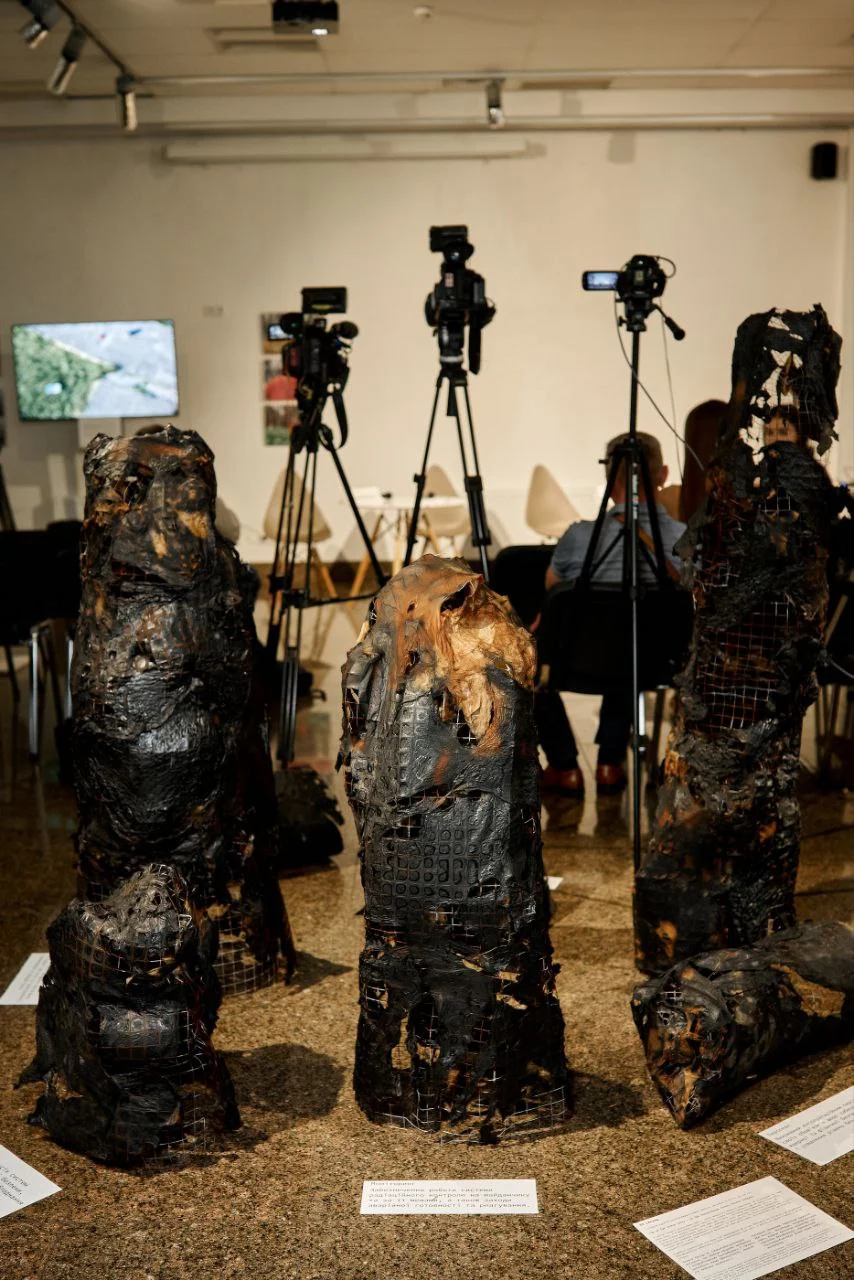
“The Seven Pillars of Nuclear Safety,” developed by the IAEA, on display at the exhibition marking the anniversary of the Chernobyl tragedy
The biggest wave of public panic over the Zaporizhzhia Nuclear Power Plant came when the reactors were finally shut down. People were stunned to learn that the plant had continued operating for six full months after the start of the full-scale invasion. The immediate question was: why?
Then came another spike in fear — the destruction of the Kakhovka Hydroelectric Power Plant. But by that point, the reactors at Zaporizhzhia had already been shut down for a year. There was no active nuclear decay taking place, which meant that a nuclear explosion was simply not on the table.
And this, again, underscores the importance of learning from history. The reactors at Zaporizhzhia were built with full containment structures — thick, reinforced shells that enclose the reactor to prevent the release of radiation. Chornobyl had no such protection. That’s why, even in the worst-case scenario, an accident at Zaporizhzhia would never look like Chornobyl. It would be something else entirely — still serious, yes, but fundamentally different.
Fukushima was a very different situation. Despite everything being built to the highest safety standards, the disaster occurred because of a natural catastrophe — a massive tsunami and earthquake. The diesel generators that were supposed to keep the cooling systems running were flooded and rendered useless. In the wake of that, nuclear power plants worldwide, including Zaporizhzhia, underwent rigorous reassessments to ensure they could withstand similar natural disasters. As a result, additional generators were added, elevated platforms were constructed to keep them safe from flooding, and the overall capacity of the systems was increased.
It’s important to point out that at Zaporizhzhia, these diesel generators have already kicked in multiple times — eight or nine, to be precise. Whenever the plant has lost power, the generators have taken over without fail.
– Ukrainian staff are still working at the Zaporizhzhia Nuclear Power Plant, despite the station itself being heavily mined. The question remains: why was the enemy able to seize the plant so quickly?
– It’s clear now that nuclear fuel cycle facilities can easily become targets in wartime. That’s why we need to establish clear protocols for personnel—precise instructions on what to do when military units approach, when to shut down reactors, how many staff should remain on-site, and who’s responsible for maintaining crucial documentation. Unfortunately, none of these protocols existed at the start of the full-scale invasion. Employees had to make their own decisions—whether to flee with their families or stay behind to manage the plant and ensure nuclear safety.
I have a lot of questions for Energoatom, the state-owned operator of the Ukrainian nuclear power plants. At the start of the war, its leadership fled Kyiv, relocating to places like Khmelnytskyi or Ternopil. The plant was left to defend itself. We have incredibly dedicated people working at these stations, but there’s also a critical need for leadership and foresight. For example, Energoatom proposed building two more reactors during the war. Seriously? With missile strikes already targeting known coordinates, are we really willing to bury billions in infrastructure just to have it destroyed? I’m a staunch supporter of nuclear energy, without a doubt, but we also need to recognise the difference between baseload and flexible generation. Nuclear power is meant for baseload production, but right now, what Ukraine needs most is flexible generation that can quickly recover in the event of an attack.
– When will the Zaporizhzhia Nuclear Power Plant return under Ukraine’s control?
– The reality is, this station will likely never be used again. The reactors have a set service life, and that’s now coming to an end. Under normal circumstances, specialists—people from our institute, for example—would have been on-site to extend their operational life, ensuring everything continued running smoothly. But for the past three years, no one has even been able to assess the situation. The plant hasn’t been properly maintained. It’s mined, and once it’s liberated, the very first task will be demining the entire area, which is vast. To make matters worse, the Kakhovka reservoir, which once provided cooling for the reactors, is no longer usable. The plant is essentially non-functional.
– If the station will no longer restart, will personnel still remain working there? What will be the next steps?
– We’re already at a point globally where the first nuclear power plants are starting to approach decommissioning. There’s a term for it—“greenfield”—which essentially means dismantling everything, removing the fuel, and safely storing it. After that, whatever remains has to be reused or repurposed. In Japan, for example, some nuclear plants have been transformed into museums. It’s a complex process, but it begins with the basics—education. Right now, we’re facing a significant shortage of engineers. Just think about the average age of scientists at Chornobyl.
We should also look at how Japan handles this issue, particularly their approach to education and community engagement. They’ve established strong communication channels with local communities, created museums, and set up programs where students meet with specialists and learn about radiation preparedness. Japan also trains medical professionals who are equipped to handle radiation-contaminated environments. Meanwhile, in Ukraine, we have various institutions, like the Radiation, Chemical, and Biological Defence Forces and the Institute for Nuclear Research, but we lack a unified infrastructure. There’s no central body that can bring all of this together and make decisions. At the start of the full-scale invasion, Ukrainian television invited the owner of “Chernobyl Tour” to comment on nuclear safety issues. Seriously? We need better communication and a deeper respect for expertise.
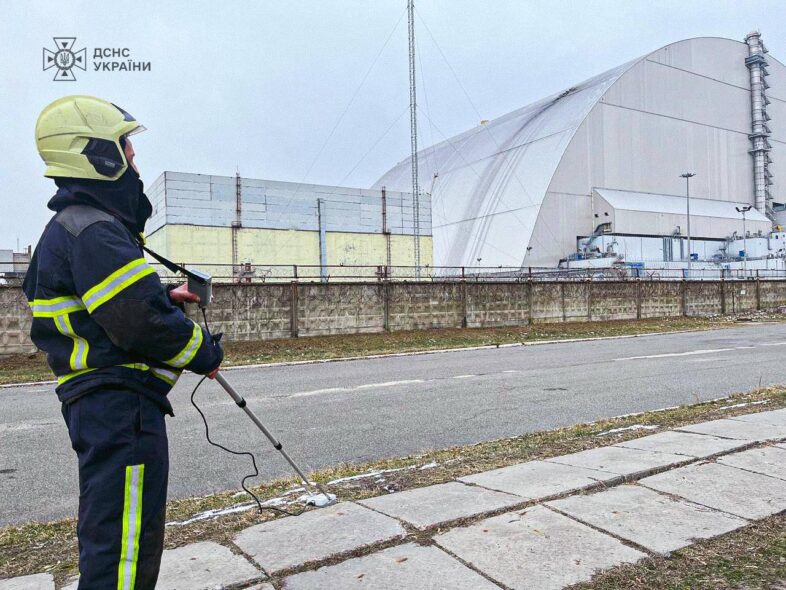
Photo: State Emergency Service of Ukraine
– Russia repeatedly resorts to nuclear blackmail, for example, launching missiles or drones at extremely low altitudes. Recently, news of a drone hitting the shelter of the fourth reactor at Chornobyl shook us all. What is the situation there now?
– This is a completely separate issue. For the past three years, everything heading toward Kyiv has been passing through the Chornobyl zone, with Russian troops entering from there. The fact that something only hit for the first time in all that time is, frankly, a miracle. Perhaps it would have been wise to at least put up protective nets during those years? Unfortunately, that wasn’t done. Now, the structure that cost billions to build and involved over forty countries is no longer functional because it has been breached. This structure, called the New Safe Confinement, was designed to begin dismantling the original shelter, which turns forty next year. The arch was built to protect the shelter from environmental impacts. The plan was that, starting this year, the dismantling of the old shelter would begin, and the nuclear fuel left inside would be properly disposed of. After all, in 1986, only 4% of the fuel was released into the atmosphere; 96% of it remained inside.
– What is the way forward now?
– I’m working with the Institute for Nuclear Power Plant Safety Problems. Once, during a conversation, the experienced head of the Department of Nuclear and Radiation Safety, Viktor Oleksandrovych Krasnov, said something that stuck with me: “Is this unpleasant? Yes, it is. What will we do? We built it for the first time in the world, so we’ll repair it for the first time too.”
Right now, a technical assignment is being developed, funds have been allocated, and many organisations are involved. We just need to figure out how to fix it. It’s not just a hole in the arch; the crane system is damaged, too. But there’s no need to panic about radioactive dust spreading or immediately jump to worst-case scenarios.
– Is there even the slightest possibility that life could fully return to Chornobyl?
– Why would it ever return? What would people do there? Back then, Soviet authorities built a nuclear power plant, then Pripyat next to it, settled people there—and that was it.
In the broader sense, everything there was done artificially. Take Chornobyl and compare it to Fukushima. Fukushima chose the path of return. They call it an evacuation zone, but we have an exclusion zone. The Japanese knew they’d return because Japan is small, land is scarce, and Fukushima is a crucial agricultural region. They cleared the land, removed the topsoil and rebuilt homes—it wasn’t just about radioactive decontamination.
Ukraine, on the other hand, has opted for a different path: creating a nature reserve. For us, that’s a good choice, especially since we lack enough protected territories. As we move closer to the European Union, there are recommendations on how much land should be designated as reserves. The Chornobyl reserve is actually several times larger than “Askania-Nova.”
— Is it safe in Chornobyl? Before the war, tours were very popular.
— Let’s start with the fact that contamination in Chornobyl is far from uniform. Some lakes and ponds are highly contaminated, while others are much cleaner. Special routes were set up for tourists, though, to be honest, we didn’t always appreciate the visitors. They had a habit of wandering off from their groups, trying to find something more exciting. But the reality is that before the full-scale invasion, the biggest danger in Chornobyl wasn’t radiation—it was the state of the buildings. They were crumbling, unstable. There’s also old, highly contaminated equipment, but that’s fenced off. And then there’s the Red Forest, which is essentially a network of dug-up channels where sand was dumped, and trees that absorbed the highest doses of radiation were buried. Obviously, that’s an area to avoid.
But let’s be clear: the Russians didn’t dig trenches there either. Yes, there’s this narrative that our land somehow protects us and harms the enemy, but the story of enemy soldiers being irradiated really ended up doing more harm to our own troops. We need to face facts—Ukrainian soldiers are there too, and sometimes they need to dig trenches. It makes us look unprofessional when the whole world already knows that radiation levels aren’t elevated, yet we’re inventing these new legends about irradiating the enemy.